13
P10452R6CO#2648
GENERALDIRECTIONS
ELEVATINGHEADOFBED(HOB): All support surfaces using air as a support medium are designed for
distributing pressures over the body in a flat, horizontal position. Bending the support surface and the body
at the midpoint when elevating the HOB concentrates the body weight over the center of the surface,
stressing that small area. This extreme change in dynamics creates a challenge for all air support surfaces.
Maximum pressure management benefits are realized between zero and 30 degrees HOB elevation. Beyond
30 degrees, the amplitude of the changes in the air cylinders begins to decrease in proportion to the increased
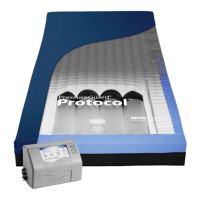
elevation of the HOB. Although the Protocol will maintain its support and therapeutic capabilities up to and
including 70 degrees HOB, for maximum benefit we recommend that any pressure management surface be
used with the head of the bed elevated as little as possible, and for limited periods at a time. If HOB is elevated
at 30 degrees or beyond, a regular pattern of pressure relief in the form of a return to non-elevated position is
warranted. Adjustment of comfort level setting may also be required. See “Comfort Setting”, above.
BEDRAILS: Due to concerns over the possibility of patient entrapment, Span-America recognizes that the use
of rails of any length is a matter currently addressed by federal and state laws/guidelines, and by individual
facility protocol. It is the responsibility of the facility to be in compliance with these laws, which typically
require that decisions on the use of bed rails of any type are based on assessment of the physical and mental
status of each patient individually. If bedrails are needed by the patient to prevent fall-related injury, as
determined by this facility assessment, we recommend that the bedrails be locked in the up position at all
times. We do not require use of bedrails with the Protocol mattress unless the patient is deemed to be safer
with them than without them.
CPR(CardiopulmonaryResuscitation):. The standard for life support recommended by the American Heart
Association recommends a hard level surface such as a crash board, or moving the person to the floor. If that
is not possible, do the following for performing CPR:
1.)
Select AUTO FIRM
2.)
Place a crash board underneath the patient
3.)
Follow CPR procedures.
POWERINTERUPTION: As a safety feature, in the event of a power interruption the system will maintain at
least a minimum level of support for up to 8 hours— depending on factors including mode, comfort setting,
and patient weight —by automatically locking in whatever air is present in the system at the time of power
interruption.
However,tomaximizepatientsupportforpowerinterruptionsofanextendedorpotentially
extendedduration,thefollowingisrecommended:
Disconnect the two smaller, white paired fittings that connect the mattress airlines to the control unit
air lines.
Once disconnected from the control unit air lines, connect the white male and female fittings
together. This will cross-connect all four mattress air cylinders, equalizing them and sealing the
entire system closed.
If head of bed is elevated, it should be returned to flat position if possible.


 To Next Page