Need help?
Do you have a question about the Spectra LL500 and is the answer not in the manual?
Details key operational controls including the power switch, leveling screws, and leveling base.
Covers visual indicators like LEDs and the rotating prism for laser signal transmission.
Describes battery housing, charging port, and tripod mounting options.
Step-by-step guide to set up the laser, use a grade rod, and calculate HI.
Illustrates HI calculation using benchmark elevation and rod reading.
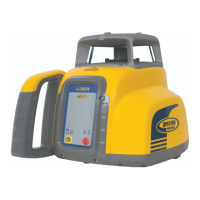
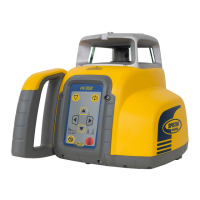
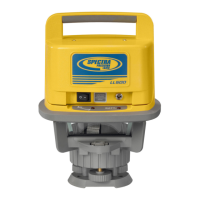
The Spectra Precision LL500 is a robust and versatile laser leveling instrument designed for construction and surveying applications, providing accurate and reliable horizontal laser beams for various tasks. Its primary function is to establish and maintain a precise level reference across a job site, simplifying elevation control and ensuring consistent results.
The core function of the LL500 is to emit a continuous, rotating laser beam that serves as a visual and detectable level reference. This is achieved through a combination of a laser diode and a rotating prism. The laser beam exits the device through a 360° exit window, known as the Lighthouse, which is sealed to protect the internal components from environmental elements, ensuring consistent performance in diverse working conditions.
The device is equipped with a self-leveling mechanism, indicated by the "Out-of-Level LED." When this LED flashes, it signifies that the laser is outside its self-leveling range, prompting the user to adjust the instrument for optimal accuracy. For initial setup and manual leveling, the LL500 features "Bull's-Eye Level" and "Leveling Screws." The Bull's-Eye Level provides a quick visual reference for approximate leveling, while the Leveling Screws allow for fine-tuning the instrument's position. Turning these screws clockwise or counterclockwise enables precise adjustment until the laser is perfectly level.
The LL500's output is a rotating laser signal, generated by a "Rotating Prism" that spins at 600 rpm. This high rotation speed ensures a continuous and easily detectable laser plane across the entire work area. The laser's beam can be detected by a separate receiver, typically mounted on a grade rod, to determine elevations relative to the established laser plane.
The instrument's design also incorporates features for calibration and maintenance of its accuracy. "X Axis Calibration Screw" and "Y Axis Calibration Screw" are provided to allow for adjustment of the laser beam's levelness along the respective axes. These screws enable users to fine-tune the instrument's calibration, ensuring that the laser beam remains precisely level over time and with continued use.
Setting up and operating the LL500 is designed to be straightforward. The "Power Switch" located on the device allows for simple on/off control of the laser. For portability, a "Handle" is integrated into the design, making it easy to carry the laser around the job site.
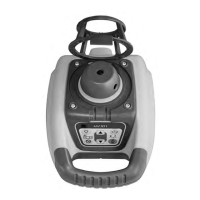
The LL500 is designed for flexible mounting options. It can be used freestanding on its "Leveling Base," which provides stable support. Alternatively, for elevated and more permanent setups, the instrument can be attached to a standard construction tripod using the "5/8-11 Tripod Mount." This mount is compatible with common tripods, offering versatility in how the laser is deployed.
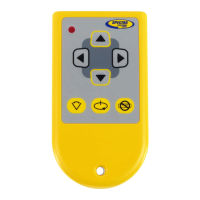
A key aspect of using the LL500 involves determining the "Height of Instrument (HI)." This is the elevation of the laser's beam, crucial for establishing accurate grade and elevation control. The process involves setting up and leveling the laser, attaching a receiver to a grade rod, and placing the grade rod on a known benchmark or elevation. By sliding the receiver up or down the grade rod until an "on-grade reading" is displayed, the grade-rod reading can be added to the benchmark elevation to calculate the HI. This HI then serves as a reference for all other elevations on the job site.
The device also includes practical indicators for operational status. The "Low-Battery LED" flashes when the batteries require replacement or recharging, preventing unexpected power loss during critical tasks.
The LL500 is designed with features that facilitate its maintenance and ensure long-term reliability. The "Battery Housing" is designed to hold four D-cell alkaline or Ni-Cd batteries, offering flexibility in power source. For rechargeable battery options, a "Battery-Recharging Jack" is provided, allowing an optional battery recharger to be plugged in directly to the unit. This eliminates the need to remove batteries for external charging, streamlining the recharging process.
The sealed "Lighthouse" protects the internal laser components from dust, moisture, and other environmental contaminants, reducing the need for frequent internal cleaning and extending the lifespan of the instrument. The presence of calibration screws for both the X and Y axes means that users can perform routine calibration checks and adjustments, maintaining the accuracy of the laser over its operational life without requiring specialized tools or external service for minor deviations. This user-friendly calibration capability is a significant maintenance feature, empowering users to keep their instrument performing optimally.
 General
| Self-leveling range | ±5° |
|---|---|
| Rotation Speed | 600 rpm |
| Power Source | 4 x D-cell alkaline batteries |
| Waterproof/Dustproof | IP66 |
| Laser type | 635 nm, Class 2 |
| Outdoor Use | Yes |
| Warranty | 5 years |
| Accuracy | ±1/8" at 100 ft (±3 mm at 30 m) |
| Operating Temperature | 20°F to 122°F (-7°C to 50°C) |

 To Next Page