90 degrees up to the supine position. At the same time they
draw back up to get off the spine board with their knees.
Once on the ground Res. 2, placed at the head, keeps the immobilization of the cervical spine.
If necessary Res. 2 communicates to others that the patient should be centred on the spine
board. Res. 1 and 3 are put astride the patient and position respectively hands under her armpits
and on the iliac crests. At the start of Res. 2 at the head, they place the patient at the centre of
the spine board translating him without lifting and maintaining the alignment of the column.
Once the patient is aligned, place a shim under the head if necessary to maintain the neutral
position.
Secure the patient to the spine board after he has been centred on the device.
4.3.2 Loading the supine patient on the spine board
This manoeuvre should be performed by at least three rescuers
(Res.).
Res. 1 sends Res. 2 to immobilize the spine, at the same
time he tells the patient not to move and communicate the
manoeuvres to be carried out.
Res. 1 and 3 align the limbs along the axis of the body,
lifting them the bare minimum. The movement of alignment
is carried out in two phases:
o Alignment of the limb
o Approach of the body
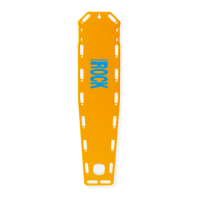
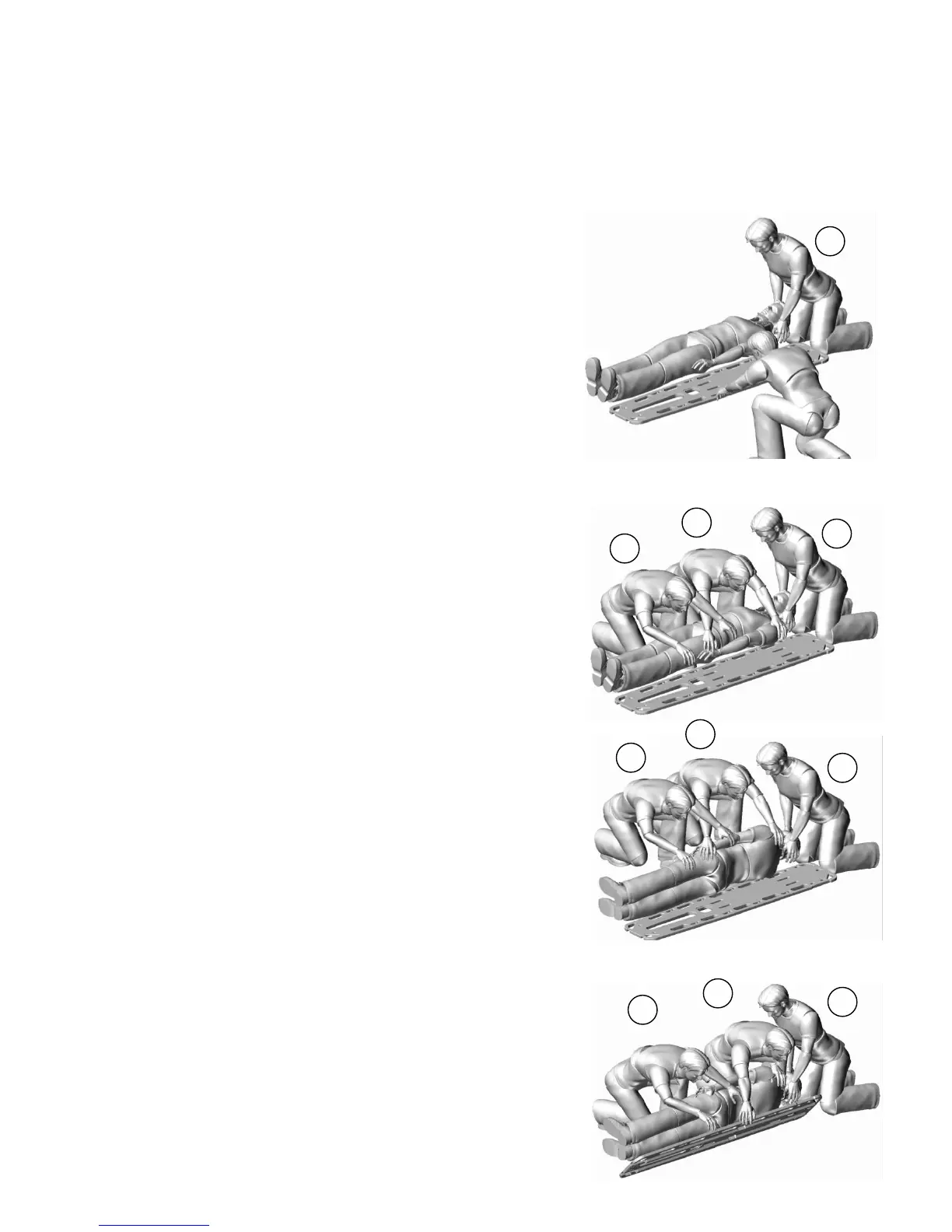
Res. 3 places the spine board at the patient's side, lying on
the ground, and makes sure that the head is (in height) at
the centre of the pillow.
Res. 1 and 3 take kneeling position at the side of the
patient from the side of rotation, with a knee above the
spine board, and are positioned one on the trunk and one to
the pelvis. Res. 1 places his hands at shoulder and pelvis,
including the patient's wrist. Res. 3 places his hands at the
side and the femur (fig. F).
Res. 2 at the head controls the rotation of the patient on
the side, saying: "On three. One, two, three.".
At "three" Res. 1 and 3 rotates the patient 90 degrees,
keeping the entire column immobilized in line, they stop at
the "stop" of Res. 2 (fig. G).
While Res. 1 maintains the patient still on the side, Res. 3
puts his hand, that first held the femur, on the spine board
to move it towards the patient and keeping it aligned and in
contact with him. At this point he raises it on the opposite
side of about 45 degrees and Res. 1 with the hand that held
the basin before, helps Res. 3 to support the spine board
(fig. H).
When Res. 1 and 3 are ready, they shall notify Res. 2,
which gives instructions to rotate the patient an additional
45 degrees to make him lay on the spine board (fig. I).
When the patient is leaning against the spine board, Res. 1
and 3 move their hands, which previously held the patient,
on the side of rotation thereof to support him and keep him
in position on the stretcher during the completion of the
rotation (fig. L).
If the patient will not be centred on the spine board, to
centre him the rescuers will use a "bridge" manoeuvre:
o Res. 2 at the head of the patient
o Res. 1 is positioned in the chest with his hands under
the armpits of the patient
o Res. 3 places his hands at the iliac crests
o Res. 1, 2 and 3, maintaining the alignment and at the
start of Res. 2, centre the patient by sliding him to the
side
Once the patient is aligned, place a shim under the head if
necessary to maintain the neutral position.
Secure the patient to the spine board after he has been
centred on the device.


 To Next Page
 Loading...