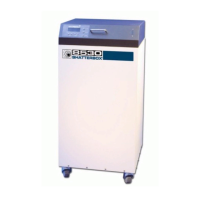
8000M Mixer/Mill
Page 12 of 27 SPEX SamplePrep LLC January 2010
5.1 Mixing and Grinding
Mixing is usually done in a plastic vial with plastic balls. Depending on the nature and amount of
material to be mixed, one or several balls may be used. With a small amount of material and
more than one or two balls, the impact may break the bottom of the plastic vial, so keep the
number of balls to a minimum. Plastic vials and balls can also be used to grind soft metals (e.g.
antimony), carbon, and other easily friable materials.
NOTE: If the Mixer/Mill clamp swings wide and hits the motor when a plastic (lightweight)
vial is used, it may be necessary to use the 8012 Adapter, which adds weight to the
clamp and prevents extra-wide oscillation.
Grinding is also done in metallic and ceramic containers: steel, tungsten carbide, alumina,
zirconia, agate, and silicon nitride. Dry grinding is the simplest approach and is most often used.
The criteria for container selection are usually those of grinding efficiency versus
contamination; steel and tungsten carbide grind more rapidly than ceramics or agate, but
contaminate more. Tungsten carbide, alumina ceramic, zirconia ceramic, silicon nitride, and
agate vials cannot be warranted against breakage.
Most 8000-series vials accept 3 to 10 ml of sample for grinding. A typical mixing load is up to 25
ml, or about 40% of the vial’s volume.
If a sample is not being ground fine enough, one can decrease the amount of sample, increase
grinding time, use a denser grinding medium, and/or add a grinding aid or a liquid. Wet grinding
keeps the sample from caking and will give a smaller final particle size, but there are handicaps:
an extra drying step is required, the fluid used for wet grinding must be chosen carefully not to
alter the sample or attack the container, and not all the vials are leak-proof. The best vials for
wet grinding are the 8001, 8007, and 8009 steel vials and the 8004 tungsten carbide vial: all
have gaskets and screw caps, and are watertight. The alumina vial (8003) has optional clamps
(8015) for slurry grinding. The 8005 zirconia vial and 8008 silicon nitride vials will hold liquid as
long as they are tightly clamped into the mill. The 8014 agate vial is not suitable for use with
liquids.
None of these vials is inherently gas-tight. Limited results can be achieved with steel vials by
loading and unloading them in a glove box under inert gas. The best results can be achieved by
also running the Mixer/Mill in a glove box under inert gas.
Avoid grinding small loads (less than 3 grams) in brittle containers such as alumina, agate,
zirconia, and silicon nitride. If there is not enough material to cushion the impact of the balls,
they will generate excess contamination and can in extreme cases chip the container.
CAUTION: Always use grinding balls that match the material of the container, e.g. steel balls
for a steel container, agate balls for an agate container, etc. This will limit
contamination. An inappropriate choice of balls, such as tungsten carbide balls in
an alumina container, can damage the container.


 To Next Page