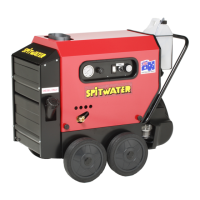
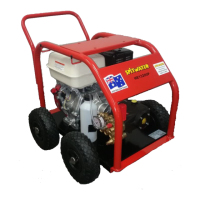
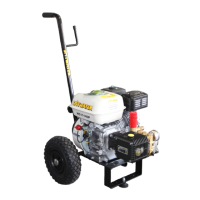
This document is an operating and maintenance manual for a Spitwater petrol cold water high-pressure cleaner, model SLD24 (HC12180P). Spitwater Australia, an Australian-owned and operated company since 1983, manufactures this unit. The manual emphasizes the importance of reading and understanding all instructions, safety warnings, and maintenance procedures to ensure safe operation, prevent accidents, and maintain warranty validity.
Function Description:
The Spitwater SLD24 (HC12180P) is a high-pressure cleaner designed for washing, degreasing, descaling, and disinfecting across various commercial and industrial applications, including cleaning, building, transport, light and heavy manufacturing, and primary industries. It utilizes a petrol engine to power a pump, generating high-pressure cold water for effective cleaning. The unit incorporates safety features such as a pressure regulating valve and a thermal relief valve to protect the pump from damage due to excessive pressure or overheating. It also supports the use of cleaning agents for enhanced cleaning performance.
Important Technical Specifications:
- Model: SLD24 (HC12180P)
- Performance:
- Flow Rate: 12 L/M
- Pressure: 18 MPa (180 BAR)
- Nozzle: 035
- Water Inlet:
- Pressure Max: 1.2 MPa
- Temp Max: 40 °C
- Engine (HONDA GX200):
- Type: Petrol
- Speed: 3400 RPM
- Power: 6.5 HP
- Fuel Capacity: 3.1 L
- Starting System: Recoil
- Oil Type: 10W-30
- Oil Capacity: 0.6 L
- Pump (E1E1812):
- Oil Type: 15W-40
- Oil Capacity: 1.1 L
- Other:
- Detergent Bottle Capacity: 1 L
- Acoustic Data (AS/NZS 60335.2.79):
- Sound Pressure Level Lp: 92 dB (A)
- Uncertainty Kp: 3.9 dB (A)
- Sound Power Level Lw + Uncertainty Kw: 100 dB (A)
- Reaction Force on Spray Gun: 37.94 N
- Vibration on Spray Gun: ≤ 2.5 m/s²
- Dimensions & Weight (Unpack):
- Length: 450 mm
- Width: 505 mm
- Height: 940 mm
- Weight: 33 Kg
Usage Features:
The SLD24 is designed for user-friendly operation with several key features:
- Foldable Handle: For easier storage and transport.
- High-Pressure Water Outlet Connector: For connecting the high-pressure hose.
- Chemical Flow Adjustment: Allows control over the detergent flow when using cleaning agents.
- Pressure Gauge: Displays the operating pressure.
- Water Inlet Connector: For connecting to a water supply.
- Petrol Tank: For fuel storage.
- Chemical Tank: For cleaning solution storage.
- Recoil Starter: For manual engine starting.
- Engine Switch: To turn the engine ON/OFF.
- Lance, Trigger Gun & High-Pressure Hose Assembly: The lance connects to the spray gun via a quick-release coupling, and the high-pressure hose connects to the spray gun and the unit's outlet connector.
- Pressure Adjustment (High/Low): The lance head can be pulled inwards for high pressure or pushed outwards for low pressure.
- Spray Angle Adjustment: The nozzle head can be turned clockwise or anti-clockwise to adjust the spray angle.
- Detergent Use: The unit allows for the use of cleaning detergents in low-pressure mode, with a dedicated chemical injector knob for adjustment.
- Safety Locks: The spray gun features a trigger lock to prevent accidental operation.
- Pre-Start Check: A daily inspection checklist is provided to ensure the unit is in safe working order before use.
- Starting Procedure: Involves turning the engine switch ON, releasing the trigger lock, pulling the trigger to expel air from the system, and then using the recoil starter.
- Stopping Procedure: Involves closing the chemical injector, turning the engine switch OFF, and releasing trapped water pressure by pulling the spray gun trigger and engaging the lock.
Maintenance Features:
The manual outlines a comprehensive maintenance schedule and troubleshooting guide to ensure the longevity and optimal performance of the unit:
- Daily Inspection Checklist (Table-B): Covers checks before starting the unit (guards, cleanliness, water leaks, hose condition, fuel/detergent levels, oil color, engine oil level, service due) and during unit run (pressure gauge function, water leaks, working pressure, exhaust fumes, unusual noise).
- Usage vs Service Frequency (Table-A): Provides recommended service intervals based on usage rate:
- More than 6 to 8 hours daily: Service once every 1 month
- 4 to 6 hours daily: Service once every 3 months
- Weekly use: Service once every 6 months
- Infrequent or monthly use: Service once every 12 months
- These intervals are for normal operating conditions; heavy use, dirty water, or extreme temperatures require reduced intervals.
- Oil Check Points:
- Engine Oil Check: Ensure the unit is on a flat surface, remove and clean the dipstick, fully insert and remove to check the level (between upper and lower limits).
- Pump Oil Check: Ensure the unit is on a flat surface, check the oil level using the dipstick or sight glass (between min/max notches or level with the indicator).
- Troubleshooting Guide (Table-C): Provides common faults, their causes, and remedies, such as:
- Pump running but not reaching rated pressure: Pump sucking air, blocked nozzle, dirty water filter.
- Fluctuating pressure: Pump sucking air, dirty water filter.
- Pump is noisy: Pump sucking air, high water inlet temperature.
- "Milky" oil in the pump: Contact Spitwater service agent.
- Water/oil leaking from pump: Contact Spitwater service agent.
- Engine not starting/operating correctly: Refer to engine instruction book or contact Spitwater service agent.
- Authorized Service: Spitwater strongly recommends that all maintenance and repairs, especially for safety devices and sealed components, be carried out by an authorized Spitwater service agent using original spare parts.
- Storage/Transport: Instructions for safe movement, lifting (using a forklift), securing during transport, and storing the unit in a dry building above 0°C to prevent frost damage.
- Detergent Line Maintenance: Keep detergent lines clean and flush regularly, especially if the unit is not used often.
- Disposal: Instructions to safely dispose of oil, batteries, chemicals, and unused equipment according to local authorities' requirements.
The manual emphasizes that failure to follow these instructions can void the warranty and release the manufacturer from responsibility for accidents or damage.


 To Next Page
 General