INSTALLATION, OPERATION and MAINTENANCE MANUAL | 37
8.3. Space Requirements
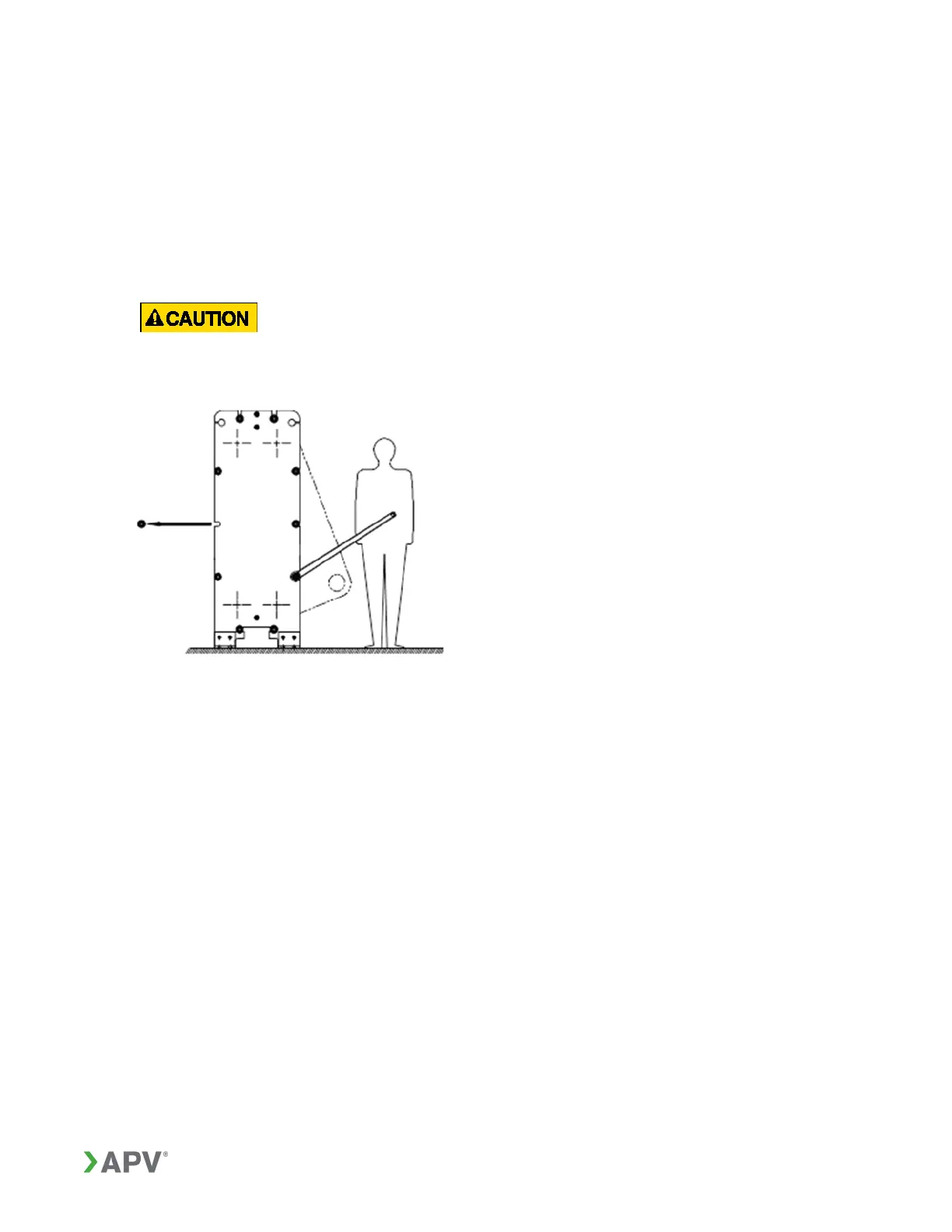
On at least one side of the plate heat exchanger there must be sufficient clearance to
remove a plate from the top bar. Also, there must be adequate room to tighten or
remove the tie bars and inspect the plate heat exchanger (Figure 30). Certain APV
GPHE’s require space in front of the head for tie bar removal. The follower must be free
to move along the full length of the top bar (Figure 31). The customer drawing provides
overall dimensions and plate removal clearance distance.
Ensure sufficient space around the APV GPHE.
Figure 30: Required clearance space
8.4. Connections and Piping
The plate heat exchanger must be connected in accordance with the arrangement
shown on the customer drawing provided with the heat exchanger. The APV GPHE
models are compliant with API 667 Table 1 allowable nozzle loads and moments for the
connections at the head.
Piping to the follower and connector grid(s) must be configured to allow the equipment
to be easily opened for inspection and maintenance. These lines must also be
sufficiently flexible to allow for small variations in the tightening dimensions and possible
thermal expansion. The line flexibility may be accomplished by use of expansion joints.
If the APV GPHE has liquid connections on the follower, it is important that the
compressed dimension is checked against the customer drawing before the pipes are
connected. For easy disassembly and reassembly of the APV GPHE, a pipe elbow
should be used at all follower connections. The APV GPHE follower and connector grid
connections have little strength against pipework or nozzle loads. Therefore, avoid
transfer of pipework loads and moments to the follower and connector grid connections.



 To Next Page