6
Piping – Suction
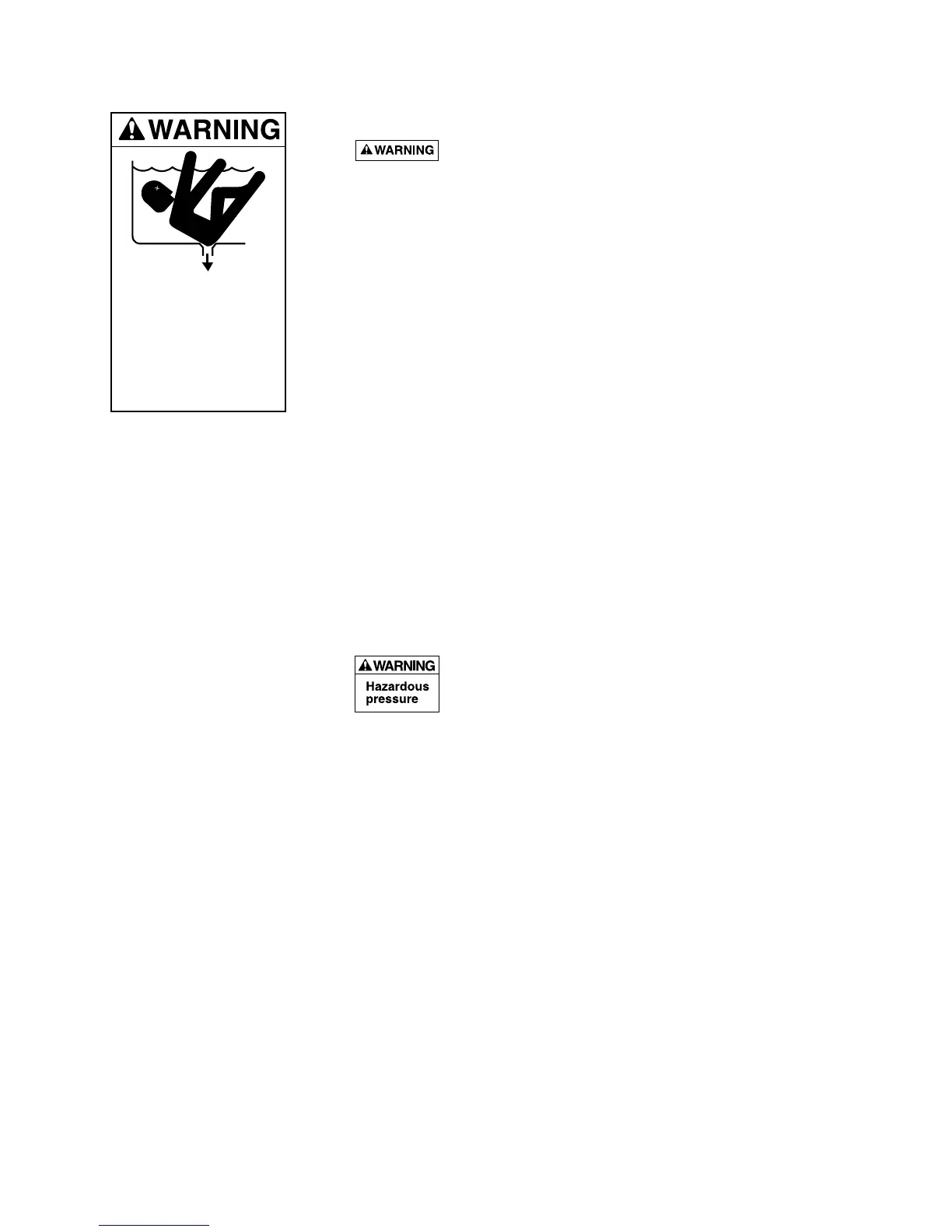
Risk of severe injury or drowning from hair or body
entrapment. To reduce risk of entrapment against pump suction opening,
connect pump to multiple drains and skimmers of non-entrapment design.
See “Pool Pump Suction Requirements,” Pages 4 and 5.
NOTICE: If pump suction becomes clogged, pump will cavitate, damaging
pump internal parts. Keep suction pipe clear of debris, dirt, etc.
NOTICE: To prevent flooding when removing pump for service, all flooded
suction systems must have valves in suction and discharge pipes.
Never use a suction pipe smaller than the pump suction connection.
Use larger pipe as required to keep water velocity below seven feet per
second or local construction code limits, whichever is lower.
Pump must be installed in a positive suction system – it is not self priming and
will not lift water if suction pipe is empty.
When using reducer to connect to pump flange, use an eccentric reducer with
the straight side on top.
Piping – Discharge
Maximum water velocity should be 10 feet per second. To minimize friction
losses, make piping one size larger than pump openings.
Fittings restrict flow; for best performance use fewest possible fittings.
Avoid fittings which could cause an air trap.
Pool fittings must conform to International Association of Plumbing and
Mechanical Officials (IAPMO) standards.
Strainer
Maximum hydrostatic test pressure is 25 PSI (172 kPa) water
pressure. To avoid explosion hazard, DO NOT test strainer
with air pressure. Air pressure in strainer can blow cover off of
strainer body, which can cause severe or fatal injury. Release
ALL air before hydrostatically testing strainer.
To avoid breaking pump or putting unnecessary strains on pump or strainer
body, support pipe independently of pump/strainer.
Center the strainer cover when installing it (especially when pressure testing).
When installing cover, clean O-Ring groove in strainer body, and lubricate
with petroleum jelly as follows:
A. O-Ring;
B. Sealing surfaces of strainer cover and body;
C. Threads and faces of wing nuts.
This will prevent corrosion, improve seal, and ease maintenance.
If strainer is installed backwards, debris will collect in suction pipe instead of
in strainer basket. Install strainer with cast-on flow arrows pointing in direc-
tion of water flow.
Basket will only go into strainer one way; don’t force it.
Hazardous suction.
Can trap hair or
body parts, causing
severe injury
or death.
Do not block
suction.




 To Next Page