Need help?
Do you have a question about the Stanley Fatmax SFMCPS620 and is the answer not in the manual?
Measures sound pressure, sound power, and vibration emission levels according to EN ISO 11680-1:2011.
Declares compliance with EU Machinery Directive and related standards.
Details compliance with EU Machinery Directive requirements.
Lists compliance with other EU directives like EMC and RoHS.
Explains the meaning of DANGER, WARNING, CAUTION, and NOTICE signals.
Covers safe work environments, electrical precautions, and personal safety measures.
Guidance on proper tool usage, maintenance, and care for safe operation.
Guidelines for safe handling, charging, and storage of battery packs.
Instructions for qualified personnel performing tool maintenance and repair.
Essential safety steps before and during operation, including environment and PPE.
Rules for safe operation, including avoiding hazards and using proper PPE.
Instructions to follow before starting, including reading manuals and checking gear.
Guidelines for safe usage during operation, staying alert and keeping area clean.
Rules for body positioning, carrying, and avoiding hazardous situations.
Lists specific conditions under which the pole saw must not be operated.
Warnings about shock hazards, proper usage, and ensuring unit safety.
Emphasizes checking for damage, proper assembly, and chain movement.
Specific warnings and guidelines for safe trimming operations.
Explains the operation of the on/off switch and the branch removal hook.
Guidance on proper pruning techniques, avoiding overload, and managing kickback.
Step-by-step guide for safely trimming branches using the pole saw.
Covers chain sharpness, fitting, tensioning, and lubrication for optimal performance.
Instructions for connecting the main pole saw components securely.
Instructions for adding the center extension to create a longer pole saw.
Steps for safely separating the saw head from the rest of the pole saw.
General operating instructions, proper grip, and hand positioning for safe use.
Safety precautions and operational tips for trimming branches with the pole saw.
Explains the operation of the on/off switch and the branch removal hook.
Guidance on proper pruning techniques, avoiding overload, and managing kickback.
Importance of keeping chain sharp, dulling factors, and sharpening advice.
Guidelines for cleaning the tool and information on recommended accessories.
Proper disposal of products/batteries and their recycling.
Details on tool lubrication and cleaning methods.
Information on accessories and proper disposal of products/batteries.
Instructions for recharging and disposing of battery packs.
Explains the meaning of pictographs found on chargers and battery packs.
Specifies compatible battery types and location of date codes.
Lists the items included in the product package.
Warnings and regulations regarding the safe transport of batteries.
Guidelines for storing the tool and battery packs for best performance.
Details the standard one-year warranty for the power tool.
Explains how to register for an additional two-year guarantee.
Possible causes and solutions when the unit fails to start.
Troubleshooting steps for battery pack charging and performance problems.
Solutions for overheating, loose chains, poor cut quality, or no cutting.
The STANLEY FATMAX SFMCPS620 is a V20 Lithium Ion pole saw designed for pruning applications and cutting limbs up to 203 mm (8 inches) in diameter. It is a professional power tool intended for use by well-instructed adults.
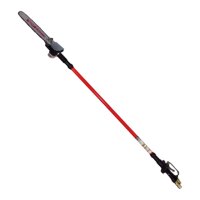
The pole saw operates on an 18-volt Li-Ion battery pack. It consists of a handle assembly, a center extension pole, and a saw head assembly, which can be joined to create a pole saw of approximately 1.8 m (6 feet) or 2.7 m (9 feet) in length. The saw head features a guide bar and a saw chain with cutting teeth, driven by a motor. A sprocket drives the saw chain, and a sprocket cover protects this mechanism. The unit also includes a branch removal hook to assist in removing small to moderately sized pruned branches.
Before operation, users must read and understand all safety instructions. The pole saw should only be used for cutting tree branches and not for other purposes. Personal protective equipment, including heavy-duty gloves, steel-toed safety footwear with non-skid soles, safety glasses/goggles or face screen, a safety hard hat, and ear mufflers or ear plugs, should always be worn. Long pants and boots are recommended, and loose clothing or jewelry should be avoided. Long hair should be secured above shoulder level.
To assemble the pole saw, the saw head module is attached to the handle module. The groove on the coupling end of the handle assembly aligns with the tongue on the saw head assembly, and the two sections are pushed together. The threaded sleeve is then slid down and rotated clockwise until it stops, completely covering the threads. For longer reach, the center extension can be added between the handle and saw head assemblies. Always ensure the sleeve is completely threaded on and no red threads are visible to prevent disconnection.
Before starting, the saw chain tension must be checked and adjusted. The tension is correct when the saw chain snaps back after being pulled 3 mm away from the guide bar with light force. There should be no sag between the guide bar and the saw chain on the underside. To adjust tension, loosen the hex head screws, then rotate the screw in the front of the housing using the flat screwdriver end of the wrench. Clockwise rotation increases tension, while counterclockwise rotation reduces it. Over-tensioning should be avoided as it can lead to excessive wear and reduced battery life. Once tension is correct, the hex head screws are tightened to clamp the bar.
Lubrication of the saw chain and guide bar is crucial for performance. A high-quality bar and chain oil or SAE30 weight motor oil should be used, with vegetable-based oil recommended for pruning trees. The entire saw chain should be lubricated evenly before each use and whenever a fully discharged battery is replaced with a charged one. Waste oil or very thick oil should not be used as they can damage the pole saw.
To operate the pole saw, a firm grip with both hands is required, with thumbs and fingers encircling the handle and pole. The lock button is pulled back with the thumb, and the trigger switch is squeezed with the fingers to turn the tool ON. The lock button can be released once the tool is running. To turn the tool OFF, the trigger is released.
When pruning, users should never stand directly under the limb being cut and should position themselves out of the path of falling debris. The pole saw should not be used on a ladder or other unstable support. Other persons should be kept at least 15 m (50 feet) from the work area. The tool should not be extended above shoulder height. Cuts should be made with the pole saw running at full speed, applying light pressure. An undercut should be made first from the underside of the limb, followed by the finish cut from the top, to prevent pinching or splintering.
The pole saw is designed for long-term operation with minimal maintenance. Regular cleaning and proper tool care are essential. After every 10 minutes of use, the battery should be removed (being aware that the chain and bar can be hot), and the bar and chain should be checked for correct tension and lubricated.
Dirt and dust should be blown out of the main housing with dry air as often as visible, using approved eye protection and a dust mask. Solvents or harsh chemicals should not be used on non-metallic parts of the tool; instead, a cloth dampened with water and mild soap is recommended. No liquid should enter the tool or any part of it be immersed in liquid.
The saw chain cutters will dull if they touch the ground, stones, masonry, or nails. To maintain optimal performance, the saw chain teeth should be kept sharp. Chain sharpening services are available at STANLEY FATMAX service centers. It is recommended that a saw chain be sharpened no maximum of four times, as each sharpening reduces its kickback qualities.
The battery pack and charger are not serviceable. If the charger indicates a problem, both the charger and battery pack should be taken to an authorized service center for testing. For transportation, the battery pack should always be removed, and the saw chain covered with the scabbard. After finishing work, the chain tension should be reduced as the chain contracts when cooling down, and failure to do so can damage the saw. The pole saw should be stored indoors in a cool, dry place, away from direct sunlight, excess heat or cold, and out of reach of children.
 General
| Type | Pole Saw |
|---|---|
| Voltage | 20V |
| Bar Length | 8 inches |
| Max Cutting Diameter | 6 inches |
| Chain Pitch | 3/8 inch |


 To Next Page