EasyManua.ls Logo

Starcraft 2005 - LP Gas System Details; LP Gas Safety and Appliance Operation; LP Tank Valve and Regulator Information; Single and Double LP Bottle Setups

Starcraft 2005
40 pages
Print Icon
To Next Page IconTo Next Page
To Previous Page IconTo Previous Page
Loading...
WARNING:
DO
NOT
bring
or
store
LP
gas
containers,
gasol
pressure
by
discharging
gas
to
the
atmosphere.
An
improperly
used
or
poorly
maintained
LP
system
can
cause
a
fire
or
explosion.
To
operate
any
LP
gas
appliance,
be
sure
all
appliances
are
off,
then
open
the
service
valve
on
the
bottle,
found
on
the
“A"
frame.
At
first
some
air
in
the
gas
line
may
escape
as
you
open
a
valve,
extinguishing
your
lighter.
Likewise
when
you
close
the
bottle
service
valve,
some
gas
remains
in
the
line
uniess
you
light
a
burner
to
burn
off
the
excess.
Turn
the
burner
off
when
the
flame
burns
out.
As
of
September
1,
1997,
we
have been
using
the
new
Type!
©PD
valve
(overfill
prevention
device)
on
all
LP
tanks
(4-40
Ibs,),
on
all
RV
products.
This
new
Type
|
OPD
valve
is
designed
with
both
male
external
and
female
internal
threading.
Itwill
accept
the
old
POL
and
regulator
you're
accustomed
to
seeing
and
it
will
accept
the
new
Type
|
hose
connection,
which
became
‘mandatory
September
1,
1998
on
all
LP
tanks
4-40
Ibs.,
which
now
connects
the
detached
regulator
to
the
tank.
The
new
Type
|
OPD
valve
now
contains
a
float
operated
valve
which
shuts
off
gas
entering
the
tank
when
being
filled,
at
the
60%
level,
preventing
overfilling.
It
also
contains
anew,
improved,
more
sensitive
excess
flow
valve
which
will
prevent
LP
gas
escaping
into
the
atmosphere
on
all
full
tanks
with
no
hoses
or
regulators
connected.
On
the
old
tank
valves,
you
could
open
the
valve
and
empty
the
tank
into
the
atmosphere.
Because
of
the
new,
more
sensitive
excess
flow
valve,
we
all
must
learn
how
to
open
tank
valves.
After
filling
a
tank
and
reconnecting
it
to
the
LP
system,
you
MUST
open
the
Type
|
PD
tank
valve
SLOWLY.
Opening
the
tank
quickly
will
lock
out
the
new
excess
flow
valve,
preventing
gas
flow
into
the
LP
system.
If
this
happens,
close
the
valve,
wait
a
few
seconds
and
reopen
SLOWLY.
This
new
excess
flow
valve
will
not
lock
out
when
an
appliance,
such
as
a
furnace,
comes
on.
Regarding
old
tanks
and
valves
and
the
new
regulations
now
inetfect:
As
of
October
1,
1998,
any
LP
tank,
4-40
Ibs.,
which
has
reached
its
12-year
recertification
date
(12
years
from
date
of
‘manufacture
stamped
onto
the
tank),
must
either
be
replaced
or
refitted
with
the
new
Type
|
OPD
valve.
It
will
probably
be
less
expensive
to
replace
the
tank
as
a
replacement
valve
will
likely
be
more
expensive
than
a
new
tank
with
a
new
Type
|
OPD
valve
on
it.
‘The
new
Type
|
OPD
valve
is
easily
identifiable
in
that
it
isa
3-sided
handle
with
OPD
cast
into
the
handle.
The
new
Type
hose
connection
uses
the
external
threading
on
the
Type
|
OPD
valve
and
black
or
green
plastic.
The
new
regulations
‘mandating
this
new
LP
equipment
and
rules
were
created
and
established
by
the
NFPA
(National
Fire
Protection
Association)
and
are
administered
by
the
RVIA.
See
Fig.
31.
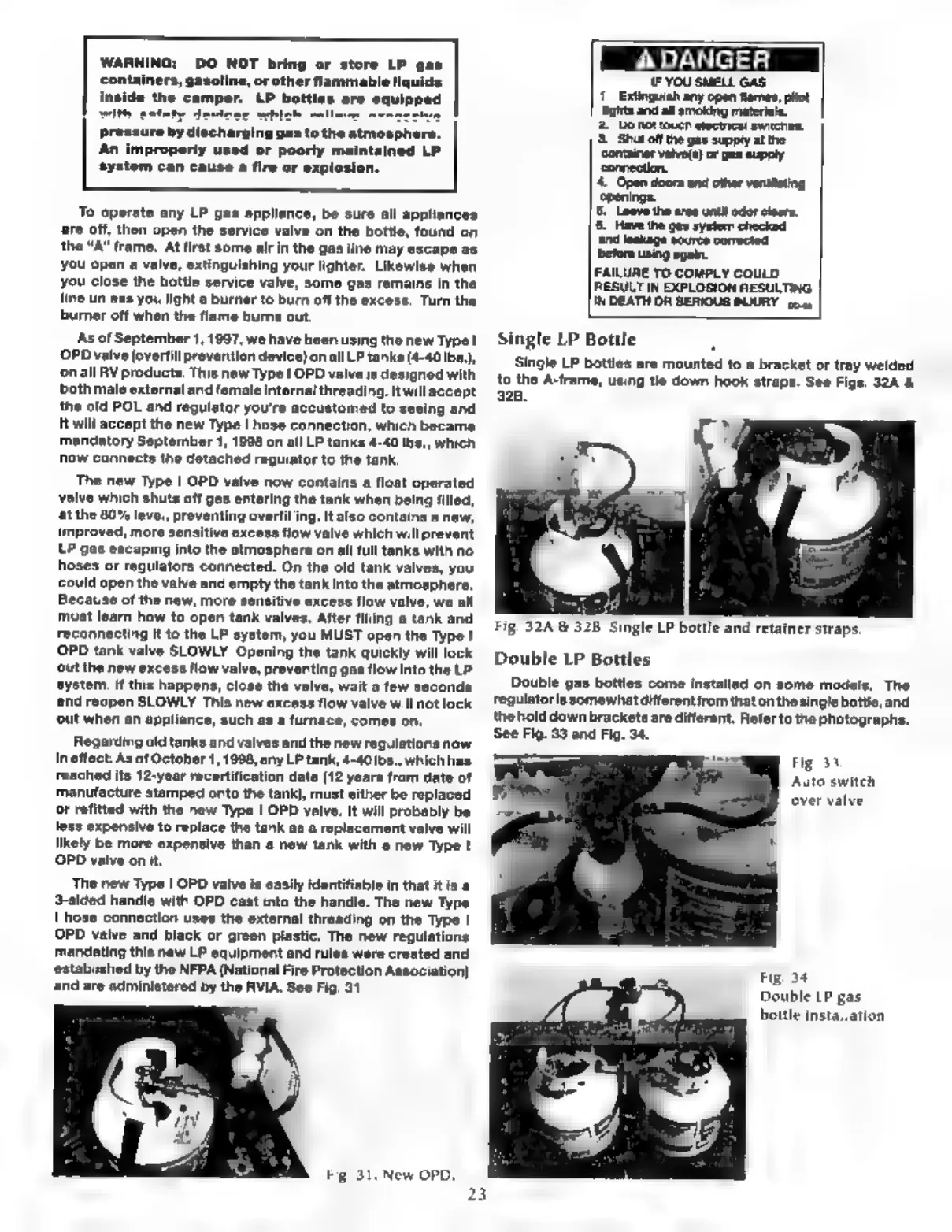
Fig.
31.
New
OPD.
23
4
DANGER
TFYOU
SMELL
GAS
4.
Extinguish
any
open
flames,
pilot
lights
and
all
smoking
materials.
2
Wonot
touen
etecrrical
suitcrios,
‘3.
Shut
off
the gas
supply
atthe
‘container
valvo(a)
or
gas
supply
connection.
4.
Open
doors
and
other
ventitating
openings.
5.
Leave
the
area
until
odor
cloars,
FAILURE
TO
COMPLY
COULD
RESULT
IN
EXPLOSION
RESULTING
IN
DEATH
OR
SERIOUS
INJURY.
53
Single
LP
Bottle
F
Single
LP
bottles
are
mounted
to
a
bracket
or
tray
welded
to
the
A-frame,
using
tie
down
hook
straps.
See
Figs.
328
&
328.
Fig.
32A
&
32B.
Single
LP
bottle
and
retainer
straps.
Double
LP
Bottles
Double
gas
bottles
come
installed
on
some
models.
The
regulatoris
somewhat
different
rom
that
on
thesingle
bottle,
and
the
hold
down
brackets
are
different.
Refer
to
the
photographs,
See
Fig.
33
and
Fig.
34.
Fig.
33.
Auto
switch
over
valve,
Fig.
34,
Double
LP
gas
bottle
installation.

Table of Contents