EasyManua.ls Logo

Starcraft 2005 - Safety and Cold Weather Operations; Fire Safety and Emergency Exits; Cold Weather Usage Precautions

Starcraft 2005
40 pages
Print Icon
To Next Page IconTo Next Page
To Previous Page IconTo Previous Page
Loading...
Fire
Safety
Make
certain
everyone
in
your
party
is
familiar
with
the
emergency
features
of
your
trailer,
location
of
exits,
and
location
and
operation
of
the
fire
extinguisher.
Fire
Extinguisher
Locations
Fire
extinguishers
are
located
close
to
the
entrance
door
of
the
trailer,
mounted
on
the
wall
or
side
of
a
cabinet.
Know
where
the
extinguisheris
located
and
CHECK
IT
FREQUENTLY
to
assure
that
it
is in
good
working
condition.
It
a
fire
does
start,
get
all
people
outside.
Use
the
fire
extinguisher.
If
the
fire
cannot
be
extinguished
quickly,
GET
OUT!
Close
the
LP
gas
service
valve
and
call
the
fire
department.
DO
NOT
re-enter
the
unit
until
officials
declare
it
sate,
Replace
a
used
fire
extinguisher
as
soon
as
possibl
Emergency
Exits
Emergency
exits
are
identified
by
an
“EXIT”
sticker
located
on
the
ceiling
or
on
bunk
end
panel.
See
Fig.
38.
Make
sure
that
everyone
who
uses
the
camper
knows
where
the
exits
are
and
is
able
to
operate
them
in
an
emergency.
In
the
unlikely
event
of
an
emergency,
grab
the
zipper
pull
at
the
lower
edge
of
the
tent
assembly
at
the
corner
lifter
post
and
pull
up.
This
same
procedure
can
be
used
at
all
four
corner
litter
posts.
Prevention
is
the
best
form
of
safety.
Follow
the
same
rules
you
would
at
home.
Follow
the
LP
gas
systeminstructions
carefully
and
perform
the
periodic
maintenance
suggestions.
1.
DO
NOT
smoke
in
bed.
2.
DO
NOT
overload
electrical
circuits.
3.DO
NOT
use
matches,
candles,
or
lighters
as
flashlights.
DO
NOT
store
flammable
liquids
inside
the
‘camper.
5.
DO
NOT
permit
children
to
play
wi
lectrical
appliance:
the
LP
gas
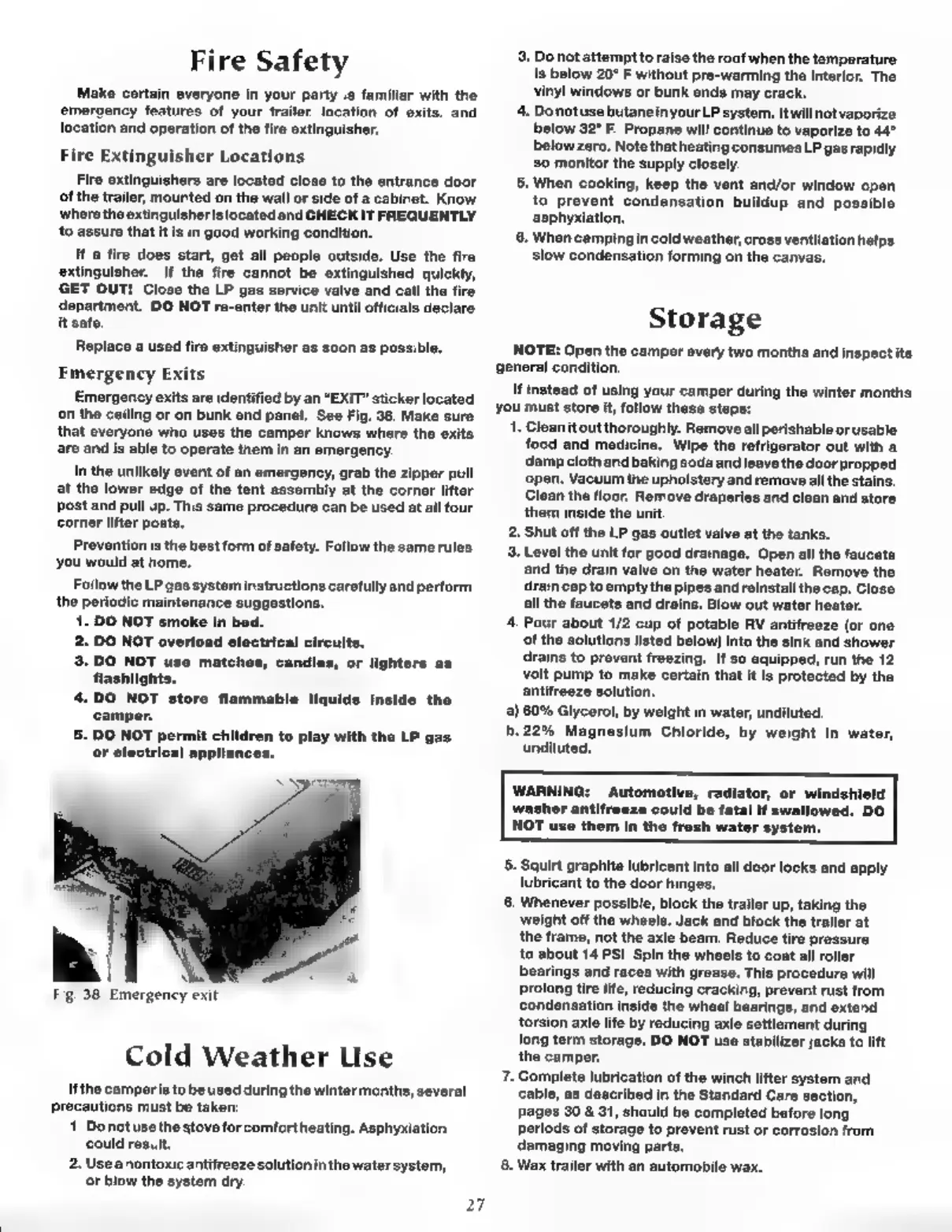
Fig.
38.
Emergency
exit.
Cold
Weather
Use
the
camperis
to
be
used
during
the
winter
months,
several
precautions
must
be
taken:
1.
Donotuse
the
stove
for
comfort
heating.
Asphyxiation
could
result,
2.
Use
anontoxic
antifreeze
solution
in
the
water
system,
or
blow
the
system
dry.
27
3,
Do
not
attemptto
raise
the
roof
when
the
temperature
is
below
20°
F
without
pre-warming
the
interior.
The
vinyl
windows
or
bunk
ends
may
crack.
4.
Donotuse
butane
inyourLP
system,
Itwillnot
vaporize
below
32°
F.
Propane
will
continue
to
vaporize
to
44°
below
zero.
Note
thatheating
consumes
LP
gas
rapidly
so
monitor
the
supply
closely.
5.
When
cooking,
keep
the
vent
and/or
window
open
to
prevent
condensation
buildup
and
possible
asphyxiation.
6.
When
camping
in
cold
weather,
cross
ventilation
helps
slow
condensation
forming
on
the
canvas.
Storage
NOTE:
Open
the
camper
every
two
months
an
general
condition.
If
instead
of
using
your
camper
during
the
winter
months
you
must
store
it,
follow
these
steps:
1.
Cleanitout
thoroughly.
Remove
alll
perishable
or
usable
food
and
medicine.
Wipe
the
refrigerator
out
with
a
damp
cloth
and
baking
soda
and
leave
the
door
propped
‘open.
Vacuum
the
upholstery
and
remove
all
the
stains.
Clean
the
floor.
Remove
draperies
and
clean
and
store
them
inside
the
unit.
2.
Shut
off
the
LP
gas
outlet
valve
at
the
tanks.
3.
Level
the
unit
for
good
drainage.
Open
all
the
faucets
and
the
drain
valve
on
the
water
heater.
Remove
the
drain
cap
to
empty
the
pipes
andreinstall
the
cap.
Close
all
the
faucets
and
drains.
Blow
out
water
heater.
4.
Pour
about
1/2
cup
of
potable
RV
antifreeze
(or
one
inspect
its
drains
to
prevent
freezing.
If
so
equipped,
run
the
12
volt
pump
to
make
certain
that
it
is
protected
by
the
antifreeze
solution.
a)
60%
Glycerol,
by
weight
in
water,
undiluted.
b.
22%
Magnesium
Chloride,
by
weight
in
water,
undiluted,
WARNING:
Automotive,
radiator,
or
windshield
washer
antifreeze
could
be
fatal
if
swallowed.
DO
NOT
use
them
in
the
fresh
water
system.
5.
Squirt
graphite
lubricant
into
all
door
locks
and
apply
lubricant
to
the
door
hinges.
6.
Whenever
possible,
block
the
trailer
up,
taking
the
weight
off
the
wheels.
Jack
and
block
the
trailer
at
the
frame,
not the
axle
beam.
Reduce
tire
pressure
to
about
14
PSI.
Spin
the
wheels
to
coat
all
roller
bearings
and
races
with
grease.
This
procedure
will
prolong
tire
life,
reducing
cracking,
prevent
rust
from
condensation
inside
the
wheel
bearings,
and
extend
torsion
axle
life
by
reducing
axle
settlement
during
long
term
storage.
DO
NOT
use
stabilizer
jacks
to
litt
the
camper.
7.
Complete
lubrication
of
the
winch
lifter
system
and
cable,
as
described
in
the
Standard
Care
section,
Pages
30
&
31,
should
be
completed
before
long
Periods
of
storage
to
prevent
rust
or
corrosion
from
damaging
moving
parts.
8.
Wax
trailer
with
an
automobile
wax.

Table of Contents