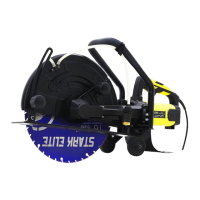
This document is an owner's manual and safety instructions for a Stark 14-inch concrete cut-off saw, walk-behind model, with a 5.5 HP engine, item number 61057.
The Stark 14-inch concrete cut-off saw is a walk-behind, depth-adjusted cutting machine designed for "flat" sawing of concrete and asphalt. It is equipped with a super rigid, sturdy frame to ensure straight cuts. This versatile machine is suitable for multi-purpose cutting tasks and can be used for both wet and dry cutting applications. The saw is powered by a Honda GX 160 engine, delivering 5.5 horsepower, making it a robust tool for demanding cutting jobs.
Important Technical Specifications:
- Engine: Honda GX 160, 5.5 HP
- Blade Diameter Compatibility: Fits 12-inch to 14-inch blades
- Blade Width: 5.9 inches
- Blade Length: 13.5 inches
- Maximum Cutting Thickness: 3 inches
- Depth Adjustment: Yes
- Assembled Dimensions (L x W x H): 37 inches x 32.7 inches x 19.7 inches (Product dimensions are also listed as 35.00 x 14.00 x 8.00 inches, which might refer to packaging or a different measurement context, but the 37 x 32.7 x 19.7 inches are listed under "Assembled Product Dimensions" in the table).
- Item Weight: 187.3 lbs.
- Engine Oil: SAE 10W/30
- General Grease: #1 Lithium
- Power Source: Gas-powered (Honda GX 160 engine)
- Batteries: No batteries included or required (indicating manual start or a system not reliant on batteries for operation).
- Frame Construction: Heavy-duty frame with a hinged blade guard.
Usage Features:
The saw is designed for ease of use and transport. It features an easy-to-fold design, which aids in its portability. The machine is operated by walking behind it, guiding the blade along the cutting line.
- Starting Procedure (Cold Start): To start, open the fuel valve, set the engine stop switch to "run," open the throttle halfway, and apply the choke. Pull the starter rope sharply. Once the engine starts, open the choke slightly to prevent flooding and adjust the throttle to keep it running. Allow the engine to warm up for a few minutes before applying a load. Always operate the engine at full throttle when under load.
- Cutting Operation:
- Align the blade and cutter with the desired cut line.
- For wet cutting, open the water valve and turn on the water safety switch.
- Use the PEDAL on the left side to engage the forward movement system (a "click" will be heard), then use the WHEEL HANDLE on top to adjust forward and reverse movement. Step down on the right side of the PEDAL to switch to a "push" driving system.
- Lower the blade into the cut slowly.
- Cut as fast as the blade allows; if the blade climbs out of the cut, reduce forward speed or depth.
- Apply only enough side pressure on the cutter handles to follow the cutting line.
- To lower the blade to the required depth, turn the tilt crank counterclockwise. Ease the saw slowly forward.
- For deeper cuts (4 inches/102mm or more), make several incremental cuts of 1-1/2 to 2 inches (38mm to 51mm) until the desired depth is reached.
- Push the saw steadily forward using the front pointer as a guide, applying enough pressure for the engine to labor but not slow down. If the saw stalls, retard forward movement until full RPM is restored. If the saw stalls, raise the blade out of the cut before restarting.
- Avoid excessive side pressure or twisting of the blade in the cut.
- Blade Installation: Disconnect the spark plug. Remove the blade shaft nut and outside flange. Clean clamping surfaces. Place the blade on the shaft, aligning the offset drive pin with the mounting collar. If the blade has a directional arrow, position it for a down cut. Replace the outside flange and tighten the shaft nut securely against the star washer. Reconnect the spark plug.
- Safety Precautions:
- Always read and understand all instructions before operation.
- Do not allow persons under 18 years of age to operate the equipment.
- Wear proper protective clothing, shatterproof glasses, steel-toed boots, and other required protective devices.
- Never operate without proper cooling airflow; avoid enclosed or narrow areas.
- Refuel in a well-ventilated area, away from sparks and open flames. Stop the engine and allow it to cool before refueling.
- Never operate in explosive atmospheres or near combustible materials.
- Ensure all guards and safety devices are attached and in place.
- Always stop the engine before servicing, adding fuel, or oil.
- Never run the engine without an air filter.
- Always inspect diamond blades before each use for cracks, dings, or flaws.
- Ensure the blade's operating speed is greater than the cutter's shaft speed.
- Keep blade guards in place; exposure of the diamond blade must not exceed 180 degrees.
- Do not transport the cutter with the blade mounted.
- Use the lifting bail for safe movement; do not use handlebars or front pointer as lifting points.
- Never tow the saw behind a vehicle.
- Be aware of the location of the nearest fire extinguisher, first aid kit, and emergency contact numbers.
Maintenance Features:
Regular maintenance is crucial for the longevity and safe operation of the saw.
- Daily Checks: Check oil levels, wiring, hoses (air, fuel, water), and lubricate the machine daily.
- Repairs: Repair or replace all worn or damaged components immediately.
- Belt Tension: Check drive belt tension; do not over-tension. Ensure the machine has a full set of matched belts. The best tension for a v-belt drive is the lowest tension at which the belts will not slip under full load. New belts may require additional tensioning after seating.
- Blade Shaft: Check the blade shaft, arbor, and threads for wear, damage, or bends. Blade shaft bearings should be tight with no free play. Grease blade shaft bearings daily.
- Blade Collars: Ensure blade collars are clean, free of nicks and burrs, and not out of round. They must be identical in diameter and the recommended size.
- Drive Pin: Check the drive pin for excessive wear, bends, or gouges.
- Cleaning: Flush water through the pump and spray the assembly every night to prolong pump and blade life.
- Fasteners and Guards: Ensure all fasteners and guards are tight and secure.
- Engine Service: Allow the engine to cool before servicing. Consult the Engine Manual for specific instructions, especially for gasoline engines.
- Waste Disposal: Dispose of hazardous waste (e.g., used motor oil, fuel, fuel filters) properly.
- Troubleshooting: The manual provides a detailed troubleshooting guide for common issues such as uneven segment wear, segment cracks, segment loss, cracks in the core, loss of tension, blade wobbles, blade not cutting, undercutting the core, arbor hole out of round, and blade worn out of round. Solutions range from checking water flow and blade specifications to tightening components, replacing worn parts, and tuning the engine.

 Need help?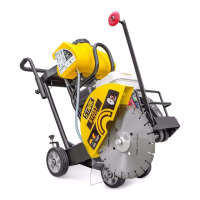

 To Next Page
 General