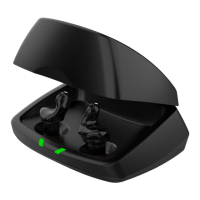
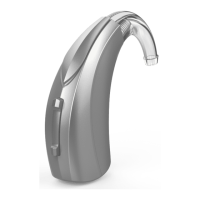
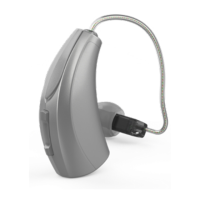
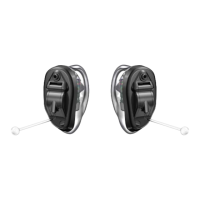
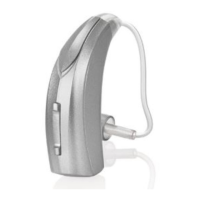
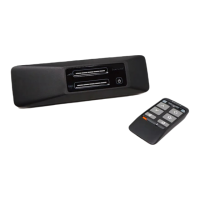
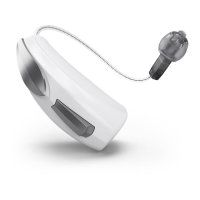
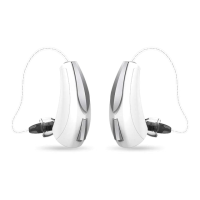
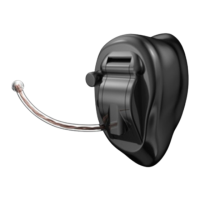
This document is a user manual for Starkey's rechargeable hearing aids, specifically the mRIC R (Micro Receiver-In-Canal) and RIC RT (Receiver-In-Canal) models, with the RIC RT also featuring Telecoil. The manual provides essential information on warnings, cautions, notices, product features, usage, care, troubleshooting, and regulatory guidance.
Function Description:
These devices are air conduction hearing aids designed to compensate for impaired hearing, suitable for hearing losses ranging from mild to profound. They amplify sound to improve speech understanding and overall quality of life. The RIC RT model includes a telecoil for enhanced listening in environments with loop systems. Both models feature Multiflex Tinnitus Technology, a software function that generates broadband white noise to be used as part of a Tinnitus Management Program for patients suffering from tinnitus. This technology can be programmed by a hearing care professional to meet individual needs and preferences, and it can operate in three modes: as a hearing aid, as a tinnitus treatment instrument, or as a combination of both. The hearing aids are designed to accommodate calls on mobile or landline phones, with specific settings available through a hearing care professional. They also include a Fall Alert feature that can notify predefined contacts via SMS text message in case of a fall or non-fall-related event, configurable for automated or manually-initiated alerts.
Important Technical Specifications:
- Battery Type: On-board, rechargeable lithium-ion battery (non-removable).
- Battery Operating Time (mRIC R): Up to 41 hours without streaming; up to 33 hours with streaming.
- Battery Operating Time (RIC RT): Up to 51 hours without streaming; up to 45 hours with streaming.
- Wireless Technology: Bluetooth® Low Energy, operating in the 2.4-2.4835 GHz frequency band.
- Maximum Effective Radiated Power: -8 dBm for mRIC R, -6.2 dBm for RIC RT (using GFSK transmission modulation).
- Receiver Section Bandwidth: 1.5 MHz.
- RIC RT Additional Wireless: Near Field Magnetic Induction (NFMI) operating on 10.281 MHz.
- NFMI Maximum Induced Magnetic Field Strength: -5 dBuA/m at 10 meters.
- NFMI Receiver Section Bandwidth: 400 kHz.
- Tinnitus Technology Maximum Output: 87 dB SPL (typical) in a 2cc coupler.
- Operating Temperature Range: 0°C (32°F) to 40°C (104°F).
- Charging Temperature Range: 10°C (50°F) to 40°C (104°F).
- Storage and Transport Temperature Range: -10°C (14°F) to +45°C (113°F).
- Humidity Range: 10%-95% rH.
- Pressure Range: 70 kPa - 106 kPa (equivalent to altitudes from 1,200 ft (380 m) below sea level to 10,000 ft (3,000 m)).
- Classification: Type B applied part under IEC 60601-1 medical device standard.
- Expected Service Life: 3 years.
- Compliance: FCC part 15, ISED Canada license-exempt RSS standards, IEC 60601-1-2 (radiated emissions, RF radiated immunity, power frequency magnetic fields, ESD levels), ANSI C63.19-2019, IEC 60118-13:2019, Directive 2014/53/EU, UK Radio Equipment Regulations Sl 2017.
Usage Features:
- User Control: The hearing aids feature a user control (push button for mRIC R, rocker switch for RIC RT) that can be programmed by a hearing care professional for various smart features. It operates with short presses (1 second), long presses (3 seconds or more), and tap control (firmly double-tapping on or near the user control).
- Power ON/OFF: Hearing aids turn ON automatically when removed from the charger (with a 3-second delay) and OFF when placed in the charging slot. They can also be turned ON/OFF manually using the user control (3-second press and hold).
- Battery Indicators: A "low battery" voice indicator sounds when approximately 30 minutes of battery life remain. A "battery shutdown" indicator may sound just before the battery stops working.
- Charging: Requires a StarLink Charger or StarLink Premium Mini Charger. The StarLink Chargers need to be plugged into an external power source, while the Premium Mini Chargers can operate with a charged internal battery or be plugged in.
- Placement: The hearing aid slides behind the ear with the cable and earbud/earmold hanging in front. The earbud/earmold is eased into the ear canal until secure, and the cable sits flat against the head. An optional retention lock can be tucked into the bottom curve of the ear for added security.
- Removal: Gently pull the optional retention lock from the ear, then pull the earbud/earmold from the ear canal.
- Mobile App Integration: Users can control hearing aid features using a compatible mobile app, which also provides guidance on connecting ("pairing") the smartphone to the hearing aids.
- Fall Alert: Configurable to send SMS text messages to predefined contacts for falls or non-fall-related events. Alerts can be automated or manually initiated and can be canceled via the smartphone or hearing aid user control. Requires the hearing aid to be powered on, paired, and connected to a powered smartphone with the mobile app open and an internet connection.
Maintenance Features:
- Cleaning: Hearing aids should be kept clean at all times. Do not use water, solvents, cleaning fluids, or oils. Do not disassemble or insert cleaning tools inside. Use the included cleaning tool (brush) to remove debris from microphones, wax guards, sound outlets, and charging contacts. Wipe hearing aids daily with a soft cloth.
- Storage: When not in use, store hearing aids in their storage case or charger (plugged in or powered) in a cool, dry location, away from heat, moisture, direct sunlight, and out of reach of children and pets.
- Wax Guard Replacement: Replace wax guards if built-up debris or poor sound is noticed. An application stick is used to remove the old wax guard and insert a new one.
- Earbud Replacement: Replace earbuds regularly or if they become loose, misshaped, or discolored. Pull the old earbud from the receiver, hold the cable near the receiver, place the receiver end into the new earbud, and push firmly to secure it, ensuring it fully covers the threaded portion.
- Troubleshooting Guide: The manual provides a troubleshooting guide for common issues such as insufficient loudness, inconsistent performance, unclear/distorted sound, no sound, and whistling in the charger, with suggested solutions including cleaning, restarting, and contacting a hearing care professional.
- Professional Care: Users are advised to consult their hearing care professional for any issues, adjustments, or additional care and maintenance tips.
- Disposal: Contains a Lithium Ion Polymer battery. Instructions for battery removal for disposal/recycling are available online. Hearing aids should be disposed of via local electronics recycling/disposal processes.

 Need help?
 General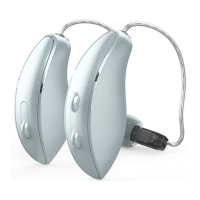

 To Next Page