Page 35
APPENDIX F
ALARM CODES / TROUBLESHOOTING
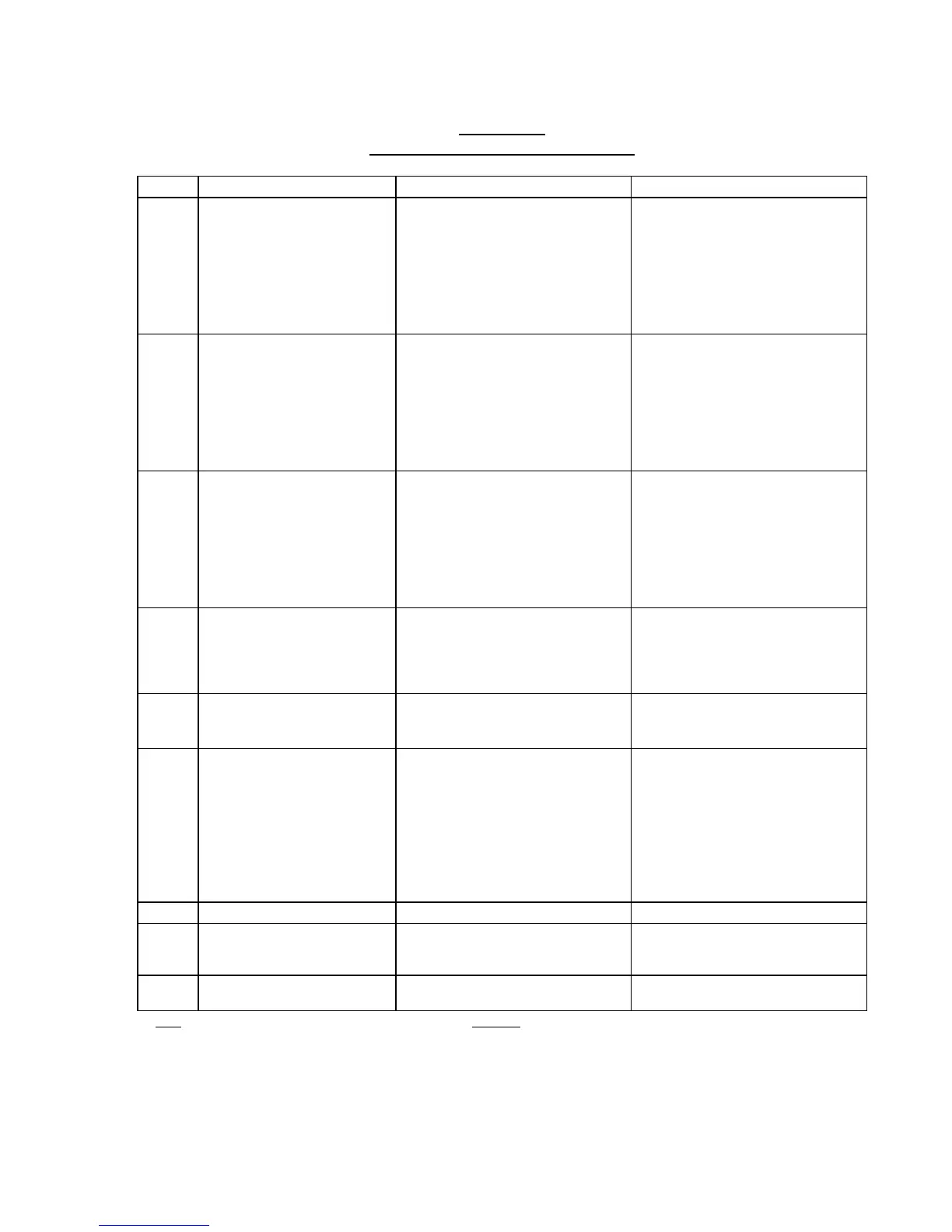
Code Alarm Probable Cause Corrective Action
A1 High Temperature 1. Refrigerator temperature higher
than temperature alarm setting.
(On initial fill, refrigerator will take
approx. 24 hours to reach normal
operating temperature.)
2. Thermocouple faulty.
1. Change temperature alarm setting
(see systems set-up procedure) or
raise sensor positions to increase
liquid level in refrigerator. (Vapour
phase only.)
2. Re-calibrate thermocouple (see
appendix D) or replace if problem
persists.
A2
A3
A4
A5
Sensor Open Circuit (Extra High)
(White wire)
Sensor Open Circuit (High)
(Yellow wire)
Sensor Open Circuit (Low)
(Blue wire)
Sensor Open Circuit (Extra Low)
(Red wire)
1. Loose wire on corresponding
sensor.
1. Check wiring connections and
repair as necessary.
A6
A7
A8
A9
Sensor Short Circuit (Extra High)
(White wire)
Sensor Short Circuit (High)
(Yellow wire)
Sensor Short Circuit (Low)
(Blue wire)
Sensor Short Circuit (Extra Low)
(Red wire)
1. Sensor damaged or loose wiring on
sensor assembly causing short
circuit.
1. Repair connection or replace
sensors if necessary.
A10 Time-out on filling 1. Liquid nitrogen supply depleted.
2. Insufficient pressure in supply
vessel.
3. Filter blocked.
1. Replenish liquid nitrogen supply.
2. Increase supply vessel pressure.
(See page 7)
3. Thaw filter and replace if still
blocked. (See maintenance section)
A11 Time-out on lid open 1. Lid open timer alarm setting has
been exceeded.
1. Close lid or adjust lid open alarm
setting if required. (See system
set-up procedure.)
A12 Overfill 1. Excessive supply pressure causing
liquid level in sensor tube to
fluctuate and reach extra high
sensor.
2. Solenoid valves not functioning
correctly due to ice contamination
or damaged relays.
1. Reduce supply vessel pressure.
(See page 7)
2. Shut off liquid nitrogen supply.
Allow solenoid valves to thaw.
Re-introduce liquid nitrogen supply
and if problem persists contact
service engineer.
A13 Underfill (low level) # See note. See A10 “Time-out on filling”.
A14 Printer faulty/unavailable. 1. Printer disconnected from
Biosystem/no power to printer.
1. Check printer connection and
power
supply.
A15 Thermocouple open circuit.
(Blue & white wire)
1. Loose wire from thermocouple.
2. Thermocouple damaged.
1. Repair connection.
2. Replace thermocouple.
# Note : If alarm A13 occurs and the refrigerator has actually overfilled this may indicate that the vent on the sensor tube has become
blocked by a build up of ice. By removing the black grommet which is located to the right of the grey top cover (when lid is open), the
sensor tube with the cable gland at the top can be seen. Just below this gland the vent tube branches off and points down. The ice
should be removed from the vent tube and if this does not rectify the problem a service engineer should be called.
F-1



 To Next Page