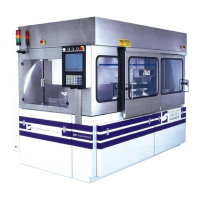
Maintenance Model 6DS-SP Planarizer
7 - 4 Version 4.0 - February 1998
The inhouse compressed air supply must be at minimum 100 psi for proper
operation of all machine functions. The inhouse compressed air supply enters
from the back of the machine through a ball check valve, filter, regulator, and
coalescing filter. These four parts are grouped together in line and located at the
back of the machine on the left side below the left electrical cabinet. From the
coalescing filter, the compressed air supply is plumbed to a distribution manifold
mounted on the valve assembly panel. This valve assembly panel is accessible
through the left front service door. All pneumatic lines are identified with
banded identification tags at the termination points. The identification marks are
encircled on the engineering drawings.
Air purge feature: (Refer to engineering drawings 217946F1-Rev. B and
220734A1-Rev. C or D.) Via an air line to the elevators, the robot, and the
second table, the air purge creates a positive pressure to help keep contacts and
electrical components dry. As a safety feature, a pressure release is located at
the regulator and factory set to just below 5 psi. The regulator and pressure
gauge are mounted at the lower left front valve panel.
VACUUM SYSTEM
The vacuum system controls the vacuum source needed to secure the wafer
carriers to the spindle drives, the wafer to the robot end effector, and the wafers
to the load chucks. Vacuum (back pressure) also pulls the wafers up off the load
chucks and into the carriers. The inhouse vacuum source must be a minimum of
25 inches Hg. Each of the five vacuum lines has a control valve mounted on the
solenoid panel. Two back pressure vacuum regulators control vacuum and air
pressure to the wafer in the carrier.
Normally open valves are used on the spindles; thus, if the machine loses power,
the wafer carriers will not fall off the spindle drive assemblies. When the
solenoid of either of the spindle valves is de-energized, air pilot pressure forces
the valve's diaphragm down to divert vacuum to the cylinder port. Air pilot
pressure must be available to permit the diaphragm to move. When the solenoid
is energized, the air pilot source is cut off, allowing the spring to return the
diaphragm and close off the vacuum source. Vacuum switches on each line test
to see if vacuum is in the line, indicating that a wafer carrier is attached.
Whenever a solenoid is de-energized to release a wafer carrier, the blow-off
solenoid energizes, routing air into the vacuum lines to release the grip upon the
wafer carrier.


 To Next Page
 Loading...