3
Electrical Supply
THIS EQUIPMENT MUST BE EARTHED
Before connection please read and understand this instruction
manual and ensure that the line supply corresponds to that
shown on the rating plate. Bibby Scientific rotary evaporators
require a supply rated at 220-240V, 50/60Hz, single phase,~.
The power consumption of the rotary evaporator is 50W.
F3.15AL (20x5mm) fuses fitted in both live and neutral lines.
IF IN DOUBT CONSULT A QUALIFIED ELECTRICIAN
The unit is supplied with two mains leads fitted with IEC plugs for
connection to the instrument. One has a U.K. 3 pin plug and the
other has a 2-pin “Shuko” plug for connection to the mains.
Choose the lead appropriate for your electrical installation and
discard the other.
Should neither lead be suitable, take the lead with the U.K. plug and
replace the plug with a suitable alternative. This involves cutting off
the moulded plug, preparing the cable and connecting to the
rewireable plug in accordance with its instructions.
IT IS IMPORTANT THAT THIS OPERATION SHOULD ONLY BE
UNDERTAKEN BY A QUALIFIED ELECTRICIAN
The wires in the mains cable are coloured as follows:
BROWN - LIVE
BLUE - NEUTRAL
GREEN/YELLOW - EARTH
The unit is fitted with an IEC socket at the rear of the instrument for
connection of the mains lead. The appropriate mains lead should be
connected BEFORE connection to the mains supply.
Should the mains lead need replacement a cable of 1mm
2
of
harmonised code H05W-F connected to an IEC 320 plug should be
used.
N.B. The UK mains lead is protected by a 10A fuse mounted in the
plug top.
Safety Advice before Use
1. If the jacking mechanism is to be raised without the
glassware fitted great care must be taken. Without the
weight of the glass the jack will rise rapidly and can cause
damage to the mechanism. Unlock the jack carefully while
applying downward pressure to control the movement.
2. As the apparatus is likely to be used under vacuum, before
operation, examine all glassware carefully for scratches or
chemical etching. Use of damaged glassware under
vacuum could result in an implosion. In any case it is
recommended that the apparatus be operated behind a
safety screen.
3. Do not use the equipment in a hazardous atmosphere or
for mixing of hazardous materials.
4. Special care should be taken when using the equipment
with flammable solvents. The unit is not spark or explosion
proof.
5. In case of mains interruption, a fault or mechanical failure,
the unit will continue to operate on removal of the fault.
6. Beware of safety issues associated with rotating glassware
and when jacking glassware up and down.
Assembly
If the jacking mechanism is to be raised without the glassware
fitted great care must be taken. Without the weight of the
glass the jack will rise rapidly and can cause damage to the
mechanism. Unlock the jack carefully while applying
downward pressure to control the movement.
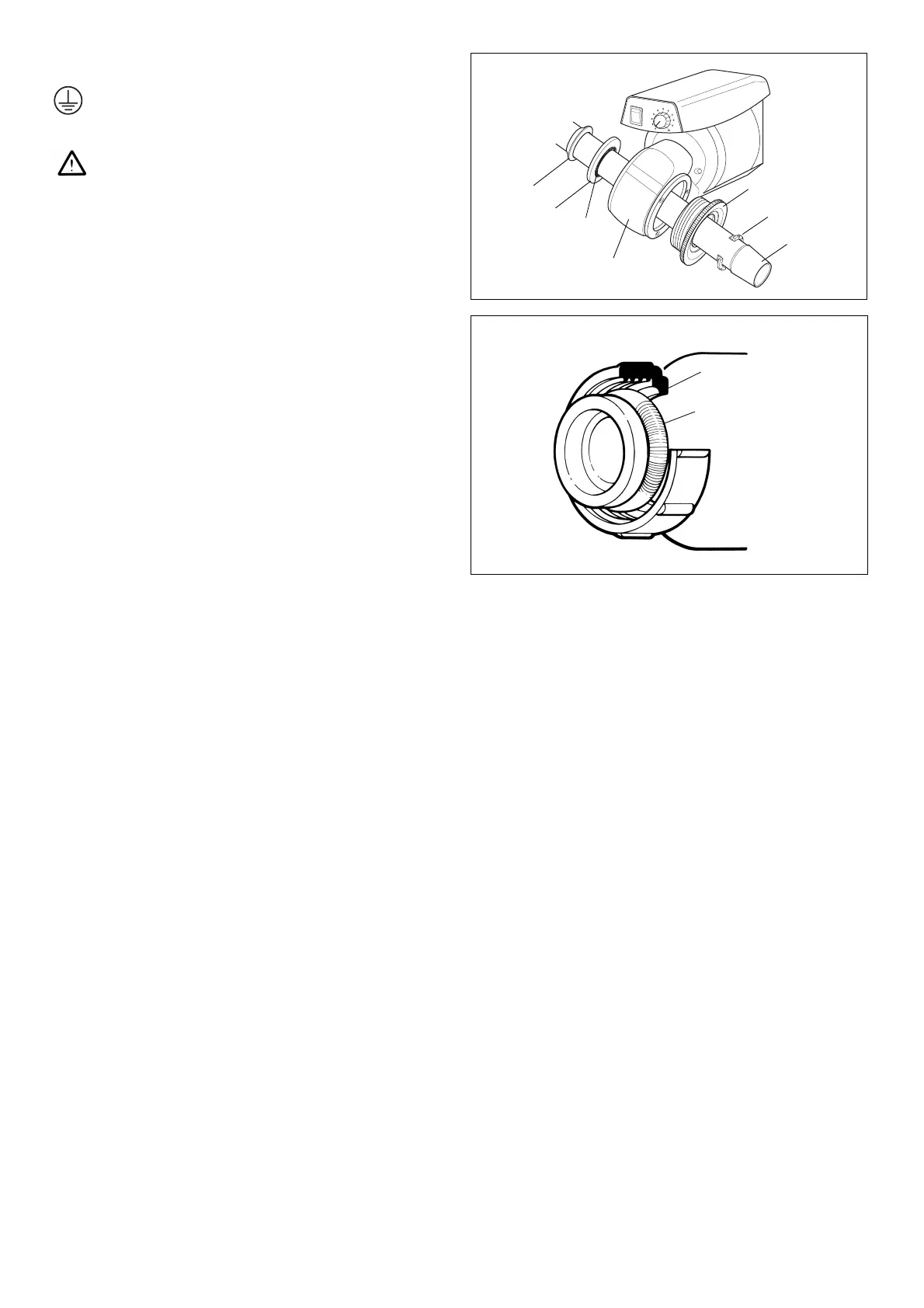
1. Unpack the rotary evaporator and identify the following
components:
Item Component Catalogue
No Number
1 Condenser RE100/CO or RE200/VC or
RE200/CF and RE200/CFD
2 Conical joint clip KCM29
3 Feed/vacuum release adapter RE100/VR
4 Florentine flask 1L FD1L/4RE
5 Receiving flask 1L RE100/RF/1L
6 Rotary evaporator motor stand RE300/MS
7 Spherical joint clip JC35
8 Vapour tube RE100/VT or RE100/VT/CF
9 Grey retaining cap
10 Circular metal spring
11 Vacuum seal
12 Sub-seal
13 Retaining clip
- UK lead
- European lead
- Spare fuse
12
11
Bearing house
Figure 2
Figure 3
Plastic screw bush
10
1
9
13
8
Spring
All components are
included in the rotary
evaporator motor stand
box



 To Next Page