Powering On the Welder
When all of the previous setup steps in this manual are complete the welder can be powered on.
1. Ensure that the power cord is connected to the power cord socket and the supply power.
2. Check the 10A fuse below the ON/OFF switch located on the back of the unit.
3. Use the ON/OFF switch to power the unit on.
Voltage Selecon
• The voltage is determined by the diameter of the stud and the base material thickness. The unit is
programmed with the recommended voltage sengs for various stud sizes. Fine tuning the volt-
age for each applicaon from this starng point is recommended.
• Seng the required weld voltage is achieved by selecng the desired stud size on the screen or
manually seng the voltage by using the + or - arrows.
• Fast voltage selecon can be done from the voltage mode screen. This will replace the preset val-
ues on the screen with voltages in increments of 10V and can be manually adjusted by using the
arrows.
Tesng the Weld Sengs
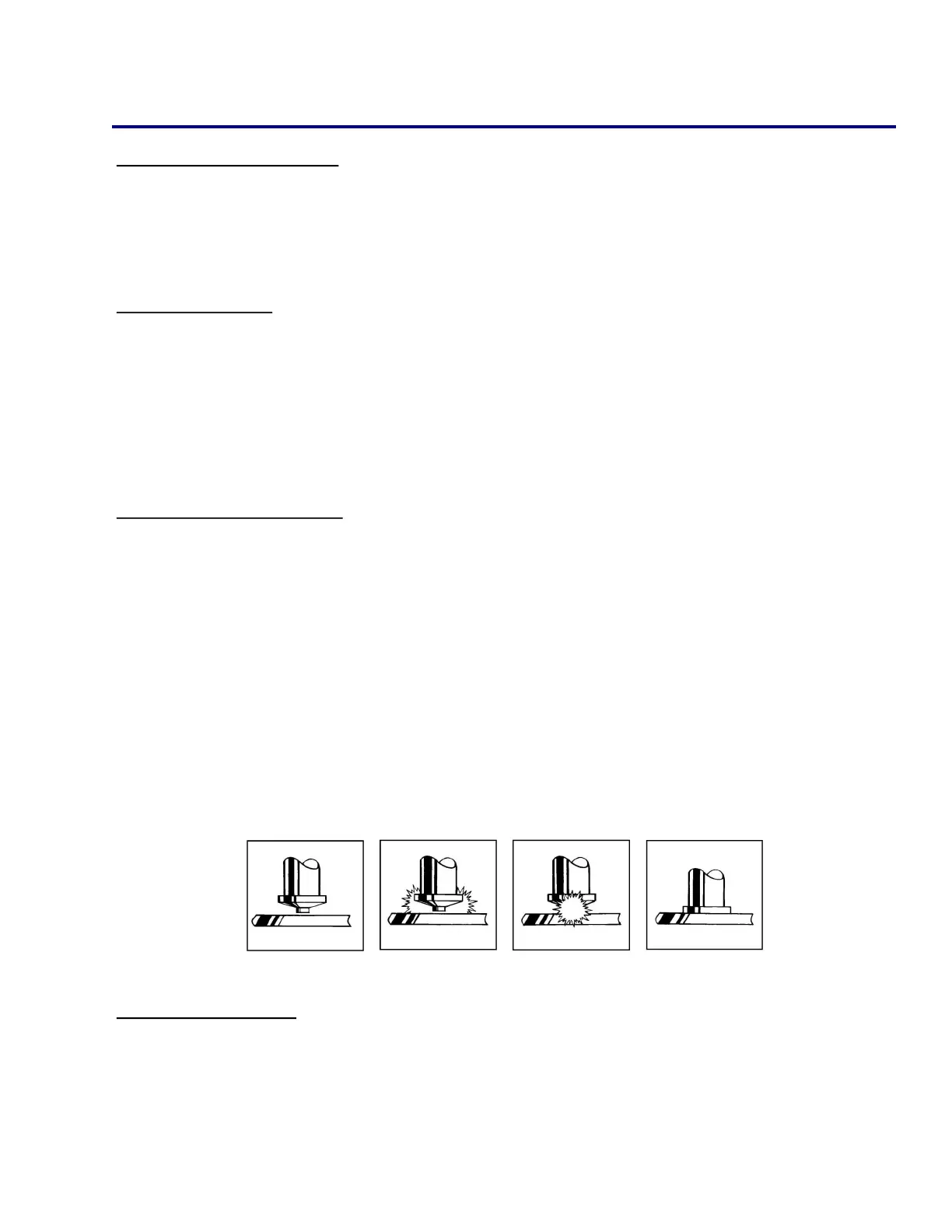
1. Aer performing all of the setup steps listed in this manual, it is recommended that several test
welds be performed with the same diameter stud and base material used for the applicaon. This
will verify that all of the sengs are correct to achieve the desired results.
2. Welding is done by placing the stud into the collet and pressing the stud gun to the work piece.
3. Hold the gun perpendicular to the work piece, align the stud to the desired locaon, press down
so that the foot piece is ush with the base material, and squeeze the trigger.
4. Spreading the collet nes when liing the stud gun from the welded stud will shorten the life of
the collet and will eventually create an undesirable weld. For maximum collet life remove the
stud gun from the welded stud by pulling the stud gun straight o of the welded stud.
5. Properly welded studs are tested by either torqueing or bending the stud. Using either method
the threaded poron of the stud may break. However, the welded ange of the stud should stay
in place. Addionally, if the base material is very thin, a full slug the diameter of the ange will
pull from the base metal.
Inspecng the Weld
1. Visually inspect the weld. If there is a signicant amount of splaer then the weld is too hot, lower
the voltage. If there is no splaer then the weld is too cold, increase the voltage.
2. A good weld will result in a small, visible, and 360° ashing surrounding the ange of the stud. If
there is weld ash on only one side of the base of the ange, this is called “arc blow,” and can be
solved by reposioning the ground clamp or using a dual ground clamp.
SETUP AND WELDING
11



 To Next Page
 Loading...