11
Power amps, whether for main PA or monitor use, need enough power to deliver a clean signal, at the full rated power of
loudspeakers, This is because once an amplifier is driven into clipping, it produces a lot of high frequency harmonics,
MICROPHONES: Dynamic cardioid microphones are usually chosen for live work because they are robust, they
produce a full, confident sound, & their cardioid response helps prevent feedback by keeping unwanted sounds out of the
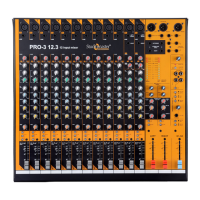
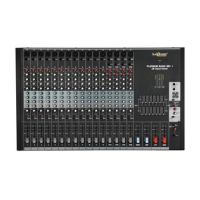
mic. Platinum consoles are designed to work with low impedance microphones so that long cable lengths won’t
compromise the sound quality. Both balanced & unbalanced microphones may be used although balanced mics provide
a better immunity to interference.
Monitor systems are also prone to feedback, especially as they are so close to performers. Careful positioning of the
monitor speakers, so as little sound as possible gets back into the stage mics, will help considerably, When using split
mode, one of the on-board graphic equalizers may be used to fine tune the monitor mix in the same way as for the main
PA. If the graphic equalizers are not used to compensate for room acoustics, or if a separate equalizer has been patched
into the insert point to handle this task, the on-board graphic equalizers may be assigned to the group mix allowing
specific groups or instruments or vocals to be treated independently of the rest of the mix. As a rule, avoid extreme EQ
settings, and if you can use cut rather than boost to achieve the desired result, feedback if less likely to be a problem.
When doing the pre-gig sound check, set the maximum safe vocal operating level first & then balance the instruments to
the vocals rather than attempting to work the other way around. Once the maximum safe level before feedback has been
found, back off the master faders slightly so as to leave al little power in hand. Finally, select a vocal Fx or echo setting
though be aware that in a typical venue, there may already be quite a lot of Fx so you may not need to add as much as
you think.
A common problem is that the vocal mic doesn’t just pick up the singer, it picks up sound from all along its axis, so anything
going on directly behind the singer will also be picked up, to some degree. If you put the drums or a loud guitar amp
behind the singer, whenever you turn up the vocal level you will increase the level of that as well. A microphone also
‘hears’ some of the ground generated by the PA system itself, either directly from the speaker cabinets or reflected from
the walls. If too much sound from the PA gets back into the mic it will build up in level resulting in the familiar squeal known
as feedback.
Feedback has to start at a particular frequency and, as you might expect, this is influenced by the room acoustics. Speakers
or mics with peaky frequency responses also provoke feedback at the frequencies where they have most gain. The Platinum
has two on-board graphic equalizer which can be used to ‘pull down’ troublesome frequencies. The best way to set up the
system is to slowly increase the sound level until feedback just starts to occur, then use the graphic EQ to pull that frequency
down in level slightly. Graphic equalization can’t provide a complete cure for feedback, but used carefully, it can enable
you to squeeze those extra few vital dB’s out of the system. Switching off mics when they are not in use also reduces the risk
of feedback.
MONITORING: Stage monitors may be thought of as a separate sound system, comprising power amplifiers & speakers,
running from the monitor output of the mixing console. The most important job of a small monitor system is to ensure that
the vocalists can hear themselves properly. For smaller venues it’s rarely necessary to feed much in the way of instruments
back through the monitor system. Stage monitors often take the form of floor-standing, wedge-shaped speaker enclosure,
and they must be fitted with high quality, full-range speaker systems, otherwise feedback will almost certainly become a
major problem. .


 To Next Page
 Loading...