14 11.8.22 © STULZ USA – all rights reserved
CYBERWALL™ INSTALLATION, OPERATION AND MAINTENANCE MANUAL
NOTE
Working clearance requirements need to be established prior to mounting the unit. Refer to local and
national electrical codes.
NOTE
These units use welded frame construction for unit rigidity. The system is designed to be installed either
on the floor or an optional stand. Ensure the curb is sealed to prevent air leakage. See the detail drawing
provided with the unit for interface dimensions. These units are designed to condition only one room.
NOTE
Working clearance requirements need to be established prior to mounting the unit. Refer to local and
national electrical codes.
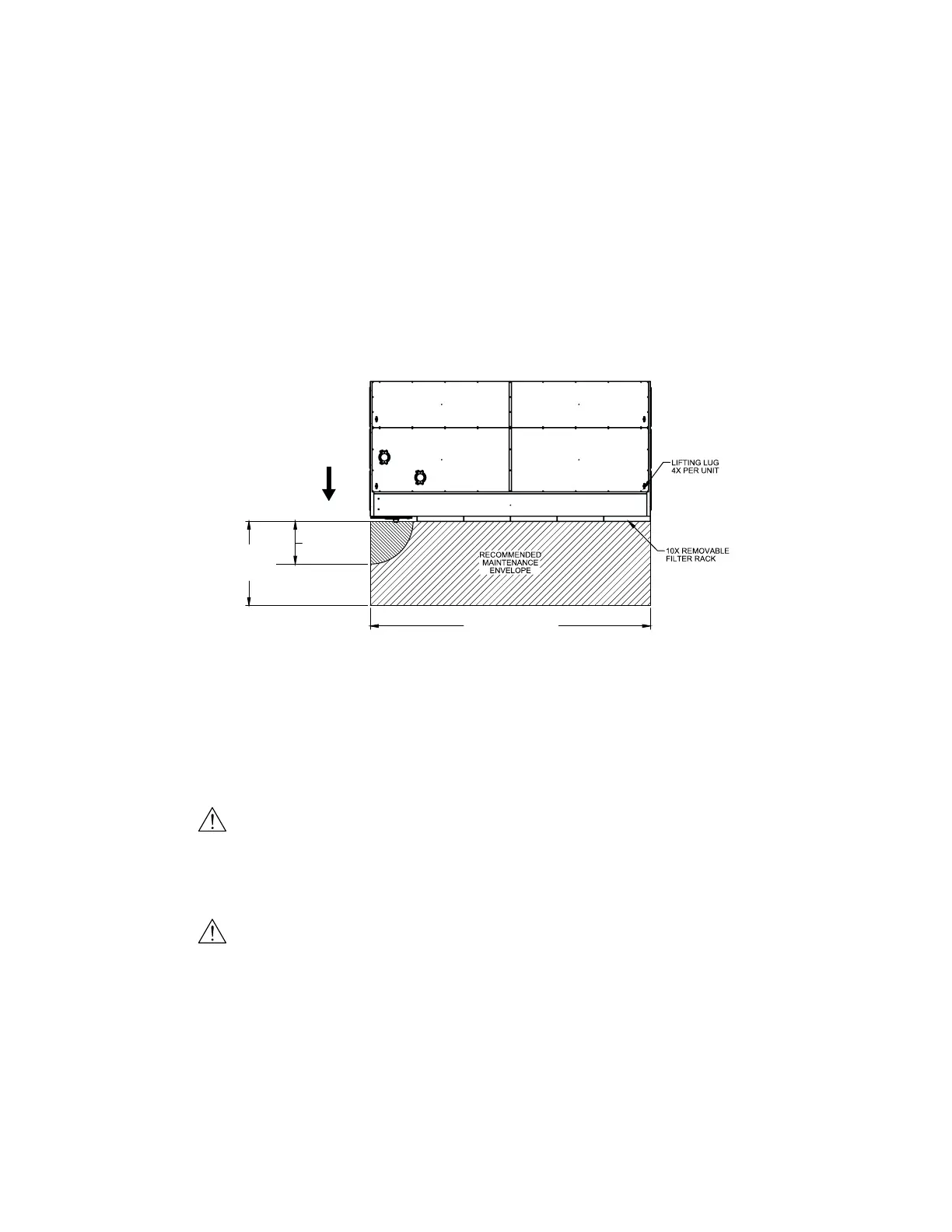
TOP VIEW
FRONT
120.0 in
[2048 mm]
36.0 in
[914 mm]
18.3 in
[465 mm]
Figure 5. Maintenance Clearance Recommendations
When determining the installation location, consider how you’ll route the piping and wiring to the cabinet. The
installation drawing furnished with your unit shows the recommended wiring entry locations. Ensure access is
available for routing the piping and wiring.
CAUTION
The A/C unit must be installed in a space that will be air conditioned.
Lifting and Rigging
CAUTION
Ensure crane is rated to lift the unit plus any additional lifting accessories. Each module (top and bottom)
weighs approximately 3,700 lbs (1,678 kg) dry. Utilize spreader bars that exceed the cabinet width
to avoid crushing the sides or damaging components mounted to the sides. When lifting a module, a
spreader bar must be used to prevent damage (see Figure 6). Attaching chains directly to the lifting lugs
will result in damage.
CyberWall™ units are designed to be kept in a vertical position. Move the unit with a suitable device such as
a pallet jack or roller bar and dollies. The unit is shipped on a skid to facilitate moving prior to installation. The
unit should always be stored indoors in a dry location prior to installation.


 To Next Page
 Loading...