Continuous operation torque characteristics
Motor temperature rise
When a general-purpose motor is used in variable-speed operation with an inverter, the temperature rise of the motor will be
slightly greater than in cases where commercial power is used. The causes are shown below:
Influence of output waveform
……
Unlike commercial power, the output waveform of an inverter is not a perfect sine wave, and
contains higher harmonics. Therefore, the motor loss increases and the temperature is
slightly higher.
…
Motors are cooled by the fan on the motor itself. When the motor speed is reduced by an
inverter, the cooling effect will decrease.
Therefore, lower the load torque or use an inverter motor to control temperature rise when the frequency is below the frequency of
commercial power.
Life of major parts
The electrolytic capacitor, cooling fan, and other parts used for inverters are consumables. Their life substantially depends on the operating
condition of inverters. When replacement is necessary, contact our dealer or service center.
Short-time max. torque
Short-time max. torque
●Combination ... The output torque is 100% when the motor rating is 60 Hz.
Use an AF motor when constant torque is necessary for motors 5.5 kW or more.
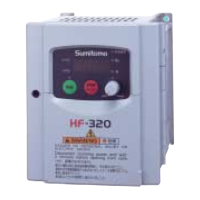
HF-320 Output torque characteristics when general-purpose motors are operated under sensorless vector control
Reduction in the motor cooling effect
during slow-speed operation
Common


 To Next Page