Need help?
Do you have a question about the sunjoe SWJ806E and is the answer not in the manual?
Basic safety precautions for operating yard tools, reducing risks.
Safe operating practices specific to using the saw as a pole tool.
Safe operating practices for using the saw as a handheld tool.
Steps for unpacking and installing or replacing the guide bar and chain.
Procedures for starting and stopping the electric pole + chain saw.
Guidance on maintaining balance and body positioning for safe cutting.
Techniques for trimming limbs from live trees.
Process of removing branches from a fallen tree.
Steps to take if the saw chain gets caught in the wood.
Ensuring proper motor cooling by cleaning air vents.
How to check and adjust chain tension for optimal performance.
Procedures for sharpening the saw chain for efficiency.
Inspecting and maintaining the guide bar for wear and damage.
Common problems and their solutions for the electric pole + chain saw.
Pre-work checks to ensure optimal performance and safety.
Proper cleaning and storage procedures for the unit.
Locating and recording model and serial numbers for service.
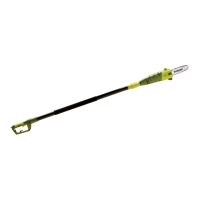
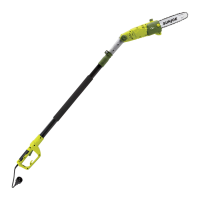
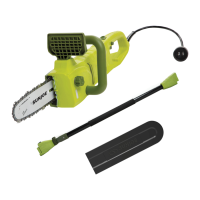
The 8-inch 8-amp electric pole + chain saw, Model SWJ806E, is a versatile outdoor power tool designed for trimming small branches and limbs. It can be used as a pole chain saw for reaching higher branches or as a hand-held chain saw for ground-level cutting. The tool is equipped with an automatic oil pump for bar and chain oiling, ensuring continuous lubrication during operation.
The primary function of this device is to cut wood, specifically for pruning and limbing tasks. As a pole chain saw, it allows users to extend their reach, providing up to 15.1 ft (4.6 m) of overhead reach, making it suitable for trimming high branches without the need for ladders or scaffolds. When converted to a hand-held chain saw, it can be used for cutting fallen branches or logs on the ground. The 8-inch cutting chain and guide bar are designed for efficient wood cutting, with a maximum recommended cutting thickness of 6.5 inches (16.5 cm) and a maximum cut of 7.5 inches (19 cm) depending on wood type.
The pole + chain saw is designed with user safety and convenience in mind. It features a telescoping pole that can be adjusted to the desired length, allowing for flexible use in various situations. The tool is activated by a trigger switch, which is protected by a safety lock button to prevent unintentional starting. Users are advised to maintain proper footing and balance at all times, especially when operating the pole chain saw, and to keep their body to the left of the chain line. Two-handed operation is recommended for both pole and hand-held modes to ensure a firm grip and better control.
When operating as a pole chain saw, the typical cutting angle is 60 degrees or less, depending on the specific situation. For pruning, long branches should be removed in several stages, starting with lower branches. An under-cut of 1/3 diameter should be made first, followed by an over-cut to drop the branch. For limbing, branches from a fallen tree should be cut one at a time, removing them from the work area to keep it clean and safe. Branches under tension should be cut from the bottom up to avoid binding the bar and chain.
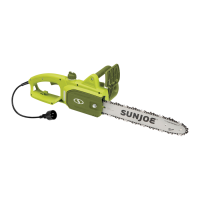
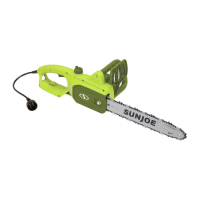
For hand-held chain saw operation, proper cutting stance involves balancing weight on both feet and keeping the left arm and elbow locked in a "straight arm" position to withstand kickback forces. Bucking a log involves cutting it into lengths, and the method varies depending on how the log is supported. For logs supported along their entire length, cutting from the top (overbuck) is recommended. If supported on one end, a 1/3 diameter underbuck should be made first, followed by an overbuck to meet the first cut. For logs supported on both ends, a 1/3 diameter overbuck is followed by an underbuck of the lower 2/3. The spiked bumper can be used as a pivot to make the bar penetrate the wood more easily.
Regular maintenance is crucial for ensuring the tool's safety and efficiency. Before each use, a daily checklist should be followed, which includes inspecting for visible damage to the chain, guide bar, or motor housing, checking the oil port and guide bar rails for debris, verifying chain tension and sharpness, and ensuring the bar and chain oil level is adequate. The chain tension should be checked when the chain is cold, ensuring it is snug but can be rotated by hand without binding. During normal operation, the chain temperature increases, and the drive links of a correctly tensioned warm chain will hang approximately 0.050 inches (1.25 mm) out of the bar groove. If the chain is too tight, it will not rotate and needs adjustment.
Chain sharpening is necessary when the sawdust looks like dust, cutting becomes difficult, the cut is not straight, or vibrations increase. While it is possible to sharpen the chain yourself using special round-section files, it is highly recommended to contact an authorized service center for proper sharpening to avoid damaging the cutting edges. The guide bar should be turned over periodically to distribute wear and extend its life. Any feathering or burring on the bar rails should be smoothed with a file. The lubrication holes and chain groove should be kept free from impurities. The chain sprocket should be checked regularly, and replaced if wear exceeds 0.5 mm.
After each use, the oil tank should be emptied to prevent seepage. For long-term storage (3 months or longer), the chain should be lightly lubricated to prevent rust. The tool should be stored indoors in a dry, high, or locked-up place, out of reach of children. It is important to keep the cooling air vents clean to prevent overheating and damage to the motor. When cleaning the tool, only mild soap and a damp cloth should be used, and no liquid should enter the motor housing. The guide bar cover should always be in place when storing the saw. Avoid storing the tool near chemicals or harsh solvents, as these can damage plastic parts.
 General
| Type | Electric Chainsaw |
|---|---|
| Bar Length | 14 inches |
| Chain Speed | 28.8 ft/s |
| Weight | 7.7 lbs |
| Automatic Oiler | Yes |
| Power Source | Corded Electric |
| Voltage | 120V |
| Tool-Free Chain Tensioning | Yes |

 To Next Page