b
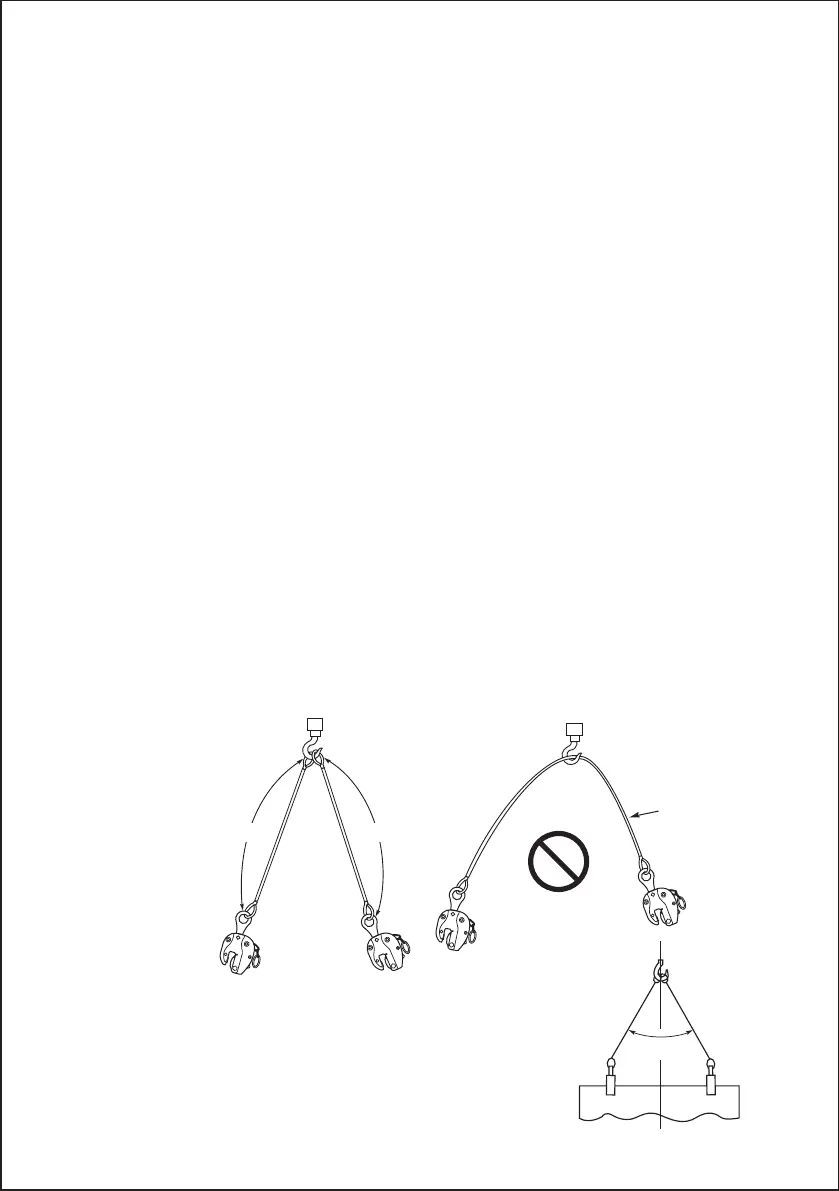
a
a=b
Within60°
One
wire rope
Fig.A
Fig.B
General warning for use (comon to all lifting clamp models)
■
Be sure to select proper model clamps for use.
Pay special attentions to keep the lifting direction (rope angle).
Confirm the weight of the load. Do not exceed maximum capacity
(designated ton) on clamps. (Never overload.)
Before use, confirm followings:
(a) Proper capacity of clamps.
(b) No abnormal movements of clamp or loosening of any bolts.
(c) No oil or other foreign matters on the surface of the cam and pad.
Never use for load beyond the clamp range.
When installing clamps, insert a lifting load completely until it comes in
contact with the deepest of the jaw opening of main body.
Depending on the model or capacity of the clamp, the cam teeth
may not bite a load sufficiently when the load is a hard or light
weight material (Less than 1/5 of maximum capacity or less than
1/4 of maximum clamp range). Confirm the condition of clamp for
safety.
Confirm that the safety lock is completely engaged in case clamp has a
built-in lock.
Confirm that the load is well balanced. Determine the clamp position or
the center of gravity of the rope properly. It is especially important to
determine the horizontal center of gravity.
When lifting at 2 points, be sure to use two wire ropes, and make them
equal length. (Fig. A)
1.
2.
3.
4.
5.
6.
7.
8.
9.
When lifting at 2 points, keep the lifting angle
within 60°. (Fig. B)
(Follow the standards if lifting angle is specified
depending on items.) If the load is long, use a
balance.
10.
Prohibited
6


 To Next Page