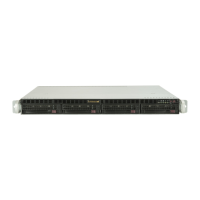
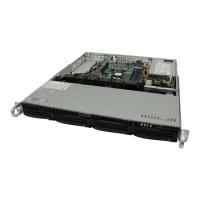
The SuperServer 5019C-M/MR is a 1U rackmount server designed for professional system integrators and PC technicians. It is built around the X11SCM-F motherboard and uses either the SC813MFTQC-350B or SC813MFTQC-R407CB chassis, depending on the model.
Function Description:
The SuperServer 5019C-M/MR is a high-performance server capable of handling demanding workloads. It supports Intel Xeon E-2100, 8th Generation Core i3, Pentium, and Celeron processors in an LGA 1151 (H4) socket. The system is designed for reliability and ease of maintenance, featuring hot-swap drive bays and redundant power supply options in the MR model. It also incorporates advanced management capabilities through IPMI 2.0 and SuperDoctor 5, allowing for remote monitoring and control of system health, including CPU temperature, voltages, power consumption, and fan speed.
Important Technical Specifications:
- Processors: Intel Xeon E-2100, 8th Generation Core i3, Pentium, and Celeron (Socket H4 - LGA 1151) series.
- Chipset: Intel C246.
- Memory: Up to 128GB of unbuffered (UDIMM) DDR4 (288-pin) ECC memory with speeds up to 2666MHz across four memory slots.
- Expansion Slots:
- One (1) PCI-Express 3.0 x16 Slot (default with 1U riser card).
- Two (2) M.2 slots for PCI-Express 3.0 x4 (one also supports SATA 3.0 x1), supporting M-Key 2280 / 22110 form factors.
- Hard Drives: Four (4) 3.5” hot-swap disk bays (2.5” drives supported with optional bracket).
- Power Supply:
- 5019C-M: 350W Single High-efficiency (Platinum level) power supply. AC Input: 100-240 VAC, 5A-2.5A, 50-60 Hz. Output: +12V (29A), +5V (15A), +3.3V (12A), +5Vsb (3A).
- 5019C-MR: 400W 1+1 High-efficiency (Platinum level) redundant power supply. AC Input: 100-240 VAC, 6.0-3.0A, 50-60 Hz. Output: +12V (33A), +5Vsb (3A).
- Form Factor: 1U rackmount.
- Dimensions: 17.2 x 1.7 x 19.8 inches / 437 x 43 x 503 mm (W x H x D).
- System Cooling: Four (4) 4-cm PWM fans.
- Motherboard: uATX form factor, 9.6 x 9.6 inches / 243.8 x 243.8 mm (W x H).
- BIOS: 256Mb AMI® BIOS SPI Flash BIOS.
- SATA Controller: On-chip Intel C246 controller, supporting RAID 0, 1, 5, and 10 across six SATA 3.0 ports (I-SATA0~I-SATA5).
- Operating Environment:
- Temperature: 10° to 35° C (50° to 95° F) operating, -40° to 70° C (-40° to 158° F) non-operating.
- Relative Humidity: 8% to 90% (non-condensing) operating, 5% to 95% (non-condensing) non-operating.
- Regulatory Compliance: FCC Class A, EN 55032 Class A, CISPR 32 Class A, CSA/EN/IEC/UL 60950-1 Compliant.
Usage Features:
- Control Panel: Features an Information LED (indicating overheat, fan failure, power failure, or UID status), NIC1/NIC2 LEDs, HDD LED, Power LED, Reset Button, and Power Button. The Information LED provides visual cues for system status, including overheating (continuously red), fan failure (blinking red at 1 Hz), power supply failure (blinking red at 0.25 Hz), and local/remote UID activation (solid/blinking blue).
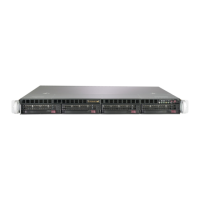
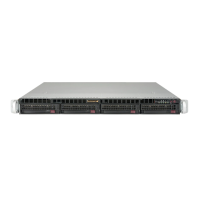
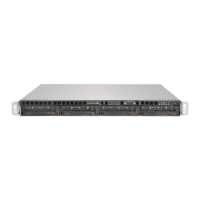
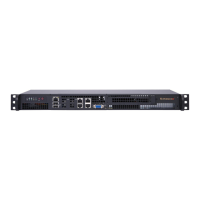
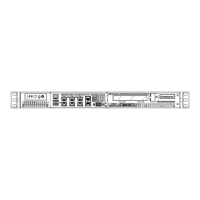
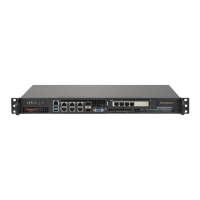
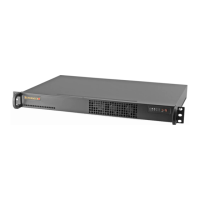
- Front Features: Includes four 3.5” hot-swap SATA hard disk drive bays, an optional DVD drive bay, and optional front USB 3.0 and COM ports. Rack ear brackets are provided for mounting.
- Rear Features: Offers a power supply (single for 5019C-M, redundant for 5019C-MR), I/O backpanel with VGA, dedicated IPMI LAN, USB 2.0/3.1 Gen 1 ports, LAN1/LAN2, and a UID switch/LED. An expansion card slot is available with a pre-installed riser card.
- BIOS Configuration: The AMIBIOS™ Setup utility allows for detailed configuration of system settings, including CPU, Chipset, USB, PCIe/PCI/PnP, Trusted Computing (TPM 1.2/2.0), iSCSI, and Network Stack. It also provides options for Boot features like Fast Boot, Quiet Boot, and Bootup NumLock State.
- OS Installation: Supports installation of Windows OS for both RAID and non-RAID systems, with specific instructions for driver integration.
- Driver Installation: Drivers and utilities are available on the Supermicro website or via a provided ISO file.
- SuperDoctor® 5: A command-line or web-based interface for Windows and Linux, offering comprehensive system health monitoring (CPU temperature, voltages, power consumption, fan speed) and alerts via email or SNMP. It supports local and remote management, including power on/off and chassis intrusion reset, and can be integrated with Nagios.
- IPMI: Intelligent Platform Management Interface support for remote access, monitoring, and management, with related BIOS settings.
Maintenance Features:
- Easy Access: Features a removable top cover for easy access to internal components.
- Component Installation/Removal: Detailed procedures are provided for installing and removing processors, heatsinks, DIMM modules, hard drives, and system fans.
- Hot-Swap Drive Bays: Hard drives can be installed and removed without powering down the system. Drive carriers include LED indicators for activity (blinking green), rebuilding (blinking red), and failure (solid red).
- Fan Replacement: System fans are controlled by IPMI based on temperature. Failed fans can be replaced while the system is powered on, with remaining fans ramping up to full speed. Arrows on fans indicate airflow direction for correct installation.
- Air Shroud: A removable air shroud concentrates airflow for maximum fan efficiency and proper cooling.
- Power Supply Replacement:
- 5019C-M: Single power supply requires system shutdown for replacement.
- 5019C-MR: Redundant power supplies are hot-swappable, allowing replacement of a failed unit without powering down the system.
- CMOS Clear: JBT1 contact pads allow clearing of CMOS settings and passwords by removing the onboard battery and shorting the pads.
- BIOS Error Codes: Provides audible beep codes during POST to indicate non-fatal and fatal errors, aiding in troubleshooting. IPMI error codes are also available.
- Rack Mounting: Instructions for installing the server into standard and Telco racks, emphasizing stability precautions and proper loading of components.
- Safety Warnings: Comprehensive standardized warning statements in multiple languages regarding electrical hazards, battery handling, power disconnection, backplane voltage, moving parts (fans), and compliance with local/national electrical codes. The manual stresses that installation and maintenance should only be performed by trained and qualified personnel in restricted access areas.

 Need help?
 General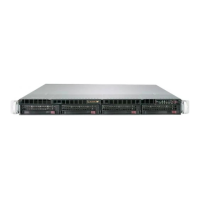



 To Next Page