Need help?
Do you have a question about the Suunto Tank POD and is the answer not in the manual?
Check Suunto Tank POD functionality before each dive. Covers visual checks, flow restrictor, gauges, connections, gas settings, installation, and pairing.
Steps to install Suunto Tank POD directly to a first-stage regulator high pressure port using Type A flow restrictor.
Steps to install Suunto Tank POD to a high pressure hose extension using Type B flow restrictor.
Instructions for pairing Suunto Tank POD with Suunto EON Core, EON Steel, EON Steel Black, and D5 dive computers.
Steps to unpair Suunto Tank POD from a specific gas using proximity or through the dive computer menu.
Guidance on how to hold the dive computer and Tank POD for optimal pairing results.
Using Suunto Tank POD with compressed air, including compliance with EU standard EN 12021:2014.
Using Suunto Tank POD with nitrox, including oxygen servicing and safety warnings.
Instructions for handling, packing, and cleaning the Suunto Tank POD to ensure its longevity and water resistance.
Details on maintenance intervals, battery replacement, and recommended service for the Suunto Tank POD.
Information on how to obtain additional support, including website resources and contact details.
Guidelines for proper disposal of the device and batteries in accordance with electronic waste regulations.
Detailed specifications including dimensions, weight, operating conditions, pressure measurements, battery type, and radio transceiver.
Information regarding product compliance with relevant standards and regulations.
Details on Suunto trademarks and brand names associated with the Suunto Tank POD.
Listing of patents and patent applications protecting the Suunto Tank POD product.
Information on the international limited warranty period, coverage, exclusions, and limitations for the Suunto Tank POD.
Copyright notice for the Suunto Tank POD documentation and its contents.
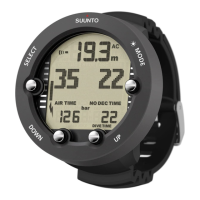
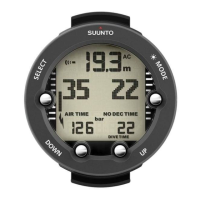
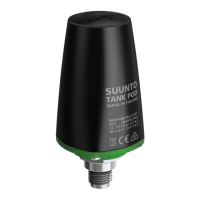
The Suunto Tank POD is an optional diving equipment designed to measure the current breathing gas level and wirelessly transmit this information to a compatible Suunto dive computer, where the reading is then displayed. It is intended for use in various types of scuba diving, including air, nitrox, and trimix. The device is installed on the dive regulator first-stage high-pressure port.
As part of the scuba diving breathing apparatus, the Suunto Tank POD helps divers monitor their breathing gas levels, enabling informed decisions about when to end a dive and ascend with sufficient gas remaining. When used with a compatible Suunto dive computer, it is classified as Personal Protective Equipment under EU Regulation 2016/425, protecting against risks associated with hazardous substances and mixtures. It is crucial to always use backup instruments such as a depth gauge, submersible pressure gauge, timer, or watch.
The Suunto Tank POD features a 7/16" - 20UNF thread connection for scuba gear and is compatible with Suunto EON Core, EON Steel, EON Steel Black, and D5 dive computers for wireless tank pressure transmission. Multiple Suunto Tank POD devices can be paired with a single dive computer for multi-gas diving. It is essential to only use accessories and equipment authorized or officially supported by Suunto.
Before diving, it is imperative to fully understand how to use the dive instruments and their limitations. Divers must familiarize themselves with the instruments and carefully read all instructions to comprehend the information provided during a dive. Any questions should be directed to a Suunto dealer before diving. Divers are solely responsible for their own safety. Prior to any dive trip, a thorough inspection of the dive computer is necessary to ensure proper functioning. At the dive site, manual pre-dive safety checks must be performed on each device before entering the water.
A critical safety precaution is the mandatory use of the Suunto Flow Restrictor with the Suunto Tank POD. Failure to do so could result in injury if the pressurized scuba gear malfunctions. Only trained divers should use a dive computer, as insufficient training can lead to errors, serious injury, or death. Backup instrumentation, including a depth gauge, submersible pressure gauge, timer or watch, and access to decompression tables, is always required. Diving alone is strongly discouraged; divers should always dive with a designated buddy and remain with others for an extended period after a dive, as the onset of possible decompression sickness (DCS) can be delayed.
Pre-dive safety checks for the Suunto Tank POD include visually inspecting it for damage, ensuring the flow restrictor is properly installed, verifying that all primary and backup gauges show correct and consistent readings, confirming device connections and gas selections on the dive computer, checking tank gas and O2 settings, ensuring proper installation and an open tank valve, and confirming that the Suunto Tank POD and dive computer are paired. The Tank POD should be sending data (indicated by a blinking wireless transmission icon and displayed tank pressure), and there should be no low battery warning. Divers must also ensure they have enough gas for the planned dive, cross-referencing the pressure reading with a backup gauge. If there is any doubt about the device's safety, contact Suunto Customer Support for inspection.
Installation of the Suunto Tank POD is recommended to be performed by a Suunto authorized dealer or trained dive expert. Two types of flow restrictors are provided: Type A for direct installation to a first-stage regulator high-pressure port, and Type B for connection to a high-pressure hose extension. The restrictor should only be removed for cleaning or changing scuba gear and must be re-installed before subsequent use. Improper tool use or overtightening can damage scuba equipment; the recommended maximum torque is 8 Nm. When pressurizing scuba gear, ensure no one is in close proximity. The battery level indication during pairing is an approximation and may deplete faster than suggested. For nitrox use, the high-pressure hose must meet EN 250 and EN 13949 standards.
Pairing the Suunto Tank POD involves installing it, opening the valve, and waiting for the green LED to flash. If the dive computer screen is blank, press any button to activate it. Proximity pairing is used by holding the dive computer close to the Tank POD, following specific alignment instructions. A menu will appear on the screen displaying the Tank POD serial number, battery status, and tank pressure. The correct gas is selected from the list, and pairing is confirmed. This process is repeated for additional Tank POD devices, assigning different gases to each. Alternatively, pairing can be initiated from the "Gases" menu on the dive computer. Unpairing can be done via proximity or through the dive computer's menu, selecting the specific Tank POD to remove. Removing pressure from the Tank POD when not diving helps conserve battery life.
The Suunto Tank POD is suitable for use with compressed air that complies with EN 12021:2014 quality standards. If a Tank POD has been used with compressed air, it must be cleaned for oxygen service by a competent person before being used with nitrox or oxygen. For nitrox use, the device needs to be oxygen serviced. Devices manufactured from May 2021 are sealed in plastic bags and marked "Cleaned for oxygen service," indicating they are oxygen compatible. If not sealed, it should be treated as not oxygen cleaned. Suunto recommends professional cleaning for nitrox use. Divers must have proper training for nitrox gas mixtures with oxygen content greater than 22%, as maximum operating depth and exposure time depend on oxygen content. For nitrox diving, the device should be used exclusively with nitrogen and oxygen, kept clean for oxygen use, and never with air. Exposure to oil-contaminated breathing gas requires re-cleaning by a competent person. Opening pressure valves slowly minimizes the risk of oxygen ignition.
Handling the Suunto Tank POD requires care to prevent damage to its sensitive internal electronic components. When traveling, it should be securely packed to avoid movement or impact. Users should not attempt to open or repair the device themselves; problems should be addressed by an authorized Suunto Service Center. A non-functioning device should be uninstalled and brought to a Suunto dive dealer for inspection. After diving, especially in salt water or pools, the device should be thoroughly rinsed with fresh water and mild soap, and its housing cleaned with a moist soft cloth or chamois. It is crucial to ensure the device's water resistance, as moisture ingress can cause serious damage. Only original Suunto accessories should be used to avoid voiding the warranty. When dismantling the Tank POD, the main tank valve must be closed, pressure lowered from the system, and then the device dismantled. Suunto Service Centers do not perform oxygen cleaning service. Registering the Suunto Tank POD online provides personalized support.
Maintenance is recommended after 200 dives or two years, whichever comes first, and should be performed by an official Suunto Service. Support resources, including user guides, FAQs, how-to videos, and service options, are available online.
 General
| Wireless Transmission | Yes |
|---|---|
| Diameter | 40 mm / 1.57 in |
| Height | 80 mm / 3.15 in |
| Radio Frequency | 2.4 GHz |
| Transmission Range | Up to 1.8 m (6 ft) |
| Gas Compatibility | Air, Nitrox |
| Depth Rating | 150 m (492 ft) |
| Compatibility | Suunto EON Steel, Suunto EON Core, Suunto D5 |
| Pressure Range | 0-300 bar / 0-4350 psi |
| Pressure Resolution | 1 bar (14.5 psi) |
| Thread Type | G5/8" |
| Battery Life | Approx. 2 years |

 To Next Page