Need help?
Do you have a question about the Sym Fiddle II 50 and is the answer not in the manual?
Overview of the instrument panel, including speedometer, odometer, and indicators.
Operation of ignition, steering lock, seat open switches, and handlebar buttons.
How to use light switches, starter, horn, signals, and beam/passing switches.
Details on engine start, horn, signals, and storage box features.
Information on helmet hooks, fuel tank cap, and safe brake operation.
Important points and cautions for starting the engine correctly.
Best practices for driving off and safely parking the scooter.
Key precautions for riding the scooter, especially in adverse conditions.
Items to check before riding, and procedures for engine oil inspection and change.
Inspecting fuel, transmission oil, and brake systems, including free play and disc brakes.
Maintenance of battery, throttle, tires, and inspection of shock absorbers.
Checking fuses, turn signals, horn, front/rear lights, and brake light.
Troubleshooting steps when the engine fails to start.
Details on CDI system, fuel suggestions, and transmission oil recommendations.
Schedule for regular inspections, cleaning, and replacement of parts.
Technical specifications for the scooter model, including dimensions, performance, and parts.
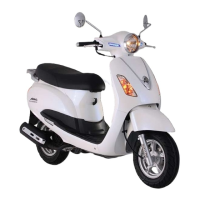
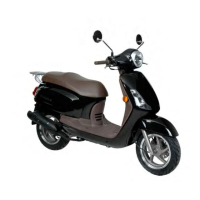
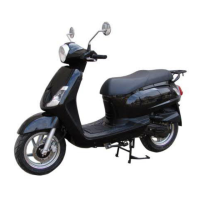
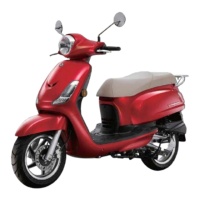
The SYM Fiddle II 50 is a scooter designed for urban and suburban travel, emphasizing a blend of modern and timeless design with technological advancements for durability, safety, and fun. Its aesthetic features include chrome rear-view mirrors, chrome accents, distinctive front optics, and a vintage tail light, contributing to its "Retro Spirit" appeal.
The scooter is equipped with a 4-stroke, air-cooled 50 c.c. engine, providing basic operation suitable for daily commuting. Key controls include an ignition switch with "ON" and "OFF" positions, where "ON" allows engine start and "OFF" shuts it down and enables key removal. A steering handle lock switch secures the scooter by turning the handle to the left, inserting the key, pressing it clockwise, and then turning it left to the "LOCK" position. Unlocking involves turning the key from "LOCK" to "OFF." A seat open switch, activated by inserting the ignition key and turning it counter-clockwise, provides access to the storage box located under the saddle.
The handlebar features several essential switches: a high/low beam switch for the headlight, a turn signal switch for indicating left or right turns, a horn switch, and an electrical starter button. The electrical starter button, when pressed while holding either the front or rear brake lever, initiates engine start. A passing switch allows the high beam to flash, warning other drivers during overtaking.
Gauges on the instrument panel include a speedometer to indicate driving speed, an odometer to track total accumulated distance, a high beam indicator, left and right turn signal indicators, and a fuel meter. The fuel meter shows the remaining fuel, with the pointer resting at "E" when the key switch is "OFF."
Braking is managed by both front and rear wheel brakes. The scooter is designed for simultaneous application of both brakes for effective stopping. An engine brake function is also available by returning the throttle valve handle to its original position.
Starting the engine requires turning the ignition switch to "ON," applying the hand (foot) rear wheel brake, and then pressing the starter button without accelerating. If the engine doesn't start after a few attempts, rotating the throttle valve handle 1/8 to 1/4 turns may assist. For cold starts or after prolonged idleness, multiple presses of the starting lever or starter button may be necessary. The scooter should always be started in a well-ventilated area due to exhaust gases. When using the kick starter, the main parking stand must firmly support the motorcycle.
Driving involves turning on the turn signal before moving and ensuring no vehicles are approaching from behind. Acceleration is achieved by slowly turning the throttle valve handle, while deceleration involves returning it to its original position. When parking, the rider should signal early, slow down, apply brakes, and then turn the ignition switch to "OFF." The scooter should be parked on level ground, supported by the main parking stand, and the steering handle locked to prevent theft.
The storage box under the saddle has a maximum load capacity of 10kg and should not be used for valuables or heat-sensitive objects due to engine heat. A safety helmet hook is provided for convenience when the scooter is stopped.
Refueling requires opening the seat, turning the fuel cap anticlockwise, and filling the tank without exceeding the upper limit. The main stand should be down, the engine off, and flames prohibited during refueling. The fuel cap must be securely tightened after refueling.
Riding safety is emphasized, with recommendations to wear a safety helmet, wear tight-sleeved clothing, hold the steering handle with both hands, observe speed limits, and wear low-heel shoes. Passengers should place their feet on the pedals to avoid burns from the hot exhaust pipe. Overloading the scooter is cautioned against as it can affect handling and safety.
The manual outlines a comprehensive periodical maintenance schedule, with inspections and replacements recommended at specific mileage or time intervals (e.g., 300km, 1000km, 3000km, 6000km, 12000km, or monthly/quarterly/yearly). Routine inspections before riding include checking engine oil, fuel level, brake condition (free play 10-20mm for hand brake, 20-30mm for foot brake), tire pressure (standard 1.75kg/cm² for front, 2.0 kg/cm² for 1 person / 2.25kg/cm² for 2 persons for rear), steering handle vibration, speedometer and lights operation, and tightness of main components. Any abnormalities found should be addressed by an authorized SYM dealer.
Engine oil inspection involves checking the oil level with the dipstick after the engine has stopped for 3-5 minutes, ensuring it is between the upper and lower marks. Oil changes are recommended after the first 300km and every 1000km thereafter, using API SH/CD SAE 10W-30 grade or better engine oil. The oil filter should also be cleaned periodically.
Fuel inspection involves checking the fuel gauge and ensuring the use of unleaded gasoline of Octane 90 or higher. Transmission oil inspection and change are also part of the maintenance, with replacement recommended every 5000km or 5 months, using Genuine SYM HYPOID GEAR OIL (SAE 85W-140).
Brake system maintenance includes checking brake free play and inspecting disc brakes (if applicable) for leakage, damage, or loose connections. Brake pads should be replaced when the wear limit is reached. The brake fluid level in the reservoir should be checked and refilled with WELL RUN BRAKE OIL (DOT 3) if below the "LOWER" mark.
Throttle valve handle clearance adjustment ensures a 2-6mm rotation, and the cable should move smoothly without interference. Battery inspection involves checking terminals for dirt or corrosion and cleaning them if necessary. The scooter uses a maintenance-free battery, so electrolyte checks are not required. If the battery needs replacement, it should be with a same closed-type battery.
Tire inspection involves checking for abnormal ground contacting curves, proper inflation with an air pressure gauge when cold, and visual checks for cracks, damage, nails, or insufficient tread groove depth. Worn tires should be replaced immediately. Steering handle front shock absorbers should be checked for damage, noises, and tightness of bolts and nuts. The steering handle should also be checked for looseness, excessive resistance, or pulling to one side.
Electrical system checks include inspecting and changing fuses (10A & 15A), checking the operation of turn signal lights and horn, and verifying the functionality of front, rear, and brake lights. Only specified specification bulbs should be used to avoid damaging the electrical system.
 General
| Displacement | 49.5 cc |
|---|---|
| Fuel System | Carburetor |
| Seat Height | 780 mm |
| Brakes (Front) | Disc |
| Brakes (Rear) | Drum |
| Ignition | CDI |
| Front Suspension | Telescopic Fork |
| Engine Type | 4-Stroke |
| Transmission | CVT |
| Cooling System | Air Cooled |
| Top Speed | 45 km/h |

 To Next Page