11
SymNet Express Cobra Family
ARC Audio
ARC Audio provides a means to take a single balanced
analog audio line and either inject it into or pick it off an
RS-485network’sCAT5cablerun.AnARCAudioportona
Symetrix device may be wired to a nearby device’s analog
input or output. This provides a means of easily running a
single audio channel to or from a remote source or destination.
TheARC-MICandARC-XLRmakeuseofARCAudioto
transport audio signals back to a SymNet rack mount unit.
Note 1:TheoriginalMenuARCremote(simplynamed
“ARC”) does not support ARC Audio lines and will ground
the audio lines if connected.
Note 2: To avoid the possible grounding, mixing, or shorting
of the ARC Audio lines, it is recommended to home run any
ARC devices making use of the ARC Audio lines so that only
one ARC device is on each chain.
Limits of ARC Audio
ARC Audio is a simple analog audio signal travelling the
samecableastheRS-485dataandpower.Assuch,the
usual audio signal cautions apply. Avoid running parallel to
otherpowerlinesornearanyothersourcesofEMIorRFI.
MostCAT5isunshieldedandissusceptibletointerference
and noise. We provide here the following information on ARC
Audio’s performance and limitations:
Line-level Balanced Audio:
Professional line level balanced signals can also be sent over
up to approximately 1500 feet of CAT5 without significant
degradation.
All unbalanced signals should be avoided completely.
Mic-level Audio:
Unbuffered condenser or dynamic microphones should
generally be avoided, though it may be possible to achieve
decent quality with cable runs of less than 50 feet using a
fairly hot microphone level with a noise gate or expander
in to clean up the signal. This technique does not provide
much flexibility within the system design, and therefore is not
recommended.
Frequency response:
Frequency response can roll-off due to the capacitance of
a long cable run. The amount of roll-off is highly dependent
on source impedance (the output impedance of what is
supplyingthesignal).Mostproaudiodeviceshavelow
output impedances (200 Ohms or less) and do not suffer
signicantroll-off(approximately-1dBat20kHzwith1500
feet of CAT5). A device with a 600 Ohm output impedance
couldcausesomeaudibleroll-off(-3dBat10kHz),but
should be of sufficient quality for speech signals.
Data Noise:
With an unbuffered mic and long cables, data noise may
be audible as a “motorboat” sound. Experimenting with
RS-485terminationandbaudratemayimprovethesound
somewhat.
RS-485 Termination
BoththeARCandtheExpressfeatureanRS-485
terminationjumper.JumperJ28insidetheExpressbythe
RS-485jackenablesanddisablestermination.Jumping
the pins = terminated, open = unterminated. For maximum
signal integrity, follow the termination guidelines below:
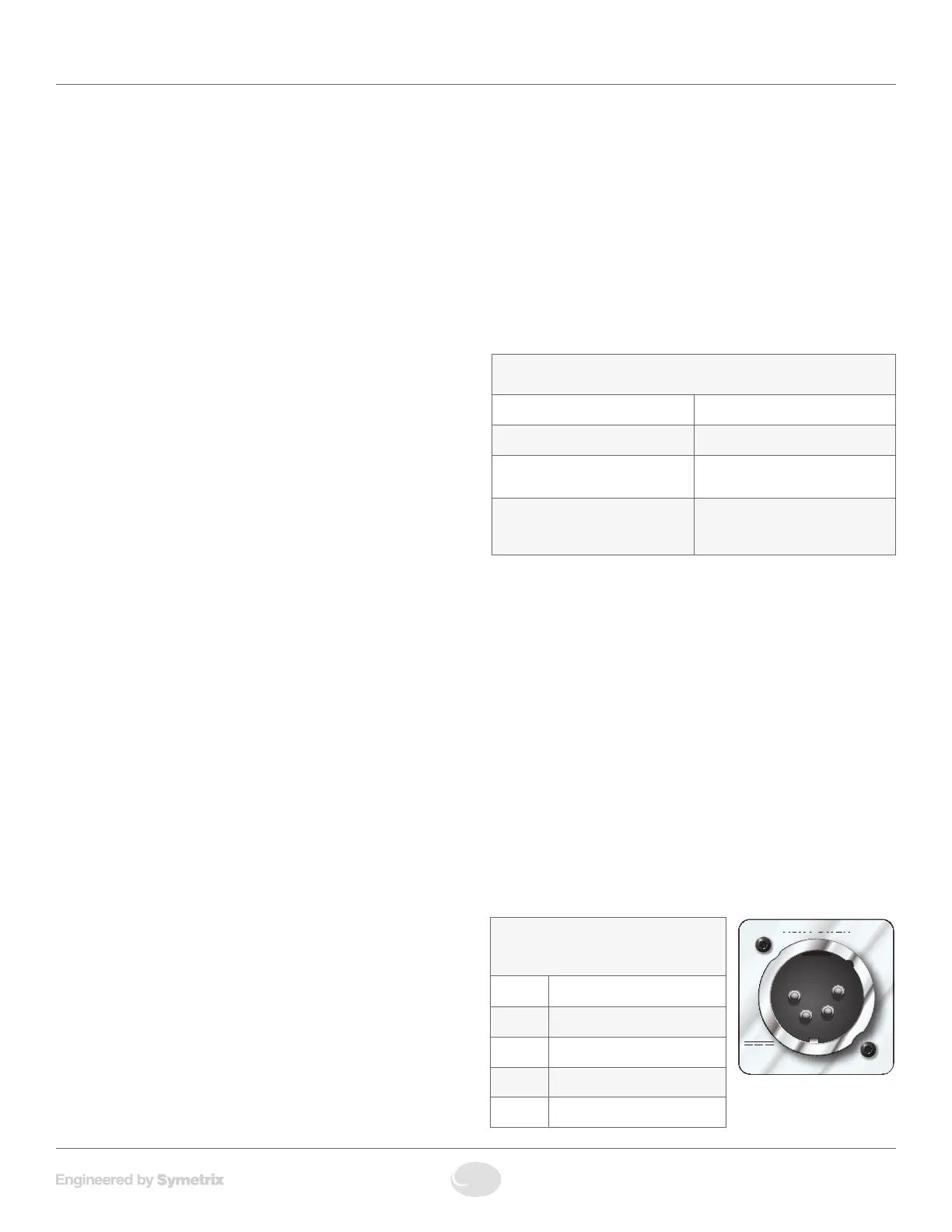
Aux Power
The4-pinXLRAuxPowerconnectorprovidesameans
of easily adding an optional redundant power supply, the
SymetrixmodelnumberPS-7,toExpress.Thisprovides
Express a cost-effective and easy upgrade path to a certain
level of fault tolerance. Should main power be lost or the
main power supply fail for any reason, the Express will
automatically switch over to the Aux Power input, glitch-
free, if present. When operating on the Aux Power input, the
POWER LED on the front of the Express will flash. When
main power is restored, the Express will automatically switch
back over to the main supply and the POWER LED will once
again light solid.
The Aux Power input can also be wired into a user-supplied
24VDC,2.5Amp,60Wattbackuppowersource.TheXLR-
4 pinout follows:
RS-485Termination•AuxPower
AUX POWER
+24VDC
2.5A
1
2
3
4
AUX POWER
XLR-4 PINOUT
Pin # Function
1 Ground
2 Unused
3 Unused
4 Power(+V)
RS-485 TERMINATION GUIDELINES
Daisy-chain length Termination
0 - 200 ft. No termination required
200 - 1000 ft.
(if powering over CAT5)
Terminate at the ARC
> 1000 ft.
(or if not powering over CAT5)
Terminate at the ARC-PS, Control
I/O or DSP device and at the furthest
ARC device


 To Next Page
 Loading...