
 Need help?
Do you have a question about the Synology DiskStation DS1815+ and is the answer not in the manual?
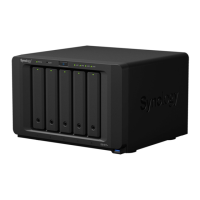
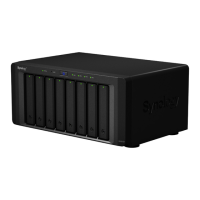
The Synology DiskStation DS1815+ is a network-attached storage (NAS) device designed for data storage, management, and sharing. It functions as a centralized hub for digital content, offering robust features for both personal and professional use. The device is equipped with multiple drive bays, allowing for significant storage capacity and flexible RAID configurations to ensure data redundancy and performance.
The primary function of the DS1815+ is to provide a reliable and scalable storage solution. It supports various drive types, including 3.5" and 2.5" SATA hard drives and solid-state drives, enabling users to customize storage based on their needs. The device operates on Synology's DiskStation Manager (DSM) operating system, a browser-based interface that simplifies setup, management, and access to a wide range of applications.
Upon initial setup, the DS1815+ connects to a network via LAN cables, allowing it to be accessed by multiple client devices such as Windows, Mac, and Ubuntu systems. The Web Assistant tool facilitates the installation of DSM, guiding users through the process of downloading the latest version from the internet and configuring the DiskStation. Once DSM is installed, users can log in as an administrator to manage volumes, users, and applications.
The DS1815+ is designed to handle various data management tasks. It supports different RAID types, including Basic, JBOD, RAID 0, RAID 1, RAID 5, RAID 6, RAID 10, and Synology Hybrid RAID, offering flexibility in balancing storage capacity, performance, and data protection. This allows users to choose a configuration that best suits their requirements for data redundancy and fault tolerance. For instance, RAID 5 or 6 provides protection against multiple drive failures, while RAID 0 prioritizes performance.
Beyond basic storage, the DiskStation offers advanced functionalities through DSM. It can act as a file server, allowing users to store, retrieve, and share files across different platforms. It also supports external device connections via USB 3.0 and eSATA ports, enabling expansion of storage or connection of other peripherals like printers. The device can be configured for scheduled power on/off and supports Wake on LAN, enhancing energy efficiency and remote accessibility.
The system includes various indicators to provide real-time status updates. The Status Indicator shows the overall system health, including volume status (normal, degraded, crashed, or not created) and DSM installation status. The Alert Indicator warns of fan malfunctions or temperature issues. LAN Indicators display network connection status and activity, while Drive Status Indicators show the status of individual drives, indicating if they are ready, idle, accessing data, or experiencing errors.
The DS1815+ is designed for user-friendly operation, starting with its straightforward hardware setup. Drives are installed into hot-swappable trays, which can be easily removed and reinserted. For 3.5" drives, fastening panels secure the drive in place without screws, while 2.5" drives require screws for secure installation. The drive trays are lockable with a provided key, preventing accidental removal.
Once drives are installed and the device is powered on, the Web Assistant guides users through the DSM installation. The process involves connecting the DiskStation to the network and accessing a specific web address (find.synology.com or diskstation:5000) from a web browser. The Web Assistant detects the DiskStation and initiates the setup, which includes downloading and installing DSM. This ensures that the device runs the latest software version.
The power button on the front panel allows for easy power-on and power-off. A short press powers on the device, while pressing and holding it until a beep sound is heard initiates a graceful shutdown. The RESET button on the back panel offers two functions: a short press and hold restores the default IP address, DNS server, and admin password, while a longer press and hold (until three beeps are heard) returns the DiskStation to a "Not Installed" status, allowing DSM to be reinstalled.
The device's expandability is a key usage feature. Users can add RAM modules to increase memory capacity, which can improve overall system performance, especially when running multiple applications or virtual machines. The process involves shutting down the DiskStation, removing the top case, and carefully inserting the RAM module into an available slot. After installation, DSM's "Info Center" can be checked to confirm the new memory capacity.
Maintenance of the DS1815+ is designed to be accessible, allowing users to perform common tasks such as replacing drives, RAM modules, and system fans.
Drive replacement is facilitated by the hot-swappable drive trays. If a drive fails (indicated by the Drive Status Indicator), the faulty drive can be removed from its tray, and a new one can be installed. This process typically does not require shutting down the entire system, especially in RAID configurations that support hot-swapping and automatic rebuilds.
Replacing a RAM module involves a more involved process but is still user-serviceable. The DiskStation must be shut down and all cables disconnected to prevent damage. The top case is secured by screws and can be lifted off to access the internal components. When handling internal components, users are advised to avoid touching sensitive parts other than the memory assembly. The RAM module is inserted into a slot, aligning the notch on the gold edge with the slot's notch, and then pushed down until it clicks into place.
System fan replacement is another maintenance task that can be performed by the user. If a fan malfunctions, the DiskStation will emit a beeping sound, and the Alert Indicator may show a warning. To replace a fan, the device must be shut down and cables disconnected. The fan panel, secured by screws, can be removed, and the fan cables disconnected from their sockets. The malfunctioning fan is then replaced with a new one, ensuring the fan cable is correctly oriented, and the screws are tightened. Finally, the fan panel is reattached, and the cables reconnected.
The DSM operating system itself provides tools for system health monitoring and maintenance. Users can check logs, monitor drive health, and receive notifications about potential issues. Regular updates to DSM, downloaded via Web Assistant, ensure that the system benefits from the latest security patches, bug fixes, and feature enhancements. Synology also provides online resources and support through its website for further assistance with maintenance and troubleshooting.
 General
| Model | DS1815+ |
|---|---|
| Category | Network Attached Storage (NAS) |
| CPU | Intel Atom C2538 |
| CPU Architecture | 64-bit |
| Drive Bays | 8 |
| Hot Swappable Drive | Yes |
| External Ports | USB 3.0 x 4, eSATA x 2 |
| Link Aggregation | Yes |
| Wake on LAN/WAN | Yes |
| AC Input Power Voltage | 100V to 240V AC |
| Operating Temperature | 5°C to 35°C (40°F to 95°F) |
| Operating Humidity | 5% to 95% RH |
| Hardware Encryption Engine | Yes |
| Maximum Internal Raw Capacity | 48TB (8 x 6TB) |
| Compatible Drive Type | 3.5" SATA HDD, 2.5" SATA HDD, 2.5" SATA SSD |
| Network Interfaces | Gigabit x4 |
| LAN | 10/100/1000 Mbps |
| RAID Support | Synology Hybrid RAID, Basic, JBOD, RAID 0, RAID 1, RAID 5, RAID 6, RAID 10 |
| File System | EXT4 |


 To Next Page