
 Need help?
Do you have a question about the Synology DiskStation DS216+II and is the answer not in the manual?
Lists items included in the product package, along with illustrations.
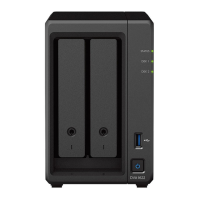
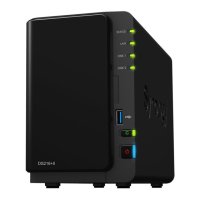
Provides an overview of the DiskStation's front and back panels and their components.
Outlines important safety precautions for using the DiskStation to prevent harm or damage.
Lists the necessary tools and compatible drive types for installing hard drives.
Step-by-step instructions for installing hard drives into the DiskStation bays.
Instructions for connecting power and network cables and powering on the device.
Guide to installing DiskStation Manager using the Web Assistant tool via a web browser.
Information on where to find additional resources and online support for your DiskStation.
The Synology DiskStation DS216+II is a network-attached storage (NAS) device designed for data storage, management, and sharing. It serves as a centralized hub for digital content, allowing users to access their files from various devices across a network. The device is built to be user-friendly, offering a straightforward setup process and intuitive management through its DiskStation Manager (DSM) operating system.
At its core, the DS216+II functions as a robust file server, enabling users to store a wide array of data, including documents, photos, videos, and music. It supports multiple hard drives, allowing for significant storage capacity and the implementation of RAID configurations for data redundancy and performance optimization. This means that even if one drive fails, the data can often be recovered from the remaining drives, providing a crucial layer of protection against data loss.
Beyond simple file storage, the DiskStation DS216+II offers a rich set of functionalities that extend its utility. It can act as a personal cloud, allowing users to sync files across multiple devices and access them remotely from anywhere with an internet connection. This eliminates the need for third-party cloud services, giving users full control over their data privacy and security. The device also supports media streaming, transforming into a home entertainment server capable of delivering movies, TV shows, and music to smart TVs, mobile devices, and other compatible players. This is particularly useful for households with large media libraries, as it centralizes content and makes it accessible throughout the home network.
For businesses or power users, the DS216+II can serve as a backup target for computers and other devices on the network, ensuring that critical data is regularly saved and protected. It supports various backup solutions, including scheduled backups, incremental backups, and versioning, which allows users to restore previous versions of files. Furthermore, the device can host a variety of applications and services through DSM's Package Center, such as surveillance station for IP camera management, mail server for hosting personal email, and web server for hosting websites. This extensibility makes the DS216+II a versatile platform that can adapt to evolving user needs.
The DS216+II also incorporates features for efficient network connectivity. It includes a LAN port for connecting to a router or switch, ensuring stable and high-speed data transfer within the local network. USB 3.0 and USB 2.0 ports are available for connecting external storage devices, printers, or other USB peripherals, expanding the device's capabilities. An eSATA port further enhances its external storage options, providing another high-speed interface for connecting external SATA drives.
Setting up the DS216+II is designed to be a quick and easy process. The physical installation of drives involves removing the front drive bay cover, pushing a latch, and pulling out the drive tray. Drives, whether 3.5" or 2.5", are secured within these trays, with fastening panels for 3.5" drives and screws for 2.5" drives. Once the drives are loaded, the trays are re-inserted into the drive bays, and the cover is replaced. The device is then connected to the network via an RJ-45 LAN cable and powered on using the AC adapter and power cord.
The software setup is facilitated by Synology's Web Assistant, an integrated tool that helps users download and install the DiskStation Manager (DSM) operating system. By simply navigating to a specific web address in a browser on a computer connected to the same network, users can initiate the installation process. The Web Assistant automatically detects the DiskStation and guides the user through the steps to get DSM up and running. This streamlined approach minimizes technical hurdles, making the device accessible even to users with limited networking experience.
Once DSM is installed, the DS216+II offers a graphical user interface that resembles a desktop operating system, complete with applications, settings, and notifications. This intuitive interface allows users to easily manage their storage, configure network settings, install additional applications, and monitor the device's status. The system status, network connection, and drive activity are clearly indicated by LED lights on the front panel, providing immediate visual feedback on the device's operation. A copy button on the front panel allows for quick data transfer from connected USB devices to the internal drives, simplifying the process of backing up photos from a camera or files from a USB stick.
The power button serves multiple functions: a single press powers on the DiskStation, while a press and hold initiates a graceful shutdown. A reset button on the back panel provides options for restoring default network settings or reinstalling DSM, offering troubleshooting capabilities without requiring advanced technical knowledge. The Kensington Security Slot allows users to physically secure the device, deterring theft in shared environments.
Maintaining the Synology DiskStation DS216+II involves several aspects, primarily focused on ensuring data integrity, system stability, and optimal performance. Regular software updates for DSM are crucial, as Synology frequently releases patches and new features that enhance security, improve functionality, and address potential bugs. These updates can typically be installed directly through the DSM interface, making the process convenient for users.
Monitoring the health of the installed drives is a key maintenance task. DSM includes tools for performing S.M.A.R.T. (Self-Monitoring, Analysis, and Reporting Technology) tests, which can detect potential drive failures before they occur. The LED indicators on the front panel also provide visual cues regarding drive status, such as a blinking orange light indicating a drive error or a port being disabled. In such cases, users are advised to restart the DiskStation or re-insert the drive(s) and run diagnostic tools. If problems persist, contacting Synology Technical Support is recommended.
The device's fan plays a critical role in cooling the system and preventing overheating. While the manual does not detail fan maintenance, it notes that a beeping sound indicates a fan malfunction, signaling a need for attention. Keeping the device in a well-ventilated area, away from direct sunlight and chemicals, and ensuring stable temperature and humidity conditions are important safety instructions that contribute to the longevity and stable operation of the DiskStation.
For data protection, the DS216+II supports various RAID types, including Basic, JBOD, RAID 0, RAID 1, and Synology Hybrid RAID. Implementing a RAID configuration, especially RAID 1 or Synology Hybrid RAID, provides data redundancy, meaning that data is mirrored across multiple drives. This allows the system to continue operating even if one drive fails, and the failed drive can be replaced without data loss. When installing drives for a RAID volume, it is recommended that all drives be of the same size to maximize capacity utilization.
In terms of physical maintenance, the device should be placed right side up at all times and kept away from liquids. Before cleaning, the power cord should be unplugged, and the unit wiped with damp paper towels, avoiding chemical or aerosol cleaners. Ensuring the power cord is plugged into the correct and stable supply voltage is also a critical safety measure. To completely remove electrical current, all power cords must be disconnected from the power source. The device's design, with easily removable drive trays, also simplifies the process of replacing or upgrading drives when necessary.
 General
| Model | DS216+II |
|---|---|
| Category | Network Hardware |
| CPU Model | Intel Celeron N3060 |
| CPU Architecture | 64-bit |
| RAM | 1 GB DDR3 |
| Memory | 1 GB DDR3 |
| Expandable Memory | No |
| Drive Bays | 2 |
| Compatible Drive Type | 3.5" SATA HDD, 2.5" SATA HDD, 2.5" SATA SSD |
| Maximum Internal Raw Capacity | 16 TB (8 TB HDD x 2) |
| External Ports | eSATA Port x 1 |
| Network Interface | Gigabit Ethernet x 1 |
| LAN | Gigabit Ethernet x 1 |
| RAID Support | Synology Hybrid RAID, Basic, JBOD, RAID 0, RAID 1 |
| Operating System | DiskStation Manager (DSM) |
| Hardware Encryption Engine | Yes |
| Wake on LAN/WAN | Yes |
| Scheduled Power On/Off | Yes |
| AC Input Power Voltage | 100V to 240V AC |
| Power Frequency | 50/60 Hz, Single Phase |
| Operating Temperature | 5°C to 40°C (40°F to 104°F) |
| Storage Temperature | -20°C to 60°C (-5°F to 140°F) |
| Relative Humidity | 5% to 95% RH |
| Weight | 1.3 kg |
| CPU Frequency | 1.6 GHz (burst up to 2.48 GHz) |
| System Fan | 1 x 92 mm |
| Dimensions | 108 mm |
| Maximum Internal Capacity | 16 TB (8 TB HDD x 2) |
| USB Ports | USB 3.0 Port x 3 |


 To Next Page