EasyManua.ls Logo

SystemAir K 100 M sileo - User Manual

SystemAir K 100 M sileo
36 pages
Print Icon
To Next Page IconTo Next Page
Loading...
Installation, Operation and Maintenance instruction EN
K Circular duct fan AC/EC
KV Circular duct fan for wall AC/EC
Prio Circular duct fan AC/EC

Table of Contents

Questions and Answers

  • B
    Brian HallAug 2, 2025
    What to do if SystemAir Fan air output is not sufficient?
    • T
      Terry StewartAug 3, 2025
      If the air output of your SystemAir Fan is not sufficient, consider these possible causes and solutions: * Ensure the fan impeller turns in the correct direction by verifying the electrical connection. * Check that the electrical connection matches the wiring diagrams. * Adjust the airflow shutters to ensure they are fully open. * Remove any blockage in the air inlet or duct system. * Confirm the product is suitable for the installation location. * For EC motors, check the ambient temperature and ensure sufficient space around the motor for cooling. If the air pressure is too low, make necessary changes to the duct system and installed components to increase it.
  • J
    Julie OliverAug 7, 2025
    Why SystemAir Fan motor does not rotate?
    • S
      Samuel SkinnerAug 7, 2025
      If the motor of your SystemAir Fan does not rotate, it could be due to several reasons: * A component in the power supply might be defective; check the power supply, replace any defective components, and reconnect it. * The electrical connection may be incorrect; ensure it agrees with the wiring diagrams. * The motor protection might be released due to overheating; let the motor cool, reset the motor protection, and identify the cause of overheating. * A phase loss might have occurred; if it's a 3-phase motor, ensure no phase is missing.
  • L
    Lindsay Black MDAug 10, 2025
    How to fix unusual noise when SystemAir Fan starts or operates?
    • R
      Rebecca HaleAug 10, 2025
      If there is unusual noise when your SystemAir Fan starts or operates, it might be due to strain in the duct system connections. To resolve this, loosen the connections, correctly align the parts of the duct system, and then tighten the connections.
  • J
    John JacobsonAug 15, 2025
    What to do if SystemAir Fan does not operate smoothly?
    • M
      Matthew MccarthyAug 15, 2025
      If your SystemAir Fan does not operate smoothly, consider the following: * Ensure the electrical connection is correct so that the fan impeller turns in the correct direction. * Clean the fan impeller carefully if there is dirt on it. * If the fan impeller has deformations because of too high temperatures: * Replace the fan impeller. * Make sure that the temperature of the transported air is not higher than the value on the name plate. * Ensure the product is correctly installed and check the duct system if there are unusually strong vibrations in the product or the duct system. * Increase or decrease the fan speed until the product operates smoothly if it is operated in a resonant frequency range.
  • J
    James Quinn DDSAug 19, 2025
    Why is SystemAir Fan electronic components or the motor overheated?
    • A
      Ashley GonzalesAug 19, 2025
      If the electronic components or the motor of your SystemAir Fan is overheated, it could be due to: * Motor overload or high ambient temperature. Let the motor cool, reset the motor protection, and find the cause of the overheating. * Insufficient cooling. Ensure adequate space around the motor for cooling. * The product is not applicable for the installation location.
  • A
    amanda09Aug 23, 2025
    What to do if SystemAir Fan speed does not get the nominal value?
    • M
      Monica BridgesAug 23, 2025
      If the fan speed of your SystemAir Fan does not reach the nominal value, consider these possible causes: * Defective motor winding: If possible, measure the resistance to check the motor winding. * Incorrect speed control setting: Set the speed control correctly. * Mechanical blockage: Remove any blockage preventing the fan impeller from turning freely. * Phase loss: If it is a 3-phase motor, ensure that no phase is missing.
  • V
    Veronica PerezAug 28, 2025
    What causes SystemAir Fan thermal contacts, PTC or resistors to be released?
    • C
      Cody ParkerAug 28, 2025
      If thermal contacts, PTC, or resistors are released in your SystemAir Fan, it could be due to several reasons: * Ensure the fan impeller turns in the correct direction by verifying the electrical connection. * If the motor is a 3-phase motor, make sure that no phase is missing. * The motor may be overheated. Check the motor cooling impeller, and if possible, measure the resistance to check the motor winding. * The capacitor may not be connected correctly. Connect the capacitor correctly, referring to the included motor wiring diagram. Note: This is not applicable for EC motors or 3–phase AC motors.

Summary

1 Introduction

1.1 Product description

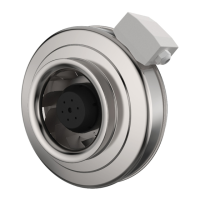
Describes the circular duct fan with an airtight casing made from sheet metal.

1.2 Intended use

Details the product's use for transporting clean or contaminated air and its application in various environments.

1.3 Document description

Outlines the content of the manual, focusing on installation, operation, and maintenance instructions.

1.4 Product overview K fan and KV fan

Provides a visual overview and labeling of the K fan and KV fan components.

1.5 Product overview prio fan

Presents a visual overview and labeling of the prio fan components.

1.6 Name plate

Explains the information found on the product's name plate, including type designation and certifications.

1.6.1 Type designation

Details the product types, dimensions, and motor types for K, KV, and prio fans.

1.7 Product liability

Specifies conditions under which Systemair is not liable for product damages.

2 Safety

2.1 Safety definitions

Defines terms like Warning, Caution, and Note used throughout the manual for safety information.

2.2 Safety instructions

Provides critical safety warnings and instructions that must be followed before working on the product.

2.3 Personal protective equipment

Lists the required personal protective equipment (PPE) to be used during all work on the product.

3 Transportation and storage

4 Installation

4.1 To do before the installation of the product

Lists essential checks and preparations required before installing the product.

4.2 To install the K fans

Describes the procedure for installing the K circular duct fans, including mounting.

4.2.1 To install the mounting bracket for K fans

Details the specific steps for attaching the mounting bracket to K fans.

4.3 To install the KV fans

Provides instructions for installing the KV circular duct fans on walls or ceilings.

4.4 To install the prio fans

Explains how to install the prio circular duct fans, typically using pendulum bars or wires.

4.5 To connect the ducts to the product

Guides on how to attach the air ducts to the fan product.

5 Electrical connection

5.1 To do before the electrical connection

Lists prerequisites and checks to be performed before making the electrical connection.

5.2 To connect the product to the power supply

Details the steps for connecting the fan product to the main power supply.

5.3 Speed controller for EC motors

Explains how EC motors are controlled using a 0-10 V signal and external speed controllers.

5.4 Motor protection for EC motors

Describes the integrated motor protection for EC motors and how to reset it.

5.5 Speed controller for AC motors

Discusses speed control options for AC motors, including transformer and frequency converter methods.

5.6 To install motor protection for AC motors

Provides instructions for installing motor protection for AC motors, including temperature monitors and switches.

6 Commissioning

6.1 To do before the commissioning

Lists checks to ensure correct installation and connection before starting the commissioning process.

6.2 To do the commissioning

Details the step-by-step procedure for commissioning the fan, including startup and speed adjustment.

7 Operation

7.1 To start a product with an EC motor

Explains how to start and operate fans equipped with EC motors.

7.2 To start a product with an AC motor

Outlines the procedure for starting and operating fans equipped with AC motors.

7.3 To stop the product

Describes how to properly stop the fan product during normal operation.

7.3.1 To stop the product in an emergency

Details the procedure for an emergency shutdown of the fan product.

8 Maintenance

8.1 Maintenance schedule

Presents a schedule for regular maintenance tasks based on operation conditions.

8.2 To clean the product

Provides instructions and cautions for cleaning the fan product and its components.

8.3 Spare parts

Gives information on how to obtain spare parts and what details to provide.

10 Disposal

10.1 To disassemble and discard the parts of the product

Explains how to disassemble and dispose of the product and its packaging according to regulations.

11 Warranty

12 Technical data

12.1 Technical data overview

Provides a summary of key technical specifications for the fans.

12.2 Product dimensions

Details the physical dimensions of the K fans.

12.2.1 Product dimensions for K fans

Presents dimensional data for various K fan models in a table format.

12.2.2 Product dimensions for KV fans

Provides detailed physical dimensions for different KV fan models.

12.2.3 Product dimensions for prio fans

Lists the physical dimensions for various prio fan models.

12.3 Wiring diagrams

12.3.1 Wiring diagrams for AC fans

Illustrates wiring diagrams for AC fans, categorised by K and KV fan types.

12.3.2 Wiring diagrams for EC fans

Shows wiring diagrams for EC fans, including K, KV, and prio fan types.

12.3.3 Wiring diagrams for speed controller for AC motors

Presents wiring diagrams for various speed controllers used with AC motors.

12.3.4 Wiring diagrams for speed controllers for EC motors

Illustrates wiring diagrams for different speed controllers compatible with EC motors.

12.3.5 Wiring diagrams for ON;OFF controls for EC motors

Details wiring diagrams for ON/OFF control systems for EC motors.

12.3.6 Wiring diagrams for demand control for EC motors

Shows wiring diagrams for EC motors used with demand control systems.

13 Accessory overview

14 EU Declaration of Conformity

15 UK Declaration of Conformity

SystemAir K 100 M sileo Specifications

General IconGeneral
Diameter100 mm
Voltage230 V
Frequency50 Hz
Phase1~
Max. ambient temperature60 °C
Enclosure classIP44
Insulation classB
ImpellerBackward curved

Related product manuals