
 Need help?
Do you have a question about the T.J.M. 9000lb and is the answer not in the manual?
TJM shall repair or replace defective products within two years of purchase at its discretion.
Defects in distributed products are covered by the original manufacturer's warranty.
Purchaser is responsible for ascertaining product compliance with local laws.
TJM is not liable for claims arising from faulty design or consequential damages.
Modifications or alterations to the product will void any warranty claims.
Wear appropriate clothing, leather gloves, and non-skid footwear to avoid entanglement and injury.
Ensure all persons stay clear of the cable during operation to prevent injury from cable lash back.
Avoid carrying the winch by the cord or yanking it. Protect cord from heat, oil, and sharp edges.
Stop winching if the motor overheats. Do not exceed maximum line pull ratings.
Disengage the winch clutch when not in use and ensure it is fully engaged during operation.
Check the winch for damage before use. Damaged parts must be repaired or replaced.
Use only identical replacement parts when repairing the winch to avoid danger.
Re-spool cable with a slight load, wearing gloves, and keeping hands clear of the drum.
Reverse winch to relieve load and adjust anchor point if cable piles up on drum end.
Store remote control switch safely and inspect it before plugging in.
Plug in remote with clutch disengaged; do not engage clutch with motor running.
Never connect hook back to cable. Use a tree trunk protector or extension strap.
Observe winch operation from a safe distance and stop if cable bunches on drum.
Attach tow hooks to vehicle recovery points, not winch mounting apparatus.
Snatch blocks double winch capacity and halve speed, requiring attachment to vehicle recovery points.
Use rated shackles with approved tree trunk protectors for safe anchor points.
Always leave at least five wraps of cable on the drum to prevent parting under load.
Red mark indicates 5 wraps remain; do not attempt recovery beyond this point.
Pull off as much line as possible, leaving minimum 5 wraps, or use a snatch block for heavy pulls.
Drape a blanket over cable to dampen backlash and raise bonnet to protect windscreen.
Neat, tight spooling prevents cable binding during operation.
Apply blocks to wheels when the vehicle is on an incline to prevent movement.
Ensure battery is in good condition, avoid acid contact, wear eye protection, and run engine.
Inspect cable condition, do not use frayed cable, avoid moving vehicle to pull load, use correct strength.
Do not attempt to exceed the winch's maximum pulling limits.
Do not use vehicle movement to assist winch, as it can overload components and cause shock loads.
Shock loads are dangerous and can be induced by slack cable or sudden force application.
These winches are intended for vehicle and boat mounted non-industrial applications only.
Do not use winch for hoisting applications due to safety factors and feature requirements.
Never use the winch to lift, support, or transport personnel.
Remove two allen head cap screws holding the tie rod on the gearbox side of the winch.
Carefully remove the gearbox away from the cable drum.
Unscrew all 10 allen head cap screws holding the gearbox foot casting to the housing.
Rotate the gearbox foot casting to the desired position.
Line up the 10 holes and gasket between the gearbox foot casting and housing.
Tighten all 10 allen head cap screws in a diagonal sequence.
Assemble gearbox back into cable drum, ensuring the sun gear aligns with the drum.
Refit and tighten the two allen head cap screws to the tie rods.
Check clutch handle operation to ensure gearbox engages and winch fits to bar.
Mount winch to a suitable steel frame in horizontal or vertical plane, ensuring flat surface and frame strength.
TJM offers frames and protection systems for popular vehicles with detailed fitting instructions.
Secure winch with four M10 x 1.5 x 30mm bolts, spring washers, and square nuts.
Mount the roller fairlead to guide the rope onto the drum evenly.
Winch parts are pre-lubricated. Use light oil for cable and inspect for wear or damage.
Unwind new cable to prevent kinking. Remove old cable carefully and observe attachment method.
A TJM Dual Battery System is recommended for self-recovery work for optimal performance.
Use two spanners to secure leads to motor terminals to prevent internal shorting and voiding warranty.
Follow diagram for correct connection of leads to battery and motor terminals.
Maintain battery health, protect cables from damage, and ensure clean electrical connections.
Install a kill switch for easy access to isolate the winch and prevent inadvertent operation.
Test the kill switch by turning it ON for operation and OFF to cut power.
Perform test runs to become familiar with winch sounds and operation for confident use.
Ensure vehicle is secure with parking brake or chocks before pulling cable to an anchor point.
Use the clutch lever to disengage for free spooling or engage for winching operation.
Operate from driver's position, use a blanket over cable, and raise bonnet.
Start the engine, select neutral, and maintain idle speed during winching operations.
Check cable winds evenly onto the drum during winching operation.
Check winch carefully and thoroughly before operating, including cable condition and connections.
Operate winch regularly (monthly) to maintain good working condition.
Periodically check rope and fairlead for damage. Wash rope with water only.
Use aluminum hawse fairleads with synthetic rope; avoid sharp-edged fairleads.
Rinse rope with water, air dry, and store covered to protect from UV fading.
A comprehensive range of spare parts is available from TJM Products.
Details single line pull, motor, gear train, clutch, braking, drum size, cable, fairlead, and dimensions.
Table showing line load, speed (MPM/FPM), and motor current for the 9000lb winch.
Details single line pull, motor, gear train, clutch, braking, drum size, cable, fairlead, and dimensions.
Table showing line load, speed (MPM/FPM), and motor current for the 9500lb winch.
Details single line pull, motor, gear train, clutch, braking, drum size, cable, fairlead, and dimensions.
Table showing line load, speed (MPM/FPM), and motor current for the 12000lb winch.
Lists part numbers, descriptions, and quantities for winch components.
Illustrates numbered components corresponding to the service part listing.
Install solenoid box onto motor mount using supplied bolts as shown.
Remove and reinstall motor mount bolts for assembly.
Install zip tie through L bracket around the motor and tighten securely.
This document is a comprehensive fitting and instruction manual for the TJM Electric Winch, available in 9000lb, 9500lb, and 12000lb capacities. It covers installation, operation, safety precautions, maintenance, and technical specifications for vehicle recovery applications.
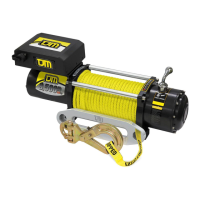
The TJM Electric Winch is designed for vehicle recovery, providing powerful pulling capabilities to extract vehicles from difficult situations. It operates using an electric motor to spool a cable (either steel or synthetic rope) onto a drum, generating significant line pull. The winch features a clutch mechanism for free-spooling the cable and a remote control for safe operation from a distance. It is intended for non-industrial applications, specifically vehicle and boat mounting.
The manual details specifications for each winch capacity:

 To Next Page
 General