8
GENERAL INFORMATION
Lock
The dispenser can be locked with the key supplied (see
gure 6.). Turn the key a quarter of a turn clockwise to
lock, an-clockwise to unlock.
Please note that the lock is a simple device intended as
an addional barrier only.
Baery Cover Screw
A screw is provided to prevent inappropriate access to the baeries (should this be
necessary). Place the screw in the hole in the baery cover securing clip and ghten.
The screw must be removed when the baeries need changing. It should then be replaced.
Medicines:
There are some pills that should not be exposed to the air and therefore should not be used
in the dispenser. If in doubt please check with your pharmacist.
Pharmacy lling: Many pharmacies will ll the TabTimer® Careousel MK3/11 Dispenser.
The device meets the requirements of the Quality Care Pharmacy Program (QCPP).
For the suggested Standard Operang Procedure for pharmacy lling of the TabTimer®
Careousel MK3/11, please ask your pharmacist to contact TabTimer Pty Ltd.
Fault handling:
The alarm will sound connuously in the event of the dispenser failing to rotate properly.
This might be caused by an obstrucon between the body of the dispenser and the internal
tray. In this event the display will show ‘ERROR’. A baery should be removed and then
immediately replaced. Any obstrucon should be removed.
If the dispenser is upside down at the alarm me, the internal tray will not move unl the
dispenser is turned upright. If the dispenser is upside down for all the me between the
‘BEFORE’ and ‘AFTER’ sengs a warning signal will sound and ‘TILTED’ will be displayed.
Press Buon 3 once to cancel. Check the posion of the internal tray to ensure that the
correct medicine due will be available at the next alarm me.
If the dispenser was upside down for the duraon of 1 or more alarms, the medicine due to
be presented at the next scheduled alarm may not be the correct one for that me of day.
(See General Observaons).
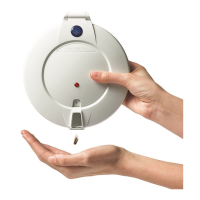
Figure 6.


 To Next Page
 Loading...