
 Need help?
Do you have a question about the Tadano GR-1000XL-2 and is the answer not in the manual?
Details the telescopic boom, its sections, and extensions.
Information on the two-stage bi-fold lattice type jib.
Details on main and auxiliary hoist systems, drums, and controls.
Overview of hydraulic system components like pumps, reservoir, and cooler.
Description of the operator's cab, controls, and instrumentation.
Carrier type, drive axle selection, and frame construction details.
Information on the automatic transmission and maximum travel speed.
Details on carrier axles and hydraulic power steering modes.
Overview of suspension systems and service, parking, and auxiliary brakes.
Specifications for tires and details on the hydraulic outrigger system.
Specifications for the crane's engine, including model and performance.
List of optional accessories and features available for the crane.
Data on line speeds and pulling capacities for main and auxiliary hoists.
Information on wire rope capacities for the main and auxiliary drums.
Specifications for the drum dimensions, including diameter and width.
Lifting capacities for fully extended outriggers at various boom lengths and angles.
Lifting capacities for mid-extended outriggers at various boom lengths and angles.
Lifting capacities for mid-extended outriggers at various boom lengths and angles.
Lifting capacities for minimum extended outriggers at various boom lengths and angles.
Lifting capacities when operating on rubber tires, stationary or creeping.
General safety warnings, setup procedures, and operational guidelines for lifting.
Guidelines on load radius, boom angle, and avoiding exceeding capacities.
Instructions for using the AML-C system when operating on outriggers.
Instructions for using the AML-C system when operating on rubber.
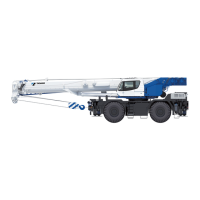
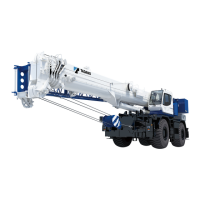
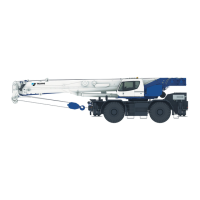
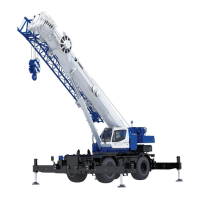
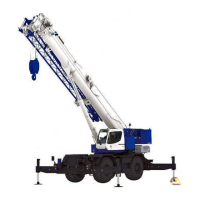
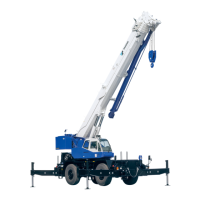
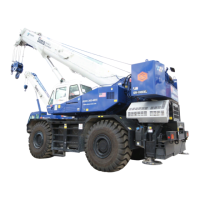
This document describes the Tadano GR-1000XL-2, a 100-ton (90.7 metric tons) capacity hydraulic rough terrain crane. It provides detailed information on its dimensions, crane specifications, carrier specifications, standard equipment, optional equipment, hoisting performance, rated lifting capacities, working range charts, and operating instructions.
The crane features a four-section full power synchronized telescoping boom, ranging from 39.4 feet to 154.2 feet (12.0m to 47.0m), constructed of round box sections. The boom's synchronization system utilizes two telescope cylinders, an extension cable, and a retraction cable, and is fitted with a holding valve. For safety, it includes two easily removable wire rope guards and rope dead ends at the boom head. Wear pads support the boom telescope sections both vertically and horizontally. The boom elevation is controlled by a double-acting hydraulic cylinder with a holding valve, allowing elevation from -1.5° to 80.5°. Operators can use combination controls for either hand or foot operation, and a boom angle indicator is provided. The system incorporates automatic speed reduction and a soft stop function for smooth operation.
For extended reach, the crane can be equipped with a two-stage bi-fold lattice jib, which can be offset at 3.5°, 25°, or 45°. The jib is available in lengths of 33.2 feet (10.1m) or 58.1 feet (17.7m) and is stored alongside the base boom section. Assistant cylinders facilitate mounting and stowing, controlled from the right side of the superstructure. Self-stowing jib mounting pins simplify setup. An auxiliary lifting sheave (single top) with a 15-5/8 inch (0.396m) root diameter is mounted to the main boom head for single line work and is stowable. Safety is further enhanced by an anti-two block system, a pendant type over-winding cut-out device with an audio-visual warning system (FAILURE lamp/BUZZER).
The swing system utilizes a hydraulic axial piston motor driving a planetary swing speed reducer, allowing continuous 360° full circle swing on a ball bearing turn table at 1.5 rpm. It is equipped with a manually locked/released swing brake and a 360° positive swing lock for pick and carry and travel modes, manually engaged in the cab. A twin swing system offers both free swing and lock swing, controlled by a selector switch on the front console.
The crane features a main hoist with variable speed, a grooved drum driven by a hydraulic axial piston motor through a winch speed reducer. It supports power load lowering and raising and is equipped with an automatic brake (neutral brake) and a counterbalance valve. The main hoist is controlled independently of the auxiliary hoist and includes a cable follower and drum rotation indicator. The drum has a 14-1/4 inch (0.362m) root diameter and is 23-5/8 inches (0.6m) wide, accommodating 820 feet of 3/4 inch diameter wire rope. The auxiliary hoist is similarly designed with variable speed, a grooved drum, and power load lowering and raising capabilities, equipped with an automatic brake and counterbalance valve, and controlled independently of the main hoist. Its drum is also 14-1/4 inches (0.362m) in root diameter and 23-5/8 inches (0.6m) wide, holding 456 feet of 3/4 inch diameter wire rope. The wire rope used is non-rotating 3/4 inch (19mm) with a minimum breaking strength of 72,765 lbs.
Hook blocks are available, including a 100-ton (90.7 metric ton) 8-sheave block with a swivel hook and safety latch for 3/4 inch (19mm) wire rope (optional), and a 7.3-ton (6.6 metric ton) weighted hook with a swivel and safety latch for 3/4 inch (19mm) wire rope.
The hydraulic system is powered by two variable piston pumps for crane functions and a tandem gear pump for steering, swing, and optional equipment, all driven by the carrier engine. A rotary switch in the operator's cab engages/disengages the pump for crane functions. Multiple control valves are actuated by pilot pressure and feature integral pressure relief valves. The hydraulic reservoir has a 224-gallon (840 lit.) capacity with an external sight level gauge. Filtration is provided by a BETA10=10 return filter, full flow with bypass protection, located inside the hydraulic reservoir for easy replacement. An air-cooled fan type oil cooler maintains optimal operating temperatures.
The crane's cab and controls allow both crane and drive operations from a single cab mounted on the rotating superstructure. The left-side, one-man steel construction cab features a sliding door, safety glass windows that open at the side, and powered control for the door window. The windshield and roof glass windows are shatter-resistant. A tilt-telescoping steering wheel enhances operator comfort. Adjustable control lever stands for swing, boom hoist, boom telescoping, auxiliary hoist, and main hoist can change neutral positions and tilt for easy access. An engine throttle knob and foot-operated controls for boom hoist, boom telescoping, service brake, and engine throttle are included. The cab is equipped with a hot water heater and air conditioning.
The dash-mounted controls include an engine start/stop, monitor lamps, cigarette lighter, drive selector switch, parking brake switch, steering mode select switch, power window switch, pump engaged/disengaged switch, swing brake switch, telescoping/auxiliary winch select switch, outrigger controls, main winch/auxiliary winch selector switch, swing stop cancel switch, slow elevation stop cancel switch, free swing / lock swing selector switch, and an ashtray. Instruments such as torque converter oil temperature, engine water temperature, air pressure, fuel, speedometer, tachometer, and hour meter are monitored and displayed on the AML-C display panel.
The carrier features a rear engine, left-hand steering, and a driving axle with 2-way selection via a manual switch, allowing 4x2 front drive, 4x4 front, and rear drive. The frame is constructed of high tensile steel with a welded mono-box design. The transmission is electronically controlled full automatic, with a torque converter driving a full powershift and a driving axle selector, offering 6 forward and 2 reverse speeds. It has 3 speeds in high range for 2-wheel drive and 4-wheel drive, and 3 speeds in low range for 4-wheel drive. The crane can travel at speeds up to 23 mph (37 km/h). The front axle is a full floating type, steering and driving axle with planetary reduction. The rear axle is also a full floating type, steering and driving axle with planetary reduction and a non-spin rear differential. Hydraulic power steering is controlled by the steering wheel, offering four steering modes: 2-wheel front, 2-wheel rear, 4-wheel coordinated, and 4-wheel crab.
The suspension system includes a rigid mounted front and a pivot mounted rear with a hydraulic lockout device. The brake systems comprise air-over-hydraulic disc brakes on all four wheels for service, spring-applied air-released brakes acting on the input shaft of the front axle for parking/emergency, and an electro-pneumatic operated exhaust brake as an auxiliary. The crane is fitted with 29.5-25 34PR(OR) tires.
Outriggers are four hydraulic, beam, and jack type, with vertical jack cylinders equipped with integral holding valves. Each outrigger beam and jack is controlled independently from the cab. Beams extend to 23' 11-3/8" (7.3 m) center-line and retract to within 10' 10-1/2" (3.315 m) overall width with floats attached, eliminating manual attachment/detachment. Controls and a sight bubble are located in the superstructure cab. Four outrigger extension lengths are provided for crane duty in confined areas: Min. Extension 8' 10-5/16" (2.7m), Mid. Extension 18' 1/2" (5.5m), Mid. Extension 21' 11-3/4" (6.7m), and Max. Extension 23' 11-3/8" (7.3m). The float size (diameter) is 1'11-5/8" (0.6m).
The Tadano electronic LOAD MOMENT INDICATOR system (AML-C) is integrated, featuring a control lever lockout function with audible and visual pre-warning, boom position indicator, outrigger state indicator, and displays for boom angle, boom length, jib offset angle, load radius, rated lifting capacities, and actual loads. It also indicates the ratio of actual load moment to rated load moment. The system includes automatic speed reduction and soft stop functions for boom elevation and swing, a working condition register switch, and preset functions for load radius, boom angle, tip height, and swing range. An external warning lamp and tare function are also part of the system. The AML-C monitors outrigger extended length and automatically programs the corresponding "RATED LIFTING CAPACITIES" table.
The operator's right-hand console includes a transmission gear selector and a sight level bubble. The upper console features a working light switch, roof washer and wiper switch, an emergency outrigger setup key switch, a drum indicator switch, a jib equipped/removed select switch, a boom emergency telescoping switch (2nd and 3rd top), and an air conditioning control switch. A swing lock lever is also present. All crane motion speeds are based on unladen conditions.
Standard equipment includes the five-section full power partially synchronized boom, the bi-fold lattice jib with pinned offsets and self-storing pins, and the auxiliary lifting sheave (single top) stowable. Both main and auxiliary hoists are variable speed with grooved drums, cable followers, and wire rope. Drum rotation indicators (thumper type) are provided for both hoists. An anti-two block device (overwind cutout) and a boom angle indicator are standard. The Tadano electronic load moment indicator system (AML-C) includes an outrigger extension length detector and an electronic crane monitoring system. The Tadano twin swing system and 360° positive swing lock are also standard.
The cab is equipped with self-centering finger control levers with pilot control, control pedals for boom hoist and boom telescoping, a 3-way adjustable cloth seat with armrests, high back, and a seat belt. A tilt-telescoping steering wheel, tinted safety glass, and a sun visor enhance comfort. Front windshield and roof window wipers and washers, a power window (cab door), and rear view mirrors (right and left side) are standard. Mirrors for main and auxiliary hoists, a cigarette lighter, and an ashtray are also included. A cab floor mat, pump disconnect in the operator's cab, a hydraulic oil cooler, and a hot water cab heater and air conditioner are provided. A telecommunications terminal (HELLO-NET Owner's Site) and positive control are standard features. The quick reeving type bi-fold jib is also part of the standard equipment.
Optional equipment includes a 100-ton (90.7 metric ton) 7-sheave hook block with a swivel hook and safety latch for 3/4 inch (19mm) wire rope, a propane heater (less tank), and a spot light.
Maintenance features are integrated throughout the design, such as easily replaceable hydraulic filters and accessible components. The AML-C system aids in monitoring crane conditions, providing alerts and data to assist in preventive maintenance and troubleshooting. The design emphasizes robust construction for durability and reliability in rough terrain environments.
 General
| Model | GR-1000XL-2 |
|---|---|
| Category | Rough Terrain Crane |
| Manufacturer | Tadano |
| Engine | Cummins QSB6.7 |
| Number of Axles | 2 |
| Maximum Lifting Capacity | 100 tons |
| Maximum Hook Height | 50.0 m |
| Engine Power | 194 kW (260 hp) |
| Drive | 4 x 4 |
| Steering | All-wheel steering |
| Outriggers | Hydraulic, H-type |
| Overall Length | 14.8 m |
| Overall Width | 3.0 m |
| Overall Height | 12.7 ft (3.9 m) |




 To Next Page