8088
Table
1.
Pin Description
The
following pin function descriptions are for 8088 systems in either
minimum
or
maximum
mode.
The "local
bus" in these descriptions is the direct multiplexed bus interface connection to the 8088 (without regard to
additional bus buffers).
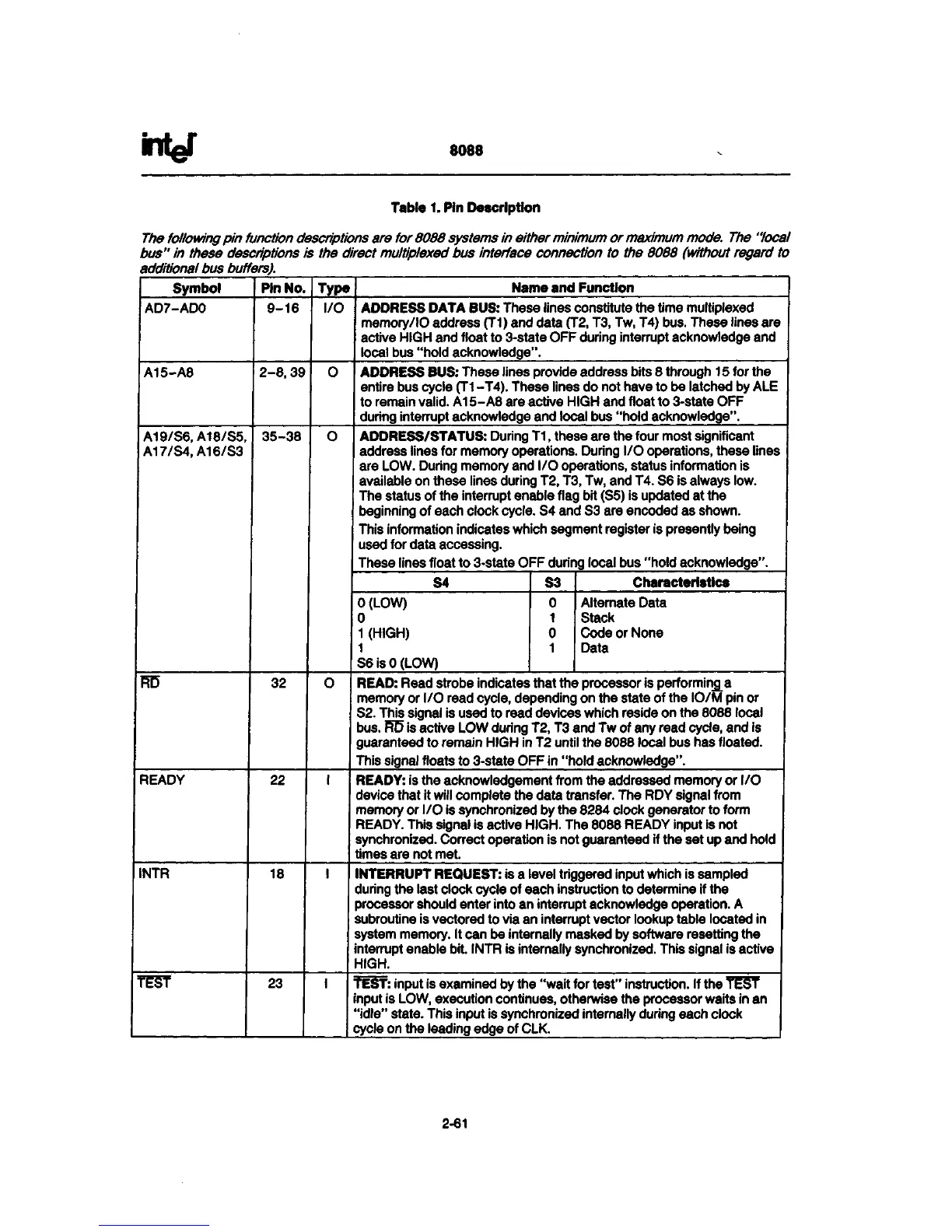
Symbol
AD7-AD0
A15-A8
A19/S6.A18/S5
A17/S4.A16/S3
m
READY
INTR
TEST
Pin
No
9-16
2-8,
39
35-38
32
22
18
23
Type
I/O
0
0
0
I
I
I
Name and Function
ADDRESS DATA
BUS:
These lines constitute the time multiplexed
memory/IO address (T1) and data
(T2,
T3, Tw, T4)
bus.
These lines are
active HIGH and float to
3-state
OFF during interrupt acknowledge and
local bus "hold acknowledge".
ADDRESS
BUS:
These lines provide address bits 8 through 15 for the
entire bus cycle (T1-T4). These lines do not have to be latched by ALE
to remain
valid.
A15-A8 are active HIGH and float to
3-state
OFF
during interrupt acknowledge and local bus "hold acknowledge".
ADDRESS/STATUS: During
T1,
these are the four most significant
address lines for memory operations. During I/O operations, these lines
are LOW. During memory and I/O operations, status information is
available on these lines during
T2,
T3, Tw, and
T4.
S6 is always low.
The status of the interrupt enable flag bit (S5) is updated at the
beginning of each clock
cycle.
S4 and S3 are encoded as shown.
This information indicates which segment register is presently being
used for data accessing.
These lines float to
3-state
OFF during local bus "hold acknowledge".
S4
0(LOW)
0
1 (HIGH)
1
S6isO(LOW)
S3
0
1
0
1
Characteristics
Alternate Data
Stack
Code or None
Data
READ:
Read strobe indicates that the processor is performing a
memory or I/O read
cycle,
depending on the state of the IO/M pin or
S2.
This signal is used to read devices which reside on the 8088 local
bus.
RU is active LOW during
T2,
T3 and Tw of any read cycle, and is
guaranteed to remain HIGH in T2 until the 8088 local bus has floated.
This signal floats to
3-state
OFF in "hold acknowledge".
READY: is the acknowledgement from the addressed memory or I/O
device that it will complete the data transfer. The RDY signal from
memory or I/O is synchronized by the 8284 clock generator to form
READY. This signal is active
HIGH.
The 8088 READY input is not
synchronized. Correct operation is not guaranteed if the set up and hold
times are not met.
INTERRUPT REQUEST: is a level triggered input which is sampled
during the last clock cycle of each instruction to determine if the
processor should enter into an interrupt acknowledge operation. A
subroutine is vectored to via an interrupt vector lookup table located in
system memory. It can be internally masked by software resetting the
nterrupt enable bit. INTR is internally synchronized. This signal is active
HIGH.
TE§T: input is examined by the "wait for test" instruction. If the TEST
nput is LOW, execution continues, otherwise the processor waits in an
'idle"
state. This input is synchronized internally during each clock
cycle on the leading edge of CLK.
2-61


 To Next Page
 Loading...