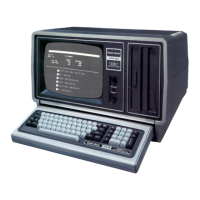
Need help?
Do you have a question about the Tandy Color Computer 3 and is the answer not in the manual?
Customer's responsibility for hardware, software, and operating environment.
Details Radio Shack's limited warranties on equipment and software, and conditions of sale.
Outlines limitations on Radio Shack's liability for damages related to equipment or software.
Specifies the terms and conditions under which the software is licensed to the customer.
Defines the scope and application of the warranty provisions.
Explains customer rights that may vary depending on state laws.
Alerts users to potential damage when handling ROM cartridges while the computer is on.
Informs about FCC compliance for Class B computing devices and peripheral attachment rules.
Describes options for connecting the computer to various types of displays.
Details the layout and function of the computer's keyboard.
Identifies the central processing unit of the Color Computer 3.
Explains ROM's role in storing built-in programs like Color BASIC.
Introduces ROM cartridges (Program Paks) for expanding computer functionality.
Explains RAM's function for temporary data storage and its volatility.
Lists and describes optional accessories that enhance computer utility.
Details how joystick controllers provide input for games and applications.
Describes the interface for connecting multiple Program Paks or controllers.
Explains using a cassette recorder for long-term program and data storage.
Mentions the option to add a disk system for greater storage capacity.
Notes the ability to connect a Tandy serial interface printer.
Explains how to connect the computer to a TV using the Antenna Switchbox.
Details connecting antenna wires to the Switchbox for different antenna types.
Instructions for connecting the computer to composite monitors and TVs.
Guides for connecting peripherals like printers and other accessories.
Details on how to connect the computer and accessories to a power outlet.
Steps to prepare the computer and display before turning it on.
Instructions on how to turn the computer on and what to expect.
How to use the RESET button to restart programs without powering off.
Proper procedure for turning the computer off and safety considerations.
A program to explore and adjust the computer's color capabilities.
A program to center the computer's display image on the screen.
How to program sounds and basic safety precautions for audio output.
Step-by-step instructions for connecting a cassette recorder to the computer.
Tips for making good recordings and preventing accidental erasure of tapes.
Explanation of potential error messages during tape loading and how to handle them.
A symptom/cure table for common operating problems with the computer.
Discusses power supply fluctuations and their effects on the computer.
Guidance on keeping the computer clean and maintaining accessories.
Details power requirements and current drain for the computer.
Specifies operating temperature and altitude limits for the computer.
Identifies the central processing unit of the Color Computer 3.
Lists standard RS-232-C signals and their pin assignments.
Diagram showing the pin locations for the SERIAL I/O jack.
Defines software parameters for printer compatibility.
Specifies input levels and switching capabilities for the cassette interface.
Diagram showing pin locations for the computer's CASS jack.
Diagram showing pin assignments for the joystick controller jacks.
Diagram showing pin assignments for the RGB OUT jack.
 General
| Manufacturer | Tandy Corporation |
|---|---|
| Release Year | 1986 |
| CPU | Motorola 6809 |
| CPU Speed | 0.89 MHz |
| RAM | 128 KB (expandable to 512 KB) |
| ROM | 32 KB |
| Graphics | Motorola 6847 VDG |
| Display Modes | 320x200, 640x200 |
| Storage | Cassette tape, floppy disk |
| Ports | joystick, cassette, serial port |
| Operating System | OS-9 |
| Power Supply | External power adapter |


 To Next Page