8088
Table
1.
Pin Description (Continued)
Symbol
RQ/GTO,
Ra/GTT
LOCK
QS1.QS0
Pin
No.
30,31
29
24,25
34
Type
I/O
0
0
0
Name and Function
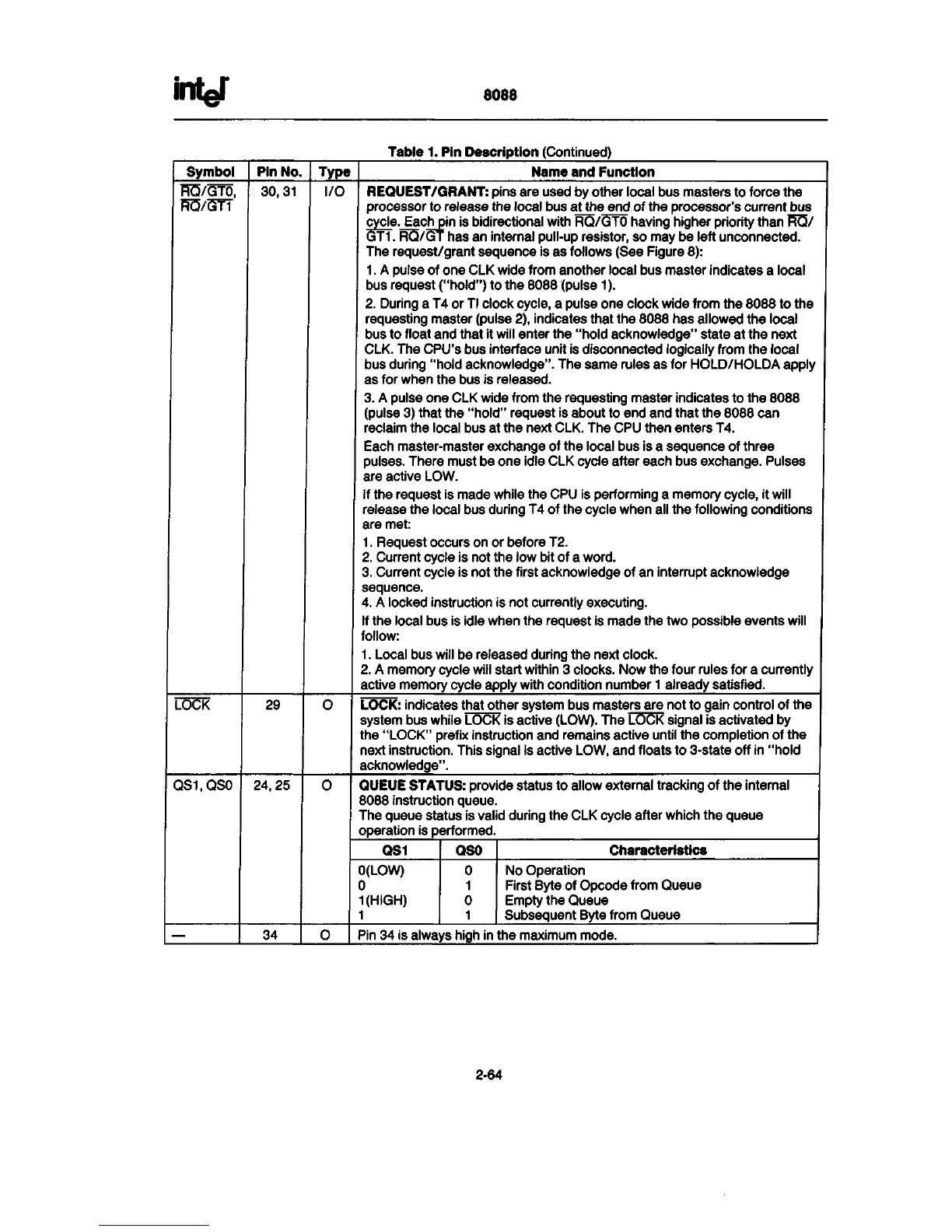
REQUEST/GRANT: pins are used by other local bus masters to force the
processor to release the local bus at the end of the processor's current bus
cycle.
Eachpn is bidirectional with RQ/CfTO having higher priority than RG/
GT1.
R5/GT has an internal pull-up resistor, so may be left unconnected.
The request/grant sequence is as follows (See Figure 8):
1.
A pulse of one CLK wide from another local bus master indicates a local
bus request
("hold")
to the 8088 (pulse 1).
2.
During a T4 or Tl clock cycle, a pulse one clock wide from the 8088 to the
requesting master (pulse
2),
indicates that the 8088 has allowed the local
bus to float and that it will enter the "hold acknowledge" state at the next
CLK. The CPU's bus interface unit is disconnected logically from the local
bus during "hold acknowledge". The same rules as for HOLD/HOLDA apply
as for when the bus is released.
3. A pulse one CLK wide from the requesting master indicates to the 8088
(pulse 3) that the
"hold"
request is about to end and that the 8088 can
reclaim the local bus at the next CLK. The CPU then enters T4.
Each master-master exchange of the local bus is a sequence of three
pulses. There must be one idle CLK cycle after each bus exchange. Pulses
are active LOW.
If the request is made while the CPU is performing a memory
cycle,
it will
release the local bus during T4 of the cycle when all the following conditions
are
met:
1.
Request occurs on or before T2.
2.
Current cycle is not the low bit of a word.
3. Current cycle is not the first acknowledge of an interrupt acknowledge
sequence.
4.
A locked instruction is not currently executing.
If the local bus is idle when the request is made the two possible events will
follow:
1.
Local bus will be released during the next clock.
2.
A memory cycle will start within 3 clocks. Now the four rules for a currently
active memory cycle apply with condition number
1
already satisfied.
LOCK: indicates that other system bus masters are not to gain control of the
system bus while LOCK is active (LOW). The LOCK signal is activated by
the "LOCK" prefix instruction and remains active until the completion of the
next instruction. This signal is active LOW, and floats to
3-state
off in "hold
acknowledge".
QUEUE
STATUS:
provide status to allow external tracking of the internal
8088 instruction queue.
The queue status is valid during the CLK cycle after which the queue
operation is performed.
QS1
0(LOW)
0
1(HIGH)
1
QS0
0
1
0
1
Characteristics
No Operation
First Byte of Opcode from Queue
Empty the Queue
Subsequent Byte from Queue
3
in 34 is always high in the maximum mode.
2-64


 To Next Page
 Loading...