50
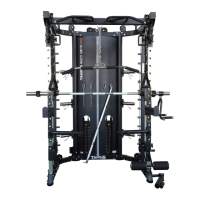
Multi Smith Pro
4.2 Faults and Fault Diagnosis
The equipment undergoes regular quality controls during production. Nevertheless, faults or
malfunctions may occur. Frequently, individual parts are responsible for these disturbances, an
exchange is usually sucient. Please refer to the following overview for the most common errors and
how to correct them. If the equipment still does not function properly, contact your contract partner.
Fault Cause Solution
Grinding noises
Cables or pulleys do not run
smoothly or are damaged
+ Visual inspection of the cable
routing or the pulley guide
+ If damaged, replace the defective
part
Weight hanging in the air Cable tensioned too tight Readjust cable tension
Cable without tension Cable too loose Readjust cable tension
Squeaking & cracking
noises
Screw connections loosened
or too tight
Check screw connections
4.3 Maintenance and Inspection Calendar
To avoid damage from body sweat, the equipment must be cleaned with a damp towel (no solvents!)
after each training session.
The following routine tasks must be performed at the specied intervals:
Part Weekly Monthly Quarterly
Cables C I
Screw connections I
Pulleys and cable routing I
Slide rails/Guide rods I
Weights I
Cushions C I
Legend: C = clean; I = inspect
5 DISPOSAL
At the end of its operational life, this equipment cannot be disposed of in normal household waste.
Instead, it must be disposed of via an recycling centre. Further information can be obtained from
your local authority‘s recycling service.
The materials can be recycled as per their symbols. Through the reuse, recycling
of materials or other forms of recovery of old equipment, you make an important
contribution to the protection of the environment.


 To Next Page