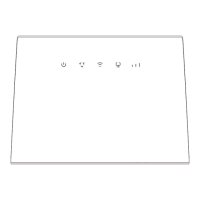
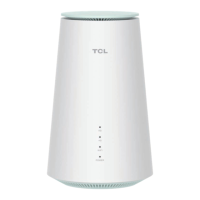
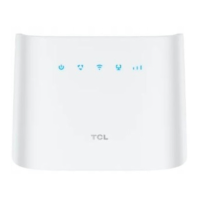
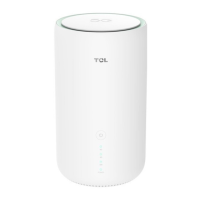
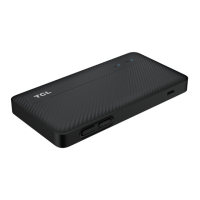
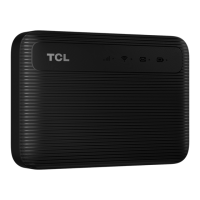
This document describes the TCL LINKHUB, a 4G LTE mobile router designed to provide fast and secure Wi-Fi connectivity in any location with cellular network coverage. The device, available in models HH40L1 and HH40L2, offers download speeds of up to 150 Mbps and supports up to 32 connected devices via a 2.4 GHz Wi-Fi network (802.11b/g/n). It is compatible with various web browsers, including Firefox, Safari, Internet Explorer, Opera, and Google Chrome.
Function Description
The TCL LINKHUB acts as a central hub for internet connectivity, converting a cellular signal into a Wi-Fi network. It can connect to the internet via a cellular network using a micro SIM card or through a wired broadband connection via its LAN/WAN port. For the HH40L1 model, it also includes telephone functionality, allowing users to make and receive calls when a telephone is connected to the dedicated port.
Important Technical Specifications
- Network Type: 4G LTE mobile router
- Download Speed: Up to 150 Mbps
- Wi-Fi Standard: 2.4 GHz (802.11b/g/n)
- Connected Devices: Supports up to 32 devices
- SIM Card Type: Micro SIM (3FF)
- Ports:
- Micro SIM card slot
- WPS button
- Wi-Fi button
- Telephone port (HH40L1 only)
- LAN/WAN port
- Power connector
- Power button
- Reset button
- Operating Temperature: 0 °C to 40 °C (32 °F to 104 °F)
- Storage Temperature: -20 °C to 70 °C (-4 °F to 158 °F)
Usage Features
Getting Started:
- SIM Card Installation: Remove the back cover, record default Wi-Fi and login information, then insert a micro SIM card. Ensure correct orientation to avoid jamming.
- Battery Installation: Align battery pins with the device's pins and install the battery.
- Power On: Press the power button to turn on the device.
- Internet Connection:
- Cellular Network: Insert a micro SIM card.
- Broadband Connection: Plug an Ethernet cable into the WAN/LAN port.
- Ideal Location: For optimal performance, place the CPE near a window, in a cool, dry, well-ventilated area, away from walls and electrical appliances, near a power outlet, and on a sturdy, flat surface.
- Power Adapter: Connect the supplied power adapter to the power connector.
- Accessing CPE Network: Devices can connect via wired (LAN/WAN port) or wireless (Wi-Fi) connections.
- WPS Connection: For WPS-enabled wireless devices, press the WPS button on the CPE for 3 seconds, then enable WPS on the wireless device within 2 minutes. Alternatively, configure WPS via the web UI using PBC or PIN code methods.
- Telephone Function (HH40L1 only): Connect a telephone to the dedicated telephone port using a telephone cable to make or answer calls.
Web UI Access and Configuration:
- Login: Open a web browser, go to
http://192.168.1.1, and enter the login information found on the label inside the CPE.
- Home Page: Provides an overview of Connection, Usage, SMS, Settings, and More.
- Status Icons: Various icons indicate device status, including charging, battery level, signal strength, network connection type (WAN, broadband, cellular), new messages, SIM card status, and connected users.
- Quick Settings: A wizard guides users through basic gateway safety parameters like Network Name (SSID), SSID Broadcast, and Security Mode (OPEN, WPA2-PSK(AES), WPA/WPA2-PSK(TKIP/AES)).
- Devices Settings:
- Connected Devices: View and edit names of connected devices.
- Advanced Settings:
- DHCP: Automatically assigns IP addresses to connected devices.
- USSD: Send USSD codes to the operator.
- PIN Management: Enable/disable SIM PIN, set/change PIN code. (Note: Incorrect PIN entry requires PUK code, obtained from customer services).
- Static IP: Bind computer IP addresses with MAC addresses to prevent ARP attacks.
- Static Routing: Manually configure routes for efficient packet forwarding.
- DDNS: Map dynamic WAN IP to a static domain name for external access.
- Cell Locking: Lock the CPE's network to a specific physical cell or frequency.
- FOTA Upgrade: Check for, download, and install firmware updates.
- Internet Settings:
- Network Selection: Set network mode (4G only, 3G only, 2G only, 4G/3G only).
- APN: Set up, edit, or delete APN profiles for network operators.
- WAN Mode: Configure internet access via cable (Dynamic IP, Static IP, PPPoE) or 4G cellular network.
- Roaming: Enable/disable roaming network connection.
- Statistics Settings: Set billing day, monthly data plan, and time limits.
- Wi-Fi Settings: Enable/disable Wi-Fi, configure SSID presets (Main SSID, SSID1, SSID2), enable/disable SSID broadcast, set security mode, and manage WPS settings (WPS Switch, Add new device via PIN or PBC).
- MAC Filter: Control device access based on MAC addresses (Ruleless, White List, Black List).
- Advanced Wi-Fi Settings: Configure Network Mode (802.11b/g/n), Channel Bandwidth, Country/Region Code, Frequency (Channel), and DCS (Dynamic Channel Adjustment).
- Voice Settings (HH40L1 only):
- SIP ALG: Enable/disable and configure Session Initiation Protocol Application Layer Gateways for data exchange with SIP softswitches.
- WB mode: Switch between broadband and narrowband for voice calls.
- VoLTE APN: Configure Voice over Long-Term Evolution Access Point Name (default is IMS).
- Digitmap settings: Define dial plans for the media gateway to process called numbers.
- SMS:
- Read/Send/Reply/Delete Messages: Manage messages saved on the device or SIM card.
- Refresh Inbox: Update the message list.
- Firewall:
- Port Filtering: Block specific devices from accessing the internet (Disable, Enabled with MAC/IP/Port address list).
- Port Mapping: Map internal network IP addresses/ports to public network IP addresses/ports.
- Port Forwarding: Allow external users to access FTP and other services within the LAN.
- URL Filtering: Set internet access schedules and block specific websites.
- UPnP: Enable Universal Plug and Play for device discovery and network services.
- DMZ: Enable Demilitarized Zone for external users to access certain network services within the LAN.
- Rate Limiting: Limit download/upload speed.
Maintenance Features
- System Settings:
- Time Setting: Display current local time, set time mode (SNTP auto synchronization), specify SNTP servers, and set time zone.
- Daylight Saving Time: Enable/disable automatic local time adjustment.
- Modify Password: Change the login password for the web UI.
- Restore Factory Setting: Reset the CPE to its factory default settings (useful for forgotten passwords or unknown internet access issues). This can also be done by simultaneously pressing the power and WPS buttons for 3 seconds.
- Network Tools:
- Ping: Test network connections by sending ICMP Echo requests.
- Trace: Debug web addresses.
- System Upgrade: Upload a file package to update the device software. (Important: Do not power off during the update process).
- Reboot: Restart the device.
Troubleshooting:
The manual provides solutions for common issues such as forgotten Wi-Fi passwords, inability to find the Wi-Fi network, problems accessing the web UI, SIM card detection issues, and PIN/PUK lock. For instance, if the Wi-Fi password is forgotten, it can be retrieved from the web UI or by restoring factory settings. If the SIM card is locked, the PIN or PUK code can be entered via the web UI.
The document emphasizes important safety instructions, including avoiding use in prohibited areas, supervising children, handling the device with care, not attempting repairs, avoiding dropping or bending, and not disposing of the device in fire. It also covers medical device interference, power adapter safety (using only supplied, CE-approved adapters), and battery safety (risk of explosion if replaced incorrectly, proper disposal, no puncturing or disassembling, using only qualified batteries). The device is designed to operate within specific temperature ranges, and exposure to dramatic changes in temperature or humidity should be avoided.


 To Next Page
 General