Need help?
Do you have a question about the TCL RB315WM1110 and is the answer not in the manual?
This document provides comprehensive instructions for the operation and maintenance of a TCL Two-Door Household Refrigerator. It emphasizes safety precautions, proper handling, and optimal usage to ensure the longevity and efficiency of the appliance.
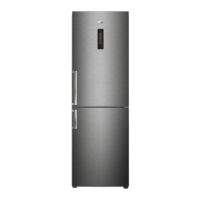
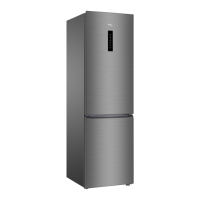
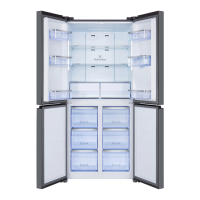
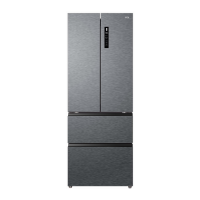
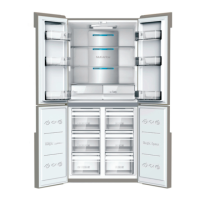
The refrigerator is designed with a focus on intelligent temperature control and environmental friendliness. It utilizes an air cooling and frost-free system, eliminating the need for manual defrosting. The refrigerant used is R600a, an environmentally friendly material, and 80% of the main components are recyclable, highlighting the product's commitment to sustainability. The design incorporates transparent drawers, allowing users to easily view the contents, and height-adjustable tempered glass shelves, which are wear-proof, heat-proof, and practical. A concealed condenser contributes to a flat back design, offering a simple, easy-to-clean aesthetic and maximizing space utility. The appliance is equipped with an efficient, quiet international brand compressor and special case foaming technology, resulting in low noise and energy consumption, making it suitable for both family and commercial use.
Before initial use, it is crucial to remove all packing materials, including case fixing tape and the foam base. The interior and exterior of the refrigerator should be cleaned with a warm, wet cloth, optionally with a neutral detergent. After cleaning and leveling, the refrigerator should stand for approximately 5 hours before being plugged in. It is then recommended to cool the refrigerator for 2 to 3 hours before storing any food items. For optimal freezing in hot summer conditions, 24 hours may be needed to fully freeze food, and the refrigerating condition should be checked on the second day.
The display panel offers several functions, including Power Cool, Smart, Energy Saving, Door Alarm, and Child Lock. Upon initial power-on, the refrigerator operates in 5 speeds. The child lock function automatically activates after 30 seconds of inactivity, entering a screen saver mode. To unlock the keyboard and enable key functions, the "Temperature Control" key must be pressed and held for 3 seconds. Gear adjustment allows users to cycle through various temperature settings (02, 04, 05, 06, 08) as well as Power Cool, Smart, and Energy Saving modes. The Power Cool function sets the temperature to 2°C, Smart function to 5°C, and Energy Saving function to 6°C in the refrigerator compartment. The refrigerator also features a power-off memory, resuming its last working state after a power interruption. A door alarm sounds if the refrigerator or freezer door is left open for over 1 minute, with a "beep, beep, beep" sound repeating after 1 minute until the door is closed or any key is pressed to temporarily stop the alarm. The display protection function automatically locks the keyboard after 30 seconds of inactivity.
For models with a damper adjustment paddle (TRF-315wexa+ and TRF-315wea+), it is generally recommended to use the mid-range setting. Adjusting the damper blade towards the "cold" side increases cold air flow to the refrigerating compartment, enhancing cooling. Conversely, adjusting it towards the "coldest" side reduces cold air flow to the refrigerating compartment, extending compressor operation and improving the freezing effect in the freezing compartment.
Food storage guidelines are provided for both compartments. The refrigerating chamber (2°C~8°C) is ideal for short-term storage of items like milk, eggs, and bottled drinks. Vegetables, melons, and fruits should be placed in the fruit and vegetable box to prevent water loss. Cooked foods should be packaged in preservative bags before being stored to prevent frosting and unnecessary power consumption. The freezing chamber (-22°C~-15°C) is for long-term food storage. Fish and meat should be cut into small pieces, packaged separately, and placed in the frozen drawer. Glass or sealed containers filled with liquid should not be stored in the freezing chamber to avoid bursting. Fresh foods should not be stored with frozen foods, and food should not be placed too close to the freezer's inner wall to prevent freezing together. Overheated water and food should be cooled to room temperature before being stored. Stored food should not block the air duct outlet or return port to ensure proper refrigerating effect.
For ice-making, if the appliance has this feature, the ice-making box should be filled with 4/5 water and placed in the freezing chamber. Once the water turns into ice, the box should be twisted slightly to separate the ice, avoiding bending the box. It is advisable to wrap the box with a dry cloth to prevent finger frostbite.
Handle installation involves using a screwdriver to tighten screws into the holes on the side of the refrigerator door, then covering them with plastic screw covers. Door reversal instructions are also provided, requiring specific tools and careful steps to change the door's opening direction.
Maintenance is recommended monthly. This involves unplugging the power plug to prevent electric shock. A wet cloth with neutral detergent should be used to wipe off oil and dirt, followed by a complete wipe with detergent. Alkaline detergents, soap powder, gasoline, alcohol, or talcum powder should be avoided as they can damage coats or plastics. The refrigerator body and ground dusts should be cleaned regularly to maintain cleanliness. After maintenance, it is important to inspect the power line and plug for damage, dust, abnormal heat, looseness, and ensure the plug is fully inserted. If the power line or plug is damaged or dusty, electric shock or fire may occur. After unplugging, 5 minutes must pass before re-plugging. Hands should not be placed under the refrigerator to avoid injury.
The document also addresses common non-failure phenomena, such as the sides and spacing between compartments being warm (due to condenser and anti-fog pipes for heat dissipation), the door being tight (due to pressure difference after closing), water ripples (from refrigerant movement or defrosting), "Click" or "tick" sounds (from case shrinkage/swelling), hum sounds (from compressor operation), and condensation/frosting on surfaces (due to high ambient temperature/humidity, prolonged door opening, or unsealed foods). Condensation on the built-in light surface can occur due to heat from the light and prolonged door opening, creating a temperature difference. Condensation and water mist on the body are attributed to high humidity in the air gathering on the case.
 General
| Brand | TCL |
|---|---|
| Model | RB315WM1110 |
| Category | Refrigerator |
| Total Capacity | 315 L |
| Energy Efficiency Class | A+ |
| Colour | White |
| Defrost System | No Frost |
| Number of Shelves | 3 |
| Voltage | 220-240 V |
| Frequency | 50 Hz |
| Climate Class | SN-T |
| Freezer Capacity | 85 L |
| Refrigerator Capacity | 230 L |

 To Next Page