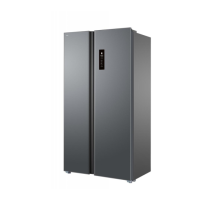
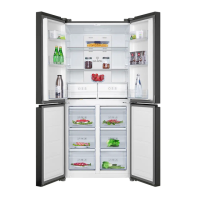
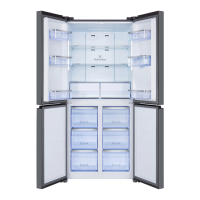
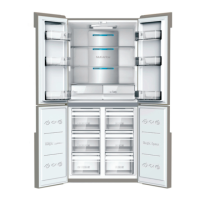
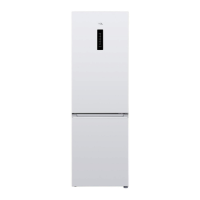
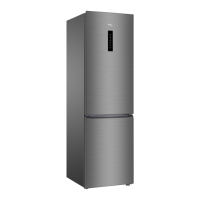
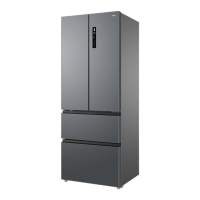
This document provides operating instructions for a TCL two-door household refrigerator, model RP505SXF1UK. It emphasizes safety, proper handling, and maintenance to ensure optimal performance and longevity of the appliance.
Function Description
The TCL refrigerator is designed for household use, offering both refrigerating and freezing capabilities. It features intelligent temperature control managed by a computer system, ensuring efficient and frost-free operation through a fan-cooled system. The appliance utilizes CFC-free materials and R600a refrigerant, making it environmentally friendly with a high percentage of recyclable main materials. Its design includes a "630mm ultra-thin machine body" for easy placement and movement.
The refrigerator is divided into two main compartments:
- Refrigerating Chamber (2°C~8°C): Primarily for short-term storage of foods like milk, eggs, and bottled drinks. It includes a fruit and vegetable box to prevent water loss from produce. Cooked foods should be packaged to prevent frosting and improve energy efficiency.
- Freezing Chamber (-22°C~-15°C): Intended for long-term storage of foods. Fish and meat should be cut into small pieces, packaged separately, and then placed in the frozen drawer. Glass or sealed containers filled with liquid should not be stored here to avoid bursting. Fresh foods should not be stored with frozen foods, and food should not be placed directly against the inner wall to prevent freezing to the surface.
The appliance also supports ice-making. Users can fill an ice-making box with water, place it in the freezing chamber, and then twist the box slightly to separate the ice once frozen.
Usage Features
The refrigerator's operation is managed via a computer control board with several key functions:
- Temperature Adjustment: Users can manually set the temperature for both the refrigerating chamber (2°C~8°C) and the freezing chamber (-22°C~-15°C). This is done by selecting the desired compartment and then adjusting the temperature in 1°C increments.
- Quick Refrigerating Function: This mode rapidly cools the refrigerator compartment. It can be activated manually and will automatically exit after two hours or if the refrigerator door is open for more than three minutes. When active, the refrigerator compartment temperature is set to 2°C.
- Quick Freezing Function: Similar to quick refrigerating, this function rapidly freezes items in the freezer compartment. It can be manually activated and automatically exits after four hours or if the freezer door is open for more than three minutes. When active, the freezer compartment temperature is set to -24°C.
- Intelligent Function: When activated, the refrigerator automatically monitors the status of all compartments and operates efficiently. In this mode, the appliance can automatically engage quick-refrigerating or quick-freezing functions based on internal temperatures. Activating other functions will automatically exit the intelligent mode.
- Child Lock Function: This function automatically engages after 30 seconds of no key operation, locking the control board. It can be unlocked by a long press of the "Function" key.
- Refrigerating Close Function: This feature allows users to turn off the refrigerating compartment. It is important to remove all food from the compartment before activating this function. The compartment enters a "close status" when this function is on.
- Power-off Memory: In the event of a power cut, the refrigerator retains its last working state and resumes it once power is restored.
- Door Alarm: If either the refrigerator or freezer door is not properly closed or remains open for more than one minute, an audible alarm will sound. Pressing any key will temporarily stop the alarm, but it will resume after one minute if the door remains open.
- Freezer Compartment Temperature Reminder: If the freezer compartment temperature rises above -12°C, the corresponding temperature area on the display will light up, and the digital area will flash to alert the user.
- Display Protection Function: The display enters a protection mode after 30 seconds of inactivity, automatically locking the key board. Pressing any key will exit this mode.
Maintenance Features
Regular care and maintenance are crucial for the refrigerator's performance and longevity. It is recommended to perform maintenance once a month.
- Cleaning:
- Always unplug the power plug before cleaning to prevent electric shock.
- Use a warm, wet cloth with a neutral detergent (cleanser essence) to wipe off oil contamination and dirt. Afterward, thoroughly wipe off any detergent residue.
- Avoid using alkaline detergents, soap powder, gasoline, alcohol, or talcum powder, as these can damage the appliance's coatings or plastics.
- Regularly clean the refrigerator body and the surrounding floor to keep it free of dust.
- Accessory Disassembly and Assembly:
- Glass Shelves (Refrigerating Chamber): Adjustable in height. To remove, pull the shelf outwardly and slightly upwardly.
- Fruit and Vegetable Box: For storing produce. To remove, pull it outwardly.
- Drawers (Freezing Chamber): For long-term food storage. To remove, pull them outwardly and lift upwardly. For large pieces of meat, it's advised to cut them into smaller pieces before freezing to avoid difficulty later. Quick-freezing foods should be distributed evenly.
- Bottle Pedestals (Refrigerating Door): For storing eggs, bottled drinks, etc. To remove, lift them slightly. Avoid forceful pulling to prevent damage.
- Light Replacement: Any replacement or maintenance of the LED lamps must be performed by the manufacturer, its service agent, or similarly qualified personnel.
- Post-Maintenance Inspection: After maintenance, check the following:
- Condition of the power line and plug for any damages.
- Presence of dust on the power plug.
- Abnormal heat on the plug.
- Looseness of the socket.
- Ensure the plug is fully inserted into the socket.
- If the power line or plug is damaged or dusty, it could lead to electric shock or fire.
- After unplugging, wait at least 5 minutes before re-plugging the appliance.
- Avoid placing hands under the refrigerator to prevent injury from sharp components.
The manual also addresses common "non-failures" or normal operating phenomena, such as the sides and spacing between compartments feeling warm (due to condenser and anti-fog pipes), the door being tight to open immediately after closing (due to pressure difference), water ripples (from refrigerant movement or defrosting), clicking or ticking sounds (from case expansion/contraction), humming sounds (from compressor operation), and condensation/frosting (due to high ambient humidity, prolonged door opening, or improperly sealed food).

 Need help?
 General

 To Next Page