EasyManua.ls Logo

TCM FB10-7 - BASIC LOAD CENTER AND RATED LOAD; THE STABILITY OF LIFT TRUCK; TRAVELING AND STARTING ON A SLOPE

TCM FB10-7
135 pages
Print Icon
To Next Page IconTo Next Page
To Previous Page IconTo Previous Page
Loading...
BASIC
LOAD
CENTER
AND
RATED
LOAD
А
CAUTION
When
traveling
with
loads,
keep
the
forks
15
to
20
cm
(6
to
18
in.)
above
the
ground
surface
and
keep
the
mast
tilted
back
fully.
«Тһе
allowable
load
of
a
truck
equipped
with
an
attachment
is
reduced
in
comparison
with
that
of
the
standard
truck.
If
the
truck
is
equipped
with
a
load-handling
means
such
as
a
hinged
fork,
load
grab,
or
rotating
clamp,
its
allowable
load
will
be
reduced
as
compared
with
that
of
the
standard
truck
(a
truck
without
any
attachment)
for
the
following
reasons:
Never
exceed
the
allowable
load
indicated
on
the
load
chart
attached
onto
the
truck
or
attachment.
Reasons
for
a
reduction
in
the
allowable
load:
1)
The
weight
of
an
attachment
is
added.
2)
The
attachment
shifts
the
basic
load
center
position
forward,
and
thus
the
allowable
load
is
reduced.
E
dis
О
1100
"А06
о О
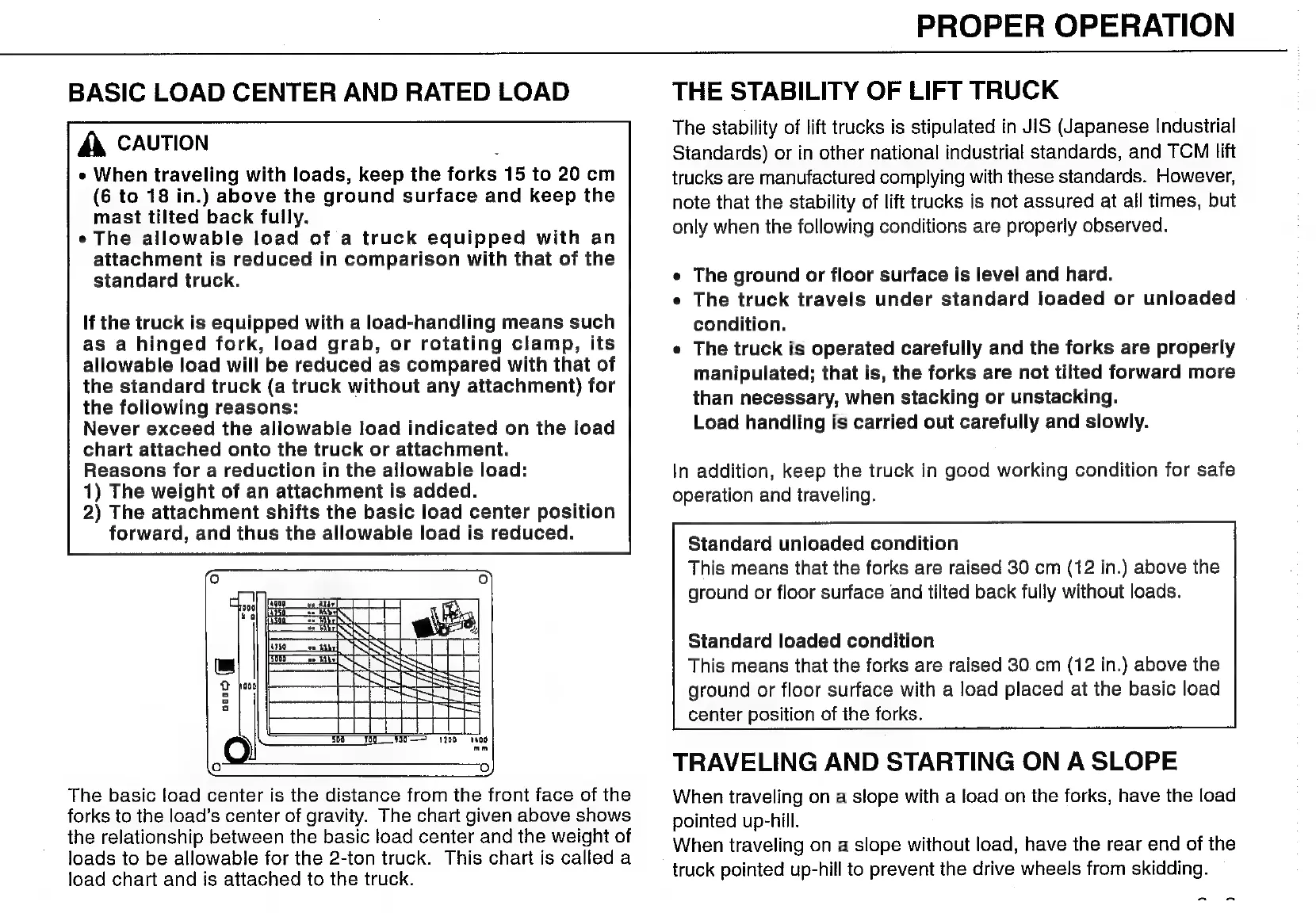
The
basic
load
center
is
the
distance
from
the
front
face
of
the
forks
to
the
load’s
center
of
gravity.
The
chart
given
above
shows
the
relationship
between
the
basic
load
center
and
the
weight
of
loads
to
be
allowable
for
the
2-ton
truck.
This
chart
is
called
a
load
chart
and
is
attached
to
the
truck.
PROPER
OPERATION
THE
STABILITY
OF
LIFT
TRUCK
The
stability
of
lift
trucks
is
stipulated
in
JIS
(Japanese
Industrial
Standards)
or
in
other
national
industrial
standards,
and
TCM
lift
trucks
are
manufactured
complying
with
these
standards.
However,
note
that
the
stability
of
lift
trucks
is
not
assured
at
all
times,
but
only
when
the
following
conditions
are
properly
observed.
e
The
ground
or
floor
surface
is
level
and
hard.
The
truck
travels
under
standard
loaded
or
unloaded
condition.
The
truck
is
operated
carefully
and
the
forks
are
properly
manipulated;
that
is,
the
forks
are
not
tilted
forward
more
than
necessary,
when
stacking
or
unstacking.
Load
handling
is
carried
out
carefully
and
slowly.
In
addition,
keep
the
truck
in
good
working
condition
for
safe
operation
and
traveling.
Standard
unloaded
condition
This
means
that
the
forks
are
raised
30
cm
(12
in.)
above
the
ground
or
floor
surface
and
tilted
back
fully
without
loads.
Standard
loaded
condition
This
means
that
the
forks
are
raised
30.
cm
(12
in.)
above
the
ground
or
floor
surface
with
a
load
placed
at
the
basic
load
center
position
of
the
forks.
TRAVELING
AND
STARTING
ON
A
SLOPE
When
traveling
on
a
slope
with
a
load
on
the
forks,
have
the
load
pointed
up-hill.
When
traveling
on
a
slope
without
load,
have
the
rear
end
of
the
truck
pointed
up-hill
to
prevent
the
drive
wheels
from
skidding.

Other manuals for TCM FB10-7

Related product manuals