EasyManua.ls Logo

Teac TASCAM 32 - Page 45

Teac TASCAM 32
117 pages
Print Icon
To Next Page IconTo Next Page
To Previous Page IconTo Previous Page
Loading...
2.
Adjusted
the
head
azimuth
of
both
heads
to
90°
by
checking
and
adjusting
progressively
higher
and
higher
frequencies.
3.
Checked
the
32
meters
against
a
precision
meter
and
set
0.316
V
output
as
“O
VU"
reproduce.
4.
Adjusted
reproduce
from
both
playhead
positions
to
be
“0
VU"
at
400
Hz
using
the
test
tapes
as
an
absolute
reference
of
magnetic
level.
5.
Applied
a
reference
level
to
the
input
of
the
32
and
adjusted
the
“O
VU”
point
to
be
0.316
V,
both
in
the
circuit
and
on
the
meter.
6.
Set
bias
level
for
the
tape
of
choice.
7.\f
you
have
the
equipment,
make
sure
no
bias
is
going
to
the
record
amplifiers.
8.
If
you
have
the
equipment,
set
(after
bias)
the
record
“0
VU”
and
read
it
off
reproduce.
You
now
know
that
the
tape
you
are
making
has
the
same
level
of
magnetic
flux
recorded
on
it
as
the
reference
alignment
tape,
but
only
at
400
Hz,
the
basic
adjustment
frequency.
8)
The
Peak
Adjust
Circuit
The
choke
coi!
in
this
circuit
only
has
a
very
small
range,
1
dB
at
tape
speed
15
ips.
It
is
for
final
high
end
adjustment.
The
frequency
to
send
in
is
20
kHz,
record
the
tone
at
“QO
VU",
switch
to
REPRO
and
read
the
result.
Adjust
choke
coil
#10
L103
to
read
“‘O
VU”
in
repro-
duce.
Both
of
the
record
equalization
circuits
have
rather
a
small
range
of
adjustment.
The
high
frequency
adjust
is
3
dB,
the
peak
adjust
is
1
dB.
If
you
can’t
seem
to
get
a
“good’’
reading
because
you
run
out
of
adjustment
range,
check
these
3
points.
eThe
“record
adjust’
(point
#8
in
this
review).
Re-do,
send
in
“0
VU”
at
400
Hz.
Record
the
tone
and
read
reproduce.
If
it
is
low,
it
will
be
impossble
to
get
18kHz
or
20
kHz
up
to
“Q
VU".
Reset
and
try
again.
Still
no
good?
Re-check
the
bias.
If
the
bias
current
is
too
high,
the
high
frequency
sensitivity
is
reduced
in
relation
to
the
400
Hz
point.
Check
it
out.
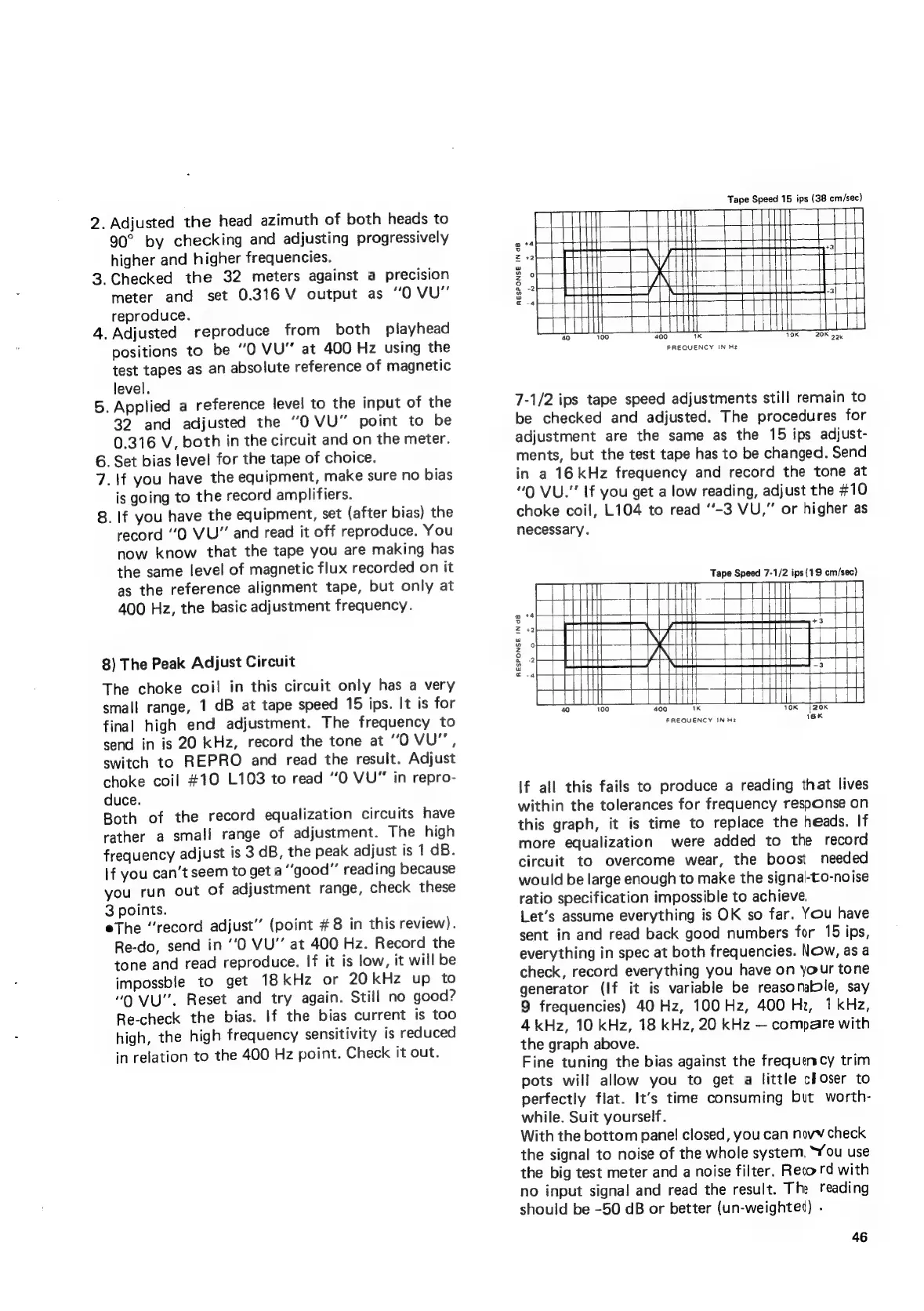
Tape
Speed
15
ips
(38
cm/sec)
+
RESPONSE
IN
oB
BN
oO
ND
+t
+
40
100
400
1K
10K
20K
924
FREQUENCY
IN
Hz
7-1/2
ips
tape
speed
adjustments
still
remain
to
be
checked
and
adjusted.
The
procedures
for
adjustment
are
the
same
as
the
15
ips
adjust-
ments,
but
the
test
tape
has
to
be
changed.
Send
in
a
16
kHz
frequency
and
record
the
tone
at
“O
VU."
If
you
get
a
low
reading,
adjust
the
#10
choke
coil,
L104
to
read
“’-3
VU,”
or
higher
as
necessary.
Tape
Speed
7-1/2
ips(19
cm/sec)
AESPONSE
IN
GB
FREQUENCY
IN
H2
16K
If
all
this
fails
to
produce
a
reading
that
lives
within
the
tolerances
for
frequency
response
on
this
graph,
it
is
time
to
replace
the
heads.
If
more
equalization
were
added
to
the
record
circuit
to
overcome
wear,
the
boost
needed
would
be
large
enough
to
make
the
signal-to-noise
ratio
specification
impossible
to
achieve.
Let’s
assume
everything
is
OK
so
far.
YOu
have
sent
in
and
read
back
good
numbers
for
15
ips,
everything
in
spec
at
both
frequencies.
Now,
as
a
check,
record
everything
you
have
on
your
tone
generator
(If
it
is
variable
be
reasorable,
say
9
frequencies)
40
Hz,
100
Hz,
400
Hz,
1
kHz,
4kHz,
10
kHz,
18
kHz,
20
kHz
compare
with
the
graph
above.
Fine
tuning
the
bias
against
the
frequerscy
trim
pots
will
allow
you
to
get
a
little
closer
to
perfectly
flat.
It’s
time
consuming
but
worth-
while.
Suit
yourself.
With
the
bottom
panel
closed,
you
can
nov
check
the
signal
to
noise
of
the
whole
system.
“You
use
the
big
test
meter
and
a
noise
filter.
Reto
rd
with
no
input
signal
and
read
the
result.
The
reading
should
be
-50
dB
or
better
(un-weightet)
-
46