EasyManua.ls Logo

Teac TASCAM 32 - Page 71

Teac TASCAM 32
117 pages
Print Icon
To Next Page IconTo Next Page
To Previous Page IconTo Previous Page
Loading...
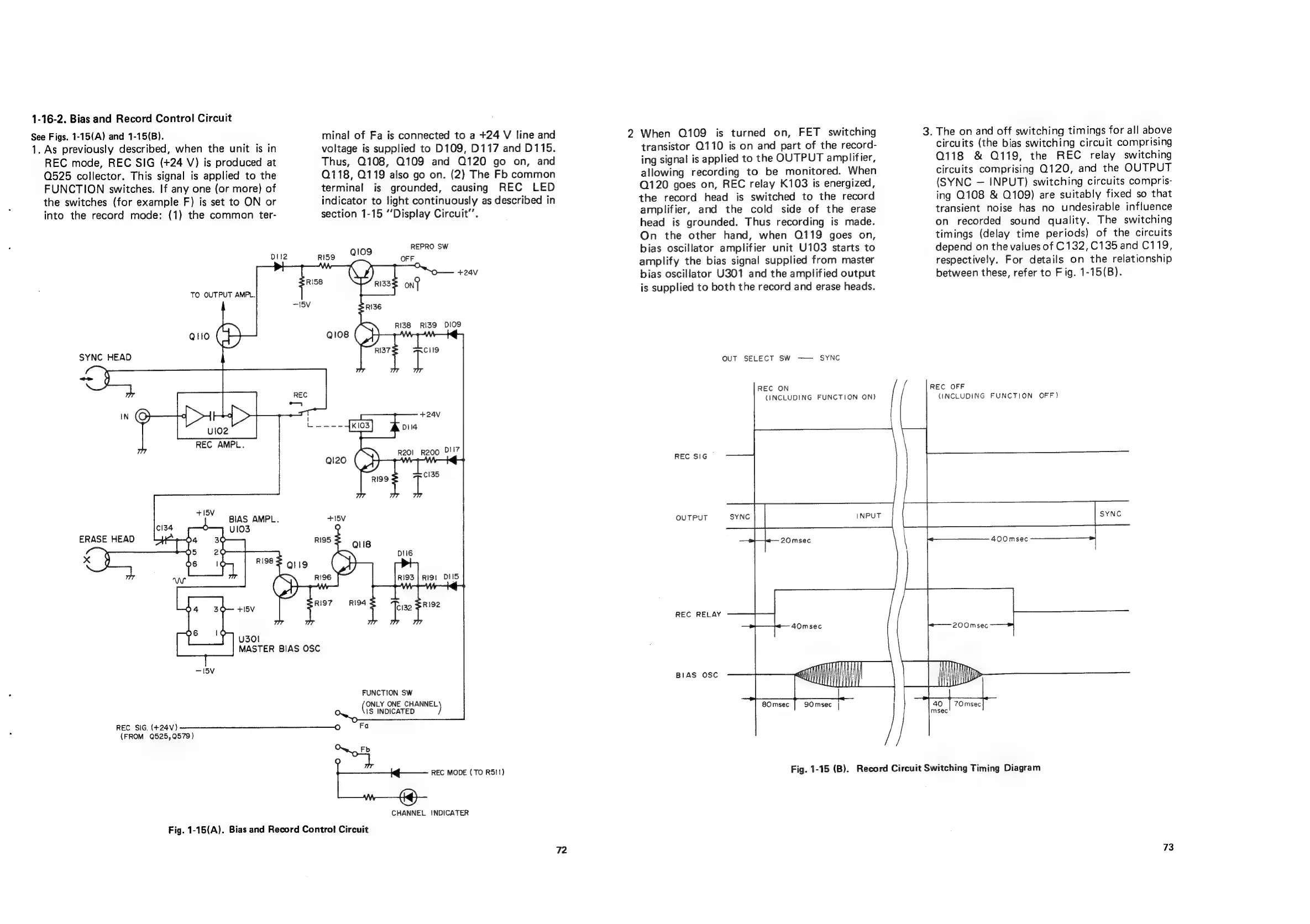
1-16-2.
Bias
and
Record
Control
Circuit
See
Figs.
1-15(A)
and
1-15(B).
1.
As
previously
described,
when
the
unit
is
in
REC
mode,
REC
SIG
(+24
V)
is
produced
at
Q525
collector.
This
signal
is
applied
to
the
FUNCTION
switches.
If
any
one
(or
more)
of
the
switches
(for
example
F)
is
set
to
ON
or
into
the
record
mode:
(1)
the
common
ter-
dIN2
TO
OUTPUT
AMPL.
QO
CH
SYNC
HEAD
4"
~~
7
"Ota
REC
AMPL.
ERASE
HEAD
xX
0
O-—
+15V
l ]
|
u301
MASTER
BIAS
OSC
—I5V
REC
SIG.
(+24V)
(FROM
Q525,Q579)
t
be
ee
a
ee
minal
of
Fa
is
connected
to
a
+24
V
line
and
voltage
is
supplied
to
D109,
D117
and
D115.
Thus,
Q108,
Q109
and
Q120
go
on,
and
Q118,
Q119
also
go
on.
(2)
The
Fb
common
terminal
is
grounded,
causing
REC
LED
indicator
to
light
continuously
as
described
in
section
1-15
‘‘Display
Circuit’’.
Ql20
RIQi
DIIS
RI97
RI94
cas
RI92
FUNCTION
SW
oT
ONE
ee)
O
\S
INDICATED
©)
Fa
1
REC
MODE
(TO
R51!)
CHANNEL
INDICATER
Fig.
1-15(A).
Bias
and
Record
Control
Circuit
72
2
When
Q109
is
turned
on,
FET
switching
transistor
Q110
is
on
and
part
of
the
record-
ing
signal
is
applied
to
the
OUTPUT
amplifier,
allowing
recording
to
be
monitored.
When
Q120
goes
on,
REC
relay
K103
is
energized,
the
record
head
is
switched
to
the
record
amplifier,
and
the
cold
side
of
the
erase
head
is
grounded.
Thus
recording
is
made.
On
the
other
hand,
when
Q119
goes
on,
bias
oscillator
amplifier
unit
U103
starts
to
amplify
the
bias
signal
supplied
from
master
bias
oscillator
U301
and
the
amplified
output
is
supplied
to
both
the
record
and
erase
heads.
OUT
SELECT
SW
——
SYNC
REC
ON
(INCLUDING
FUNCTION
ON)
REC
SIG
OUTPUT
SYNC
REC
RELAY
BIAS
OSC
3.
The
on
and
off
switching
timings
for
all
above
circuits
(the
bias
switching
circuit
comprising
Q118
&
QO119,
the
REC
relay
switching
circuits
comprising
Q120,
and
the
OUTPUT
(SYNC
INPUT)
switching
circuits
compris-
ing
Q108
&
Q109)
are
suitably
fixed
so
that
transient
noise
has
no
undesirable
influence
on
recorded
sound
quality.
The
switching
timings
(delay
time
periods)
of
the
circuits
depend
on
the
values
of
C132,C135
and
C119,
respectively.
For
details
on
the
relationship
between
these,
refer
to
Fig.
1-15(B).
REC:
OFF
(INCLUDING
FUNCTION
OFF)
Fig.
1-15
(B).
Record
Circuit
Switching
Timing
Diagram
73