EasyManua.ls Logo

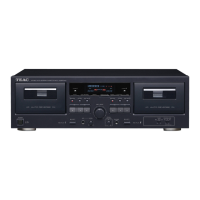
Teac W-520R - Dolby Hx Pro; Specifications

Teac W-520R
17 pages
Print Icon
To Previous Page IconTo Previous Page
Loading...
DOLBY
HX
PRO
al
Dolby
HX
Pro
is
an
"active
bias"
technique
that
can
improve
the
quality
of
audio
tape
recordings.
High-
level
high
frequencies
can
be
recorded
more
accurately,
without
sacrificing
the
signal-to-noise
ratio,
while
such
side
effects
of
tape
saturation
as
distortion
are
reduced.
What
Is
Bias?
Bias
is
a
very
high-frequency
signal
generated
within
a
tape
deck
and
recorded
on
the
tape
simultaneously
with
the
program
material.
This
inaudible
signal
allows
low
noise,
low
distortion
recording
and
a
flat
frequency
response.
Different
magnetic
tape
formulations
require
differeent
amounts
of
bias
for
optimum
performance.
If
the
bias
level
is
too
high,
the
high-frequency
Maximum
Output
Level
(MOL)
decreases.
The
Problem
of
Self-Bias
Unfortunately,
the
bias
level
is
often
influenced
by
the
signal
being
recorded.
The
high
frequency
components
of
some
music
act
as
bias.
This
unpredictable
source
of
bias
is
added
to
the
existing
bias,
resulting
in
a
loss
of
high-frequency
response.
As
the
high-frequency
contents
of
the
signal
increase,
the
ability
of
the
recorder
to
record
high
frequencies
(MOL)
decreases.
This
phenomenon
is
called
self-iasing.
The
Dolby
HX
Pro
Solution
Dolby
HX
Pro
monitors
the
high-frequency
contents
of
the
program
and
adjusts
the
recorder's
bias
oscillator
to
maintain
a
constant
total
bias
level.
The
result
is
improved
high-frequency
response
and
lower
distortion.
Depending
on
the
type
of
tape,
the
improvement
in
headroom
(dynamic
range)
can
be
6
dB
or
more.
The
Benefits
With
Dolby
HX
Pro,
it
is
easier
to
make
more
accurate
recordings
of
music
which
contains
high-
level
high
frequency
components.
The
improvement
is
similar
to
that
of
high-performance
tape
over
conventional
tape,
and
regardless
of
the
type
of
tape
used,
the
results
will
sound
better.
Most
important
of
all,
Dolby
HX
Pro
requires
no
decoding
process.
Once
a
tape
is
recorded
with
it,
the
improvement
will
be
realized
when
playing
the
tape
back
on
any
machine.
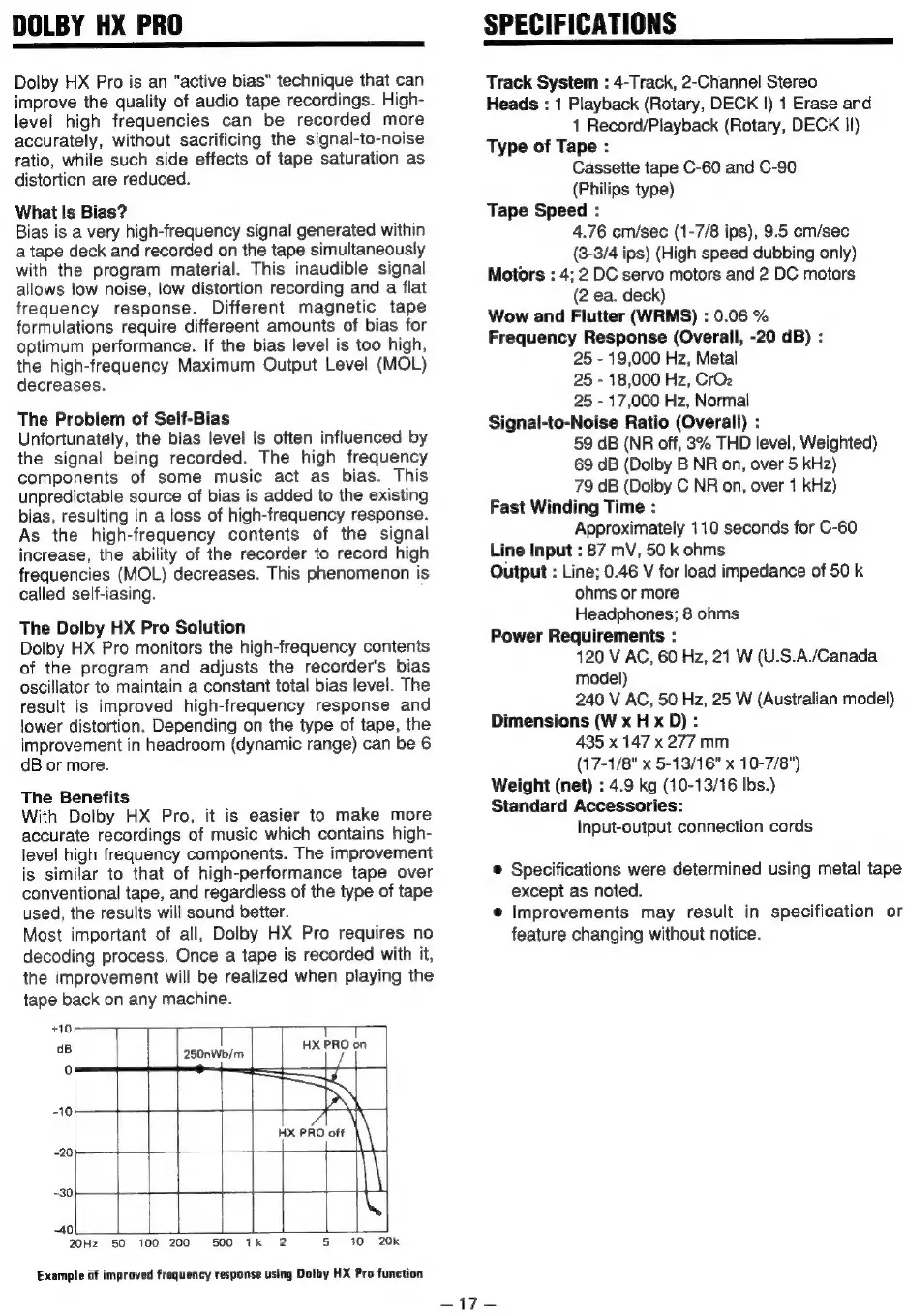
+10,
|
250nWb/m
HX
PRO
on
HX
PRO
off
40
20Hz
50
100
200
500
1k
2
5
10
20k
Example
of
improved
frequency
response
using
Dolby
HX
Pro
function
a
Fo
SPECIFICATIONS
Track
System
:
4-Track,
2-Channel
Stereo
Heads
:
1
Playback
(Rotary,
DECK
|)
1
Erase
and
1
Record/Playback
(Rotary,
DECK
I!)
Type
of
Tape
:
Cassette
tape
C-60
and
C-90
(Philips
type)
Tape
Speed
:
4.76
cm/sec
(1-7/8
ips),
9.5
cm/sec
(3-3/4
ips)
(High
speed
dubbing
only)
Motors
:
4;
2
DC
servo
motors
and
2
DC
motors
(2
ea.
deck)
Wow
and
Flutter
(WRMS)
:
0.06
%
Frequency
Response
(Overall,
-20
dB)
:
25
-
19,000
Hz,
Metal
25
-
18,000
Hz,
CrOz
25
-
17,000
Hz,
Normal
Signal-to-Noise
Ratio
(Overall)
:
59
dB
(NR
off,
3%
THD
level,
Weighted)
69
dB
(Dolby
B
NR
on,
over
5
kHz)
79
dB
(Dolby
C
NR
on,
over
1
kHz)
Fast
Winding
Time
:
Approximately
110
seconds
for
C-60
Line
Input
:
87
mV,
50
k
ohms
Output
:
Line;
0.46
V
for
load
impedance
of
50
k
ohms
or
more
Headphones;
8
ohms
Power
Requirements
:
120
V
AC,
60
Hz,
21
W
(U.S.A./Canada
model)
240
V
AC,
50
Hz,
25
W
(Australian
model)
Dimensions
(W
x
H
x
D)
:
435
x
147
x
277
mm
(17-1/8"
x
5-13/16"
x
10-7/8")
Weight
(net)
:
4.9
kg
(10-13/16
Ibs.)
Standard
Accessories:
Input-output
connection
cords
©
Specifications
were
determined
using
metal
tape
except
as
noted.
e
Improvements
may
result
in
specification
or
feature
changing
without
notice.

Related product manuals