9
Using the Water Tank
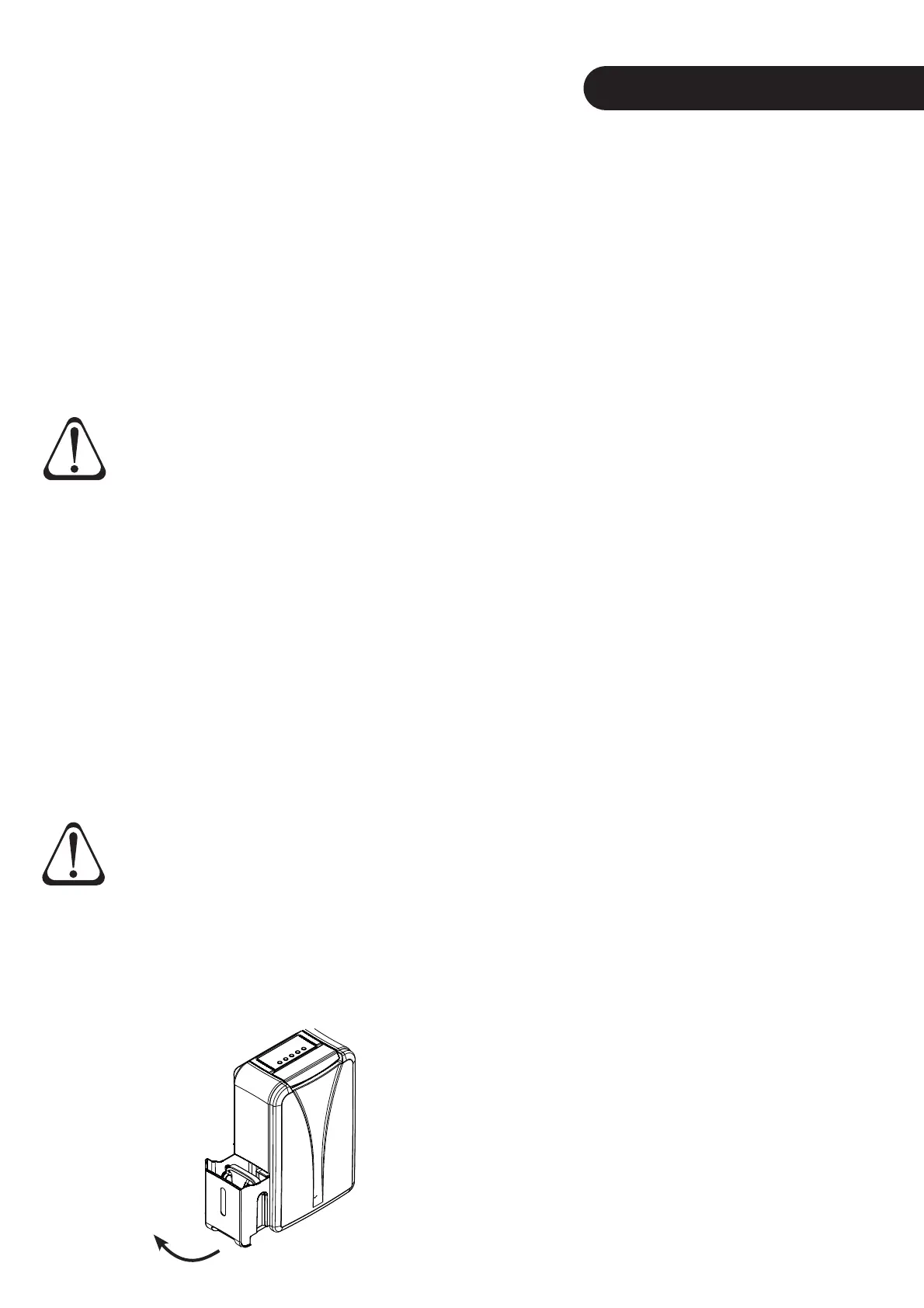
When using the water tank to drain water, once full, the dehumidi er will stop and the buzzer will sound.
The WATER FULL light will be displayed. Carefully remove the water tank using the handle at the base and
dispose of collected water. NOTE: Drainage of collected water must comply with local council regulations.
Once the water tank is empty, replace and ensure it is securely back inside the dehumidi er. The appliance
will resume operating.
Caution - The dehumidi er can be damaged if the water tank is not replaced correctly or if it is
removed and replaced frequently. Only remove the water tank when full or when the dehumidi er is
o .
Using Continuous Drainage
In situations of extremely high humidity or for convenience, you may nd connecting continuous drainage
more suitable. To connect continuous drainage, remove the water tank.
Insert a PVC pipe with a Ø14mm ID (not supplied) into the drainage outlet. Ensure a tight t so that no water
leaks from the dehumidi er. Replace the water tank while feeding the pipe through the space provided.
The dehumidi er can now be operated with continuous drainage.
NOTE: Drainage of collected water must comply with local council regulations.
Do not drain water continuosly if there is a possibility that temperature around the hose could
drop to freezing point. Water inside the hose may freeze and prevent the water in the drainage
tank from owing out. The water may leak from the unit and damage surrounding objects.
When using the unit after it has been stored for a long period of time or when draining water continuosly
for a long time with no assistance, check the unit periodically for foreign objects, etc. that could clog the
CAUTION
Fig. 6
Removing
the water
tank.
Pull from
bottom.
CAUTION
DRAINAGE
Note: When using the continuous drain feature,
make sure the drain tube is laid at horizontally
and fastened in place; avoid overlapping or
depressing, and make sure it lays lower than the
drain hole.
pipes resulting in heat generation and/or a water leakage.


 To Next Page
 Loading...