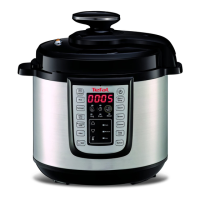
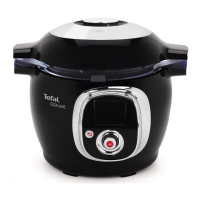
This document describes the Tefal Cook4me, a smart pressure cooker designed for domestic household use.
Function Description:
The Tefal Cook4me is a versatile cooking appliance that offers various cooking modes and guided recipes. It functions as a pressure cooker, classic cooker (slow cooking, simmering, browning), reheater, and keeps food warm. The device features an intuitive control panel with a main operation button (OK), a return button, and a display that guides the user through different menus and cooking steps. It allows users to select recipes based on ingredients, meal type (stew/broth, main dish, rice/Korean drinks & healthy desserts, international recipes), or manually set cooking parameters. The Cook4me+ provides instructions for various weights and types of ingredients, including meat, fish, vegetables, fruits, and cereals. It also includes a "Favorites" menu where users can save their preferred recipes for quick access. The appliance is designed to simplify cooking by offering pre-programmed recipes and step-by-step guidance on the screen, including ingredient preparation and cooking instructions.
Important Technical Specifications:
- Model Series: EPC09
- Pressure Levels: Low pressure 40kPa (109°C) / High pressure: 70kPa (115°C)
- Product Capacity: 6L
- Useful Capacity: 4L
- Heating: Built-in heating element.
- Pressure Achievement Time: Operational pressure is achieved 4 minutes after the beep.
- Altitude: Can be used up to an altitude of 2000m.
- Power Cord: The supply cord must be replaced by the manufacturer, its service agent, or similarly qualified persons if damaged.
Usage Features:
- Interface Controls: The device is operated via a main OK button for selection and confirmation, a return button for navigating back, and a 3-second press on the return button for restart.
- First-time Setup: Upon first turning on, the user is prompted to select their language and country.
- Lid Operation: The lid opens by turning the open/close handle until the marking aligns with the open padlock icon. It must be properly closed and bolted before pressure cooking.
- Cooking Bowl: The appliance must always be used with its cooking bowl. The bowl handles align with slots in the appliance housing.
- Steam Basket: A stand can be installed under the steam basket for certain cooking methods.
- Condensation Trap: A condensation trap is installed at the back of the appliance.
- Menus:
- ON/OFF Menu: Allows switching the appliance on or off.
- SETTINGS Menu: Includes options for language/country, screen/sounds (brightness and volume adjustment). Alert sounds remain active even if general sound is deactivated.
- MANUAL Menu: Provides control over cooking mode (pressure cooking, classic cooking, reheat, keep warm) and cooking time. Classic cooking modes (slow cooking, simmering, browning) require the lid to remain open.
- INGREDIENTS Menu: Guides users through cooking single ingredients by selecting the ingredient type (e.g., fruits & vegetables, rice & cereals) and quantity. It displays recommended cooking times and step-by-step instructions.
- RECIPES Menu: Offers a selection of over 100 savory or sweet recipes categorized into stew & broth, main, rice & Korean healthy drink & dessert, and international recipes. Users can select the number of people and view preparation/cooking times and ingredients.
- FAVORITES Menu: Allows users to save recipes from the recipes menu for quick access. Recipes can be added, deleted, or modified within this menu.
- Delayed Start: Available for pressure cooking mode and some ingredients, allowing users to program the end of cooking time.
- Safety Features:
- Lid Locking: The lid cannot be opened when the product is under pressure. The manometric rod prevents opening until internal pressure has normalized.
- Overpressure Safety: Two devices release pressure: a safety valve and the sealing gasket.
- Pressure Regulation: The heating element automatically switches on/off to maintain the adapted pressure level. The decompression ball may briefly release steam to improve regulation accuracy.
- Boiling Over Prevention: Recommendations on food and water volume must be followed to prevent boiling over.
- Hot Surfaces: Avoid touching hot parts of the appliance. Use carrying handles and oven mitts when moving a hot appliance.
- Food Expansion: Do not fill the appliance more than the MAX mark, and for expanding foods like rice or dehydrated vegetables, fill no more than half full.
Maintenance Features:
- General Cleaning: Disconnect the appliance after each use. The cooking bowl and steam basket can be washed in soapy hot water or in the dishwasher. The appliance body should be cleaned with a damp cloth. Do not immerse the appliance in water.
- Metal Lid Cleaning: The metal lid can be washed in the dishwasher without removing the valve. For hand cleaning, the valve cover and decompression ball must be removed.
- Disassembly: Grip the lid sub-assembly, unscrew the central nut, remove the nut, then the lid. The valve cover is unclipped by turning it slightly. The decompression ball is accessed by turning its cover anti-clockwise.
- Cleaning Components: Clean the cooking bowl, metal lid, valve cover, condensation trap, steam basket, and decompression ball with water and washing-up liquid. Dry thoroughly.
- Reassembly: Reassemble the metal lid by aligning it with the central axis and tightening the nut clockwise. Reclip the valve cover, ensuring it's flush against the inside of the lid. Reinsert the decompression ball and lock its cover clockwise.
- Safety Device Checks:
- Before reinstalling the decompression ball, blow into the pipe to ensure it's not blocked.
- Press the internal part of the safety valve spring to check it's not clogged.
- Clean the upper part of the cooking bowl and the inside of the metal lid, checking that the manometric rod is properly positioned and can move freely.
- Clean the silencing valve at the back of the lid.
- Sealing Gasket: The watertight seal should be replaced at least every three years by an approved Service Centre.
- Storage: Do not store the appliance with the lid closed; leave it open or half-open to prevent unpleasant odors.
- Troubleshooting: The manual provides a comprehensive troubleshooting guide for common issues like the lid not closing, pressure problems, steam leaks, and control panel malfunctions, along with corresponding solutions. For persistent issues or damage, the appliance should be taken to an approved Service Centre.

 Need help?
 General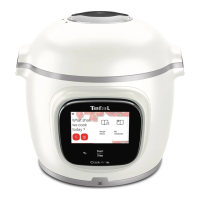





 To Next Page