6
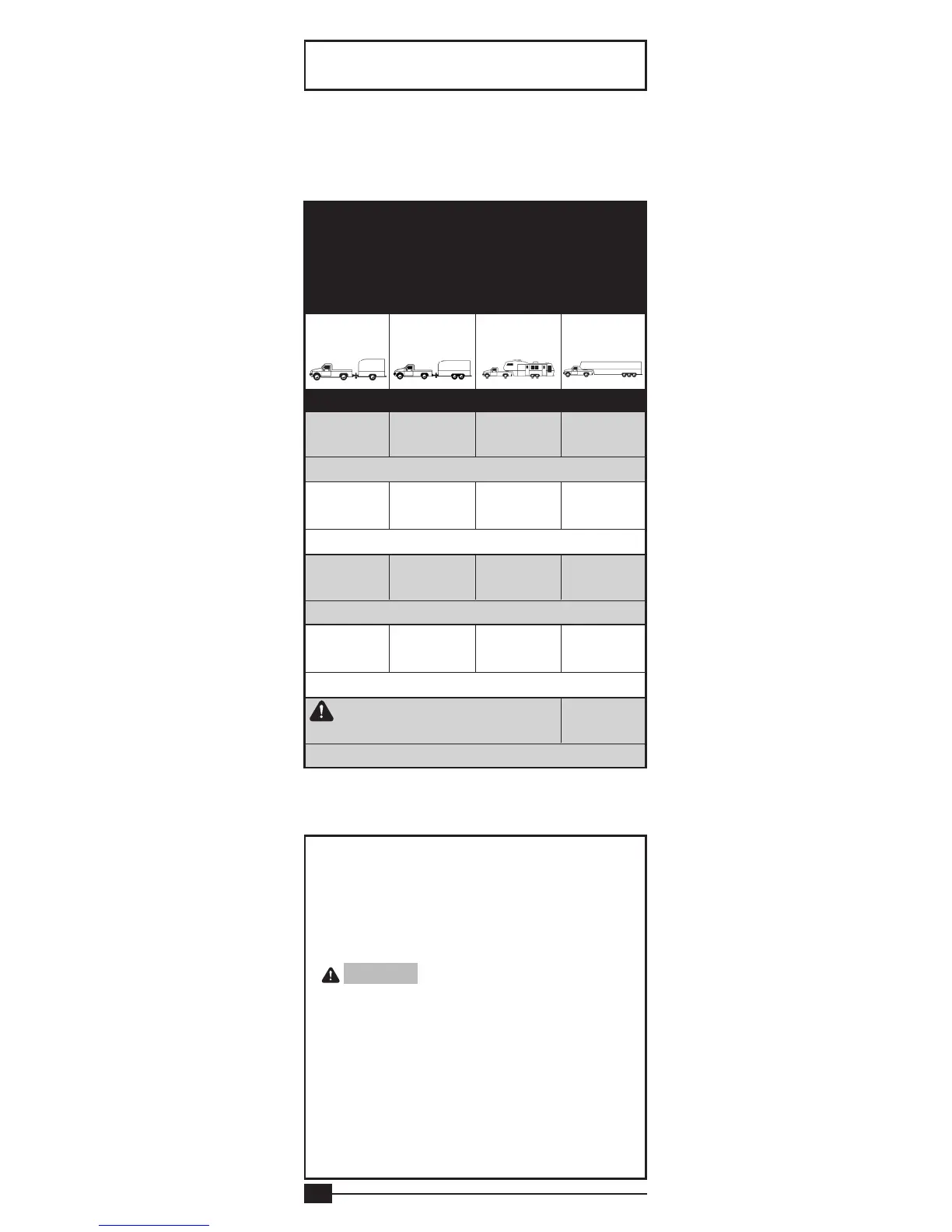
See the chart below for recommended “Boost” settings
(indicated with X) for typical Trailer to Vehicle weight
relationships.
Select your boost setting based on your towing situation,
driving preference and condition of your trailer brakes.
Typical Boost Settings For
Optimal Performance
TRAILER WEIGHT compared to VEHICLE WEIGHT
(with properly adjusted trailer brakes*)
WARNING
Do not exceed Gross
Combined Weight Rating (GCWR)
* Increased Boost setting may be needed if trailer
brakes are worn, see Appendix A or a dealer for brake
adjustment or repair
.
INCREASING BOOST LEVEL
➮➮
BOOST “OFF”
NOTE: Boost not intended to be used to take place of
trailer brake adjustment or repair.
Trailer weighs LESS than Vehicle
Trailer weighs APPROXIMATELY SAME as Vehicle
Trailer weighs UP TO 25% MORE than Vehicle
Trailer weighs UP TO 40% MORE than Vehicle
Trailer weighs OVER 40% MORE than Vehicle
XX
XXX
XXX
XX
X
” B1 B2 B3
NOTE:
1. Always warm the trailer's brakes before setting the
power. Warm trailer brakes tend to be more
responsive than cold brakes. To warm trailer
brakes, drive a short distance (1/4 mile) at 45 MPH
with manual lever engaged enough to cause trailer
braking at a low level.
2. WARNING The power should never be set high
enough to cause trailer brakes to lock up. Skidding
trailer wheels can cause loss of directional stability
of trailer and tow vehicle.
3. The power/Boost may need to be adjusted for
different load weights and road conditions.
4. Not all trailer brakes will lock up due to various
conditions. However, inability to lock up the
brakes generally indicates the need for an
inspection to determine the cause.
5. When the power is set correctly you should feel
unified braking between the trailer and tow vehicle.
(BOOST “OFF”)


 To Next Page