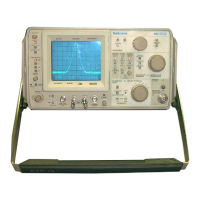
Theory of Operation—492/492P Service Vol. 1 (SN B030000 & up)
There are actually two second converters in the
492/492P; the appropriate converter is selected automati
cally for each band so the input frequency range does not
overlap the first IF frequency. Each second converter has its
own local oscillator (LO), mixer, and filters. Both convert the
signal to 110 MHz and send it to the third converter.
The third converter amplifies the 110 MHz IF signal and
converts it to the final intermediate frequency of 10 MHz.
The third converter passes the signal to the IF section for
detection.
IF Section
The IF section analyzes how much power is present in
the frequency component that has been converted to
10 MHz. Three functions are performed here:
1) weak signals can be amplified by a set of switchable am
plifiers so that they may be analyzed. By amplifying the sig
nal, the vertical window (dynamic display range) is shifted up
or down. The REFERENCE LEVEL control selects the gain
(and input RF attenuation as a pair) to frame this window;
2) the signal is bandpassed by any of several 10 MHz
bandpass filters selected by the RESOLUTION
BANDWIDTH control. The greater the selectivity, the better
two closely-spaced signals can be resolved, but narrow
bandwidths require longer sweep times. The microcomputer
selects the best combination of bandwidth and sweep time,
unless overridden by the operator;
3) the remaining signal is detected by a combination of a
logarithmic amplifier and a linear amplitude detector. The
output of this combination is a voltage that corresponds to
the signal strength in decibels. This amplitude detector out
put is sent to the vertical channel of the display section to
show the strength of the particular component.
Display Section
The display section draws the display on the crt screen.
Vertical deflection of the beam is increased as the output of
the amplitude detector increases. The horizontal position is
controlled by the frequency control section and corresponds
to the frequency analyzed at that instant. As the 492/492P
sweeps from low frequencies to high frequencies during its
analysis, the beam is swept from left to right. Any time a
signal is encountered during the analysis, a vertical deflec
tion shows the strength of the signal at the horizontal posi
tion corresponding to the frequency. The result is a display
of amplitude as a function of frequency.
The video amplifier scales the output of the detector for
vertical deflection in dB/div or performs a log/linear conver
sion, depending on the vertical display mode. The video pro
cessor filters the video if either the wide or narrow filter is
selected.
The display section displays control settings on the crt
based on data from the microcomputer.
The sweep is often rapid enough to give a flicker-free
display, but at times the sweep must be slowed below the
flicker rate. With Option 02, the display can be recorded and
refreshed at a flicker-free rate by the digital storage section.
The 492/492PP can read out the display data from digital
storage through the IEEE 488 interface.
Frequency Control Section
The instantaneous frequency being analyzed is con
trolled by the frequencies of the local oscillators. To analyze
another frequency, a local oscillator frequency is changed
so that the new frequency is converted by the three convert
ers to 10 MHz and passes through the IF section. Each con
verter section has its own local oscillator. Only the local
oscillators of the first two converters are changed to vary
the frequency being analyzed; the 3rd LO remains fixed.
The 492/492P periodically sweeps and analyzes a fre
quency range centered about a frequency set by the FRE
QUENCY knob. The FREQUENCY knob tunes the first and
second local oscillators. The analyzer sweep is generated
by the sweep generator and the span attenuator. As the
sweep generator sweeps through its range, the trace is de
flected across the screen on the front panel. The frequency
sweep is controlled by the span attenuator, which scales the
sweep according to the current SPAN/DIV. The output of
the span attenuator drives the 1st LO to sweep wide spans
and the 2nd LO to sweep narrow spans. Option 03 adds
phase-lock circuitry to stabilize the 1st LO in narrow spans.
If the 492/492P is equipped with Option 01, the frequen
cy control section tunes the preselector to track the signal
frequency being detected.
Digital Control Section
Internal functions are controlled from the front panel
through a microcomputer. An internal instrument bus allows
communication between the microcomputer and all parts of
the instrument. Front-panel control data goes to the
microcomputer on this bus. The microcomputer controls cir
cuit functions such as; the span attenuator, IF gain, and crt
readout on this bus. The microcomputer also receives infor
mation from circuit functions such as, the sweep and phase
lock circuitry on this bus.
The 492P may be controlled remotely through the IEEE
488 bus, which interfaces to the microcomputer through a
General Purpose Interface Bus (GPIB) board. The IEEE 488
connector is located on the rear panel of the instrument. The
control language corresponds closely to front-panel oper
ation of the 492P.
5-2
REV AUG 1981


 To Next Page
 Loading...