
 Need help?
Do you have a question about the Tektronix THM565 and is the answer not in the manual?
Lists necessary external test equipment for verification procedures.
Verifies basic instrument operation and resets to factory defaults.
Verifies DC voltage, AC voltage, and resistance accuracy of the DMM.
Verifies oscilloscope performance including noise, accuracy, and bandwidth.
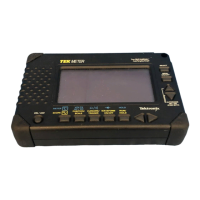
The Tektronix THM500 Series instruments are versatile handheld devices that integrate the functionalities of a complete digital multimeter (DMM) and a powerful oscilloscope into a single, compact package. These instruments are designed for a wide range of applications, from general-purpose electrical measurements to specialized tasks like motor testing and power line monitoring.
The DMM portion of the THM500 Series instruments provides comprehensive measurement capabilities, including true RMS AC and DC voltage, resistance, continuity with an audible mode, and a diode test. For current measurements, the DMM supports both AC and DC current when used with an optional current probe. This allows users to accurately assess various electrical parameters in diverse environments.
The oscilloscope functionality is a key feature, offering both an autoranging mode and a manual mode. In autoranging mode, the instrument automatically adjusts its settings to display a usable signal without requiring operator intervention, making it ideal for quick checks and users who may not be familiar with oscilloscope operation. For more experienced users or specific measurement needs, the manual mode allows for precise control over general oscilloscope operations such as coupling, triggering, and acquisition modes. This flexibility ensures that the instrument can adapt to a variety of signal analysis requirements.
Specific models within the THM500 Series offer preconfigured modes tailored for specialized applications. For instance, the THM550, THM560, and THM565 models include modes for motor testing, transformer THDF (Total Harmonic Derating Factor) measurement, power line monitoring, and power measurement. These preconfigured setups simplify complex measurements by automatically applying the correct settings, reducing setup time and potential errors. The THM57x series instruments further extend this specialization with preconfigured automotive test setups, catering to the unique diagnostic needs of the automotive industry.
The THM500 Series instruments are designed for ease of use and efficiency in the field. The DMM features a "hold" function to freeze the displayed reading, which is particularly useful when taking measurements in hard-to-reach areas or when the reading needs to be recorded. Additionally, the MIN and MAX readouts track instantaneous signal variations from the last held value (Δ Hold), providing valuable insights into signal fluctuations over time.
The oscilloscope's autoranging mode is a significant convenience feature, ensuring that a stable and viewable waveform is always presented. This eliminates the need for manual adjustments of vertical and horizontal scales, allowing users to focus on the signal itself rather than the instrument setup. When manual control is desired, the intuitive interface allows users to easily switch modes and fine-tune settings for detailed waveform analysis.
Beyond real-time measurements, the THM500 series instruments offer robust data storage and transfer capabilities. They can store waveforms, instrument settings, and screen displays. This allows users to recall previous setups for repetitive tests, automate test procedures, and save critical waveforms and screens directly in the field for later analysis. The ability to transfer these saved waveforms and screens to a personal computer (requiring an optional communications adapter) enhances post-analysis capabilities, enabling more in-depth examination and reporting.
The instruments are powered by six AA cells, providing approximately 4.5 hours of continuous operation with alkaline batteries (backlight off). A user-adjusted battery saver feature helps extend battery life by turning off the instrument after five minutes and the backlight after one minute of inactivity. This ensures that the instrument is ready for use when needed and conserves power during periods of non-use.
The manual outlines performance verification procedures to ensure the THM500 Series instruments operate as warranted. These procedures are recommended annually or after every 2000 hours of operation, or whenever the accuracy or function of the instrument is in question. The verification process includes a functional test, DMM verification (DC voltage accuracy, AC voltage accuracy, resistance accuracy), and oscilloscope verification (noise, input leakage trace shift, time base accuracy, vertical accuracy, analog bandwidth, crosstalk from DMM to oscilloscope, crosstalk between oscilloscope channels, and DC offset).
The functional test involves basic steps like installing charged batteries, powering on the instrument, and resetting it to factory default settings. This helps confirm basic operational integrity and prepares the instrument for more detailed verification. The DMM verification steps guide users through connecting the instrument to a calibrator or voltage/resistance source and checking readings against specified limits. Similarly, the oscilloscope verification involves setting up test signals and observing waveform characteristics to ensure they meet performance specifications.
The instrument is designed for reliability and ease of service, with no user-replaceable fuses. The manual provides clear instructions for setting up test equipment and performing each verification step, ensuring that maintenance can be carried out effectively to maintain the instrument's accuracy and performance over its lifespan. The detailed verification checks cover critical aspects of both DMM and oscilloscope functions, providing a thorough assessment of the instrument's health.
 General
| Display Type | LCD |
|---|---|
| Continuity Test | Yes |
| Diode Test | Yes |
| Safety Category | CAT III 1000 V, CAT IV 600 V |
| DC Voltage Range | 0.1 mV to 1000 V |
| Temperature Range | -200 °C to +1350 °C, -328.0 °F to +2462 °F |
| Basic DC Voltage Accuracy | 0.05% |
| Basic DC Current Accuracy | 0.2% |
| Basic Resistance Accuracy | 0.1% |
| Basic Capacitance Accuracy | 1.0% |


 To Next Page
