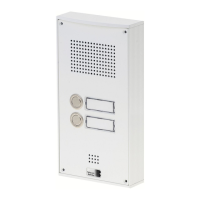
The Behnke SIP intercoms series 20-0001B-IP, 20-0014B-IP, and 20-0016B-IP are high-quality VoIP intercom stations designed for robust and flexible communication. These devices feature acoustic echo cancellation for full-duplex hands-free speech, ensuring excellent voice quality. The operating elements, including the loudspeaker, microphone, keypad, and call buttons, along with the electronics, are housed in a compact, double-shell casing. The modular design allows for maximum flexibility in planning and application, making them suitable for various installation scenarios.
Function Description:
The intercoms facilitate voice communication via Voice over IP (VoIP) using the SIP standard over a connected Ethernet LAN. This can be achieved through a SIP-capable telephone system, a SIP provider, or by direct dialing of an IP address. Configuration and software updates are managed via a web browser, offering a user-friendly interface. Power is supplied via Power over Ethernet (PoE), simplifying installation by eliminating the need for separate power cables.
These SIP intercoms are equipped with two relays, providing freely configurable potential-free switching outputs. These outputs can be used for various functions such as door opening, call indication, or other custom switching operations. The system supports expansion modules, allowing for the retrofitting of additional functionalities. This includes up to 75 direct call buttons, radar motion detectors, or similar functions, all integrated via the Behnke bus system.
The 20-0016B-IP model specifically supports locally detached mounting of the electronics, offering greater flexibility in installation.
Important Technical Specifications:
- Connectivity: Ethernet 100BaseT (IEEE 802.3) via RJ45 or screw terminals. WLAN (802.11 b/g/n with WPA2) is also available with an antenna module, primarily for configuration purposes in network configuration mode. The WiFi range depends on the mounting situation.
- Power Supply: PoE according to IEEE 802.3af (PoE class0 required).
- IP Address Assignment: Supports static, dynamic (DHCP), or link-local IP address assignment.
- VLAN Support: Tagged VLANs are supported, with the possibility of a dedicated VLAN connection for a webcam.
- Time Synchronization: NTP (Network Time Protocol) version 4, capable of synchronizing with public time servers (requiring Internet access) or local time servers.
- Email Functionality: The system can send emails via SMTP or SMTPS upon triggering a call button, an alarm input, detected sabotage, or motion detection by a camera (if available) for access control logging.
- USB Expansion Port: Available with AIF IP and a USB expansion port adapter. It includes one Ethernet port with PoE (RJ45) and can operate as an absorption or extension port. The maximum PoE power available via the expansion port is 3W.
- IP Camera Integration: Automatic integration of Behnke IP cameras connected to the USB expansion port (for AIF IP) or manual integration of other IP cameras (retrieval of MJPG streams).
- UDP Communication: Supports status and remote control messages via UDP, compatible with Behnke IP video software.
- Port Authentication: IEEE 802.1x with EAP (EAP-MD5, EAP-TLS, EAP-TTLS (PAP, CHAP, MSCHAP, MSCHAPv2, GTC, MD5), or PEAP (MSCHAPv2, GTC, MD5)).
- LLDP Support: IEEE 802.1AB, LLDP-MED, CDP, EDP, SONMP.
- SIP Phone Features:
- Connections: Via SIP server (IP telephone system) or as SIP direct calls.
- Accounts: Two freely configurable SIP accounts.
- Transmission Protocol: UDP, TCP, or TLS.
- Communication: SIP server, SIP server and replacement SIP server, SIP registrar and SIP proxy, query SIP server via DNS NAPTR/SRV.
- NAT Strategy: Public IP address, ICE with STUN or TURN server, UPNP.
- AVPF Support: Yes, 0-5s report interval.
- Media Encryption: SRTP, ZRTP, or DTLS.
- Speech Codecs: G.711 A-law (PCMA), G.711 μ-law (PCMU), G.722, G.729, GSM, iLBC, Speex (8 kHz or 16 kHz).
- Video Codecs: H.264 or VP8.
- Early Media: Adjustable for outgoing calls.
- Media Management: Early offer or late offer.
- Packetization: Ptime according to codec or adjustable (10-200 ms).
- Video: Incoming (if display available) and/or outgoing (if camera available).
- Video Resolution: QCIF, QVGA, CIF, VGA, 4CIF, or SVGA.
- DTMF Transmission: SIP INFO or RFC 2833.
- DSCP: Individually adjustable classification for SIP protocol, audio, and video transmission.
- Jitter Compensation: For audio and video, 0-200 ms.
- Relays: Two relays.
- Operating Mode (per relay): Door opener relay, connection indicator, additional bell, or fault indication.
- Switching Voltage: Max. 30 VDC / 30 VAC.
- Switching Current: Max. 2 A.
- Switching Capacity: Max. 60 W / 60 VA.
- Switching Contact: Normally open or normally closed for door opener, otherwise normally open.
- Door Opener Relay: Controls a door opener for access.
- Opening Time: 1-90 s.
- Codes: Max. 9 codes, valid for in-house remote station or code lock, always or according to schedule. Manual, permanent opening (activatable via codes) or automatic opening according to schedule possible. Activation via door opener button possible, always or according to schedule. Logging of access control by e-mail.
- Connection Indicator: Controls the relay when the device is connected, activatable for incoming, outgoing, or outgoing connection after the remote station is answered.
- Additional Bell: Triggers the relay during ringing on an incoming call, at the beginning of a direct call (1-90 s), or during setup of a direct call.
- Fault Indication: Controls the relay when a fault (network connection, SIP registration) is present.
- Operating Temperature Range: -20 to 50 °C.
- Compliance: CE, RoHS, EN55035, EN55032, EN62368-1.
Usage Features:
- Configuration: Can be configured via a web browser (HTTP or HTTPS), a DTMF-enabled telephone, the keypad, or the display (if available). Access is password-protected.
- Language Support: German, French, or English.
- Installation Height: Optimal installation height ensures the user can operate the door station and speak into the microphone comfortably from 30-50 cm.
- Acoustics: Maintain the largest possible distance between the microphone and loudspeaker for optimal full-duplex speech intelligibility.
- Outdoor Mounting: For weather-exposed installations, in-wall mounting with a rain protection cover is recommended, ensuring correct gasket installation. Cable entry for surface-mounted housings can be from the bottom or rear, using supplied fittings. Unused cable entries must be sealed.
- Condensation Prevention: Measures must be taken to prevent condensation in third-party pedestals or housings.
- Module Installation: Modules must be flush with the frame, paying attention to anti-twist devices and correct fit.
- Cable Lengths: Connected components (loudspeaker, microphone, keys, keypad) must not exceed 2.50m in cable length. Behnke extension cables (20-9305-BS, 20-9311) should be used for longer runs.
- Labeling Fields: The supplied key for opening labeling fields must remain with the intercom station or customer.
- Startup Process: The device starts upon network and PoE connection. A red status LED indicates the start phase. After about 20 seconds, software starts, and a high-pitched beep is emitted. The IP address is announced for factory-configured devices or briefly displayed on devices with a display.
- Configuration Key: A physical configuration key on the connection board allows for initial setup (language, operating mode, intercom group) and querying IP address for already configured devices.
- Firmware Update Recovery: In case of a failed firmware update, the device can be reverted to the previously used firmware version by a specific key sequence during startup.
- Factory Reset: The device can be reset to factory settings by holding the configuration key for at least 5 seconds during startup.
- Hardware Error Indication: In case of a hardware error, the device attempts to display an error number via the status LED, loudspeaker, or display.
Maintenance Features:
- Cleaning: High-quality Behnke products with front panels made of various materials require regular cleaning with a suitable agent to prevent premature aging and patina formation. Specific care instructions are available on the Behnke website.
- Original Parts: Only Behnke components (accessories, spare parts, PoE injectors) should be used to ensure trouble-free operation and maintain warranty. Electronics should only be installed in supplied housings.
- Moisture Protection: Ensure the intercom station is mounted in a moisture-protected area.
- Sealing: Gaskets must be correctly placed during installation to protect against dampness. The top edge of in-wall mounted stations should be sealed against rainwater, leaving the bottom center free for drainage.

 Need help?
 General

 To Next Page