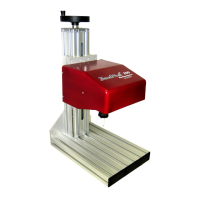
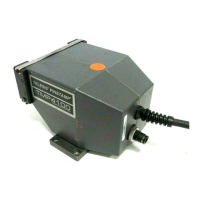
BenchMark 320/BM470 Marking System
34753A 3 of 10
BENCHMARK 320 MARKING HEAD
Specifications
The BenchMark 320 marking head specifications are
subject to change without notice.
Dimensions...................... see the BenchMark 320 Marking
Head Dimensions drawing
Weight
Marker .......................5.84 kg (12.865 lb)
Marker & Cable ...........6.39 kg (14.055 lb)
Tool Stand.................. 16.0 kg (35.200 lb)
Noise (maximum)...........65.4 dB
59.1 dB (LEQ)
see Marking Noise
Operating Temperature... 0° to 50°C
(32° to 122°F),
non-condensing
Marking Area.................. 150 x 100 mm
(6.0 x 4.0 inches)
Pin Types.......................25XLE-series
Pin Material.................... Tungsten Carbide
Marking Characteristics
The BenchMark 320 can accommodate character
sizes from .762 to 100 mm (.030 to 4.0 inches) in
.025 mm (.001-inch) increments. Characters can be
rotated in 1° increments with printing resolutions
from 4 dots/cm (10 dots/inch) to 32 dots/cm
(80 dots/inch) for an engraved look.
Marking Speeds
The system generally marks three characters per
second using 5 x 7 font, 3 mm (.118-inch) high, 2
mm (.080-inch) wide characters. Speeds vary
slightly depending on the selected character size,
style, and dot density. Specific times can be verified
by a Telesis representative.
Marking Noise
Although every attempt is made to reduce noise,
the material being marked significantly influences
the noise level. For example, marking a solid lead
block produces less noise than marking a thin-
walled steel pipe.
Marking Depth
The BenchMark 320 can obtain a marking depth of
.127 mm (.005 inch) in mild steel (Rb53) using a
25XLE carbide pin with a 45° cone angle. The depth
of mark can be adjusted over a significant range by
changing the impact force (via software parameter)
or by changing the impact distance (pin stroke).
Specific depths can be verified by a Telesis
representative.
Pin Life
Pin life depends largely on the type of material
being marked, how hard or abrasive it is, and the
required marking depth. On typical metals with a
hardness of Rockwell Rb47, marking at a depth of
.127 mm (.005 inch), carbide pins average
approximately 9 million impressions before needing
sharpened.


 To Next Page