Need help?
Do you have a question about the Telex FMR-70 and is the answer not in the manual?
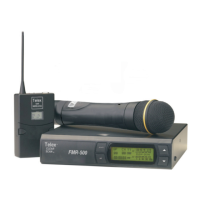
Defines microphone, transmitter, and receiver in a wireless system.
Details the VHF Band operation (150-216 MHz) and system compatibility.
Explains simultaneous operation and frequency requirements for multiple systems.
Discusses transmitter radiation patterns and receiver sensitivity.
Explains receiver behavior when the transmitter is off and potential interference.
Addresses audio feedback issues and provides methods for minimization.
Provides detailed technical specifications for the FMR-70 receiver.
Lists the main features and benefits of the FMR-70 receiver.
Details front and rear panel controls and indicators.
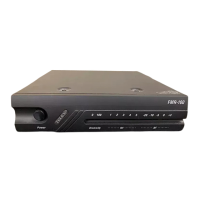
Describes the controls and indicators on the FMR-70 front panel.
Explains the Diversity and AF LED bar indicators.
Details rear panel connectors and their functions.
Describes the XLR audio output and adjustment control.
Explains the connection for the external AC power adapter.
Provides detailed technical specifications for the WT-55 transmitter.
Lists the main features of the WT-55 belt transmitter.
Details top panel controls and microphone jack.
Describes the specific controls on the top of the WT-55.
Explains the operation of power and microphone mute switches.
Details the microphone input connector.
Details rear panel components including antenna, gain control, and battery compartment.
Describes the antenna and audio gain adjustment.
Explains battery access and recommendations.
Offers a general overview of the HT-200 series microphone.
Provides detailed technical specifications for the HT-200.
Lists the technical specifications for the HT-200 transmitter.
Details the specifications for various HT-200 microphone models.
Details controls on the HT-200 microphone handle and bottom.
Describes controls located on the bottom of the HT-200.
Explains the low battery indicator and various switches.
Instructions for unpacking the wireless microphone system.
Step-by-step guide for installing batteries in transmitters.
Specific instructions for battery installation in the WT-55.
Instructions for battery installation in HT-200 models.
How to check the battery status on WT-55 and HT-100.
Instructions for connecting microphones to the WT-55.
Notes on compatibility of HT-200 with the FMR-70 receiver.
Explains the WT-55 compandor setting for system matching.
Explains the HT-200 compandor setting for system matching.
Information on connecting antennas to the FMR-70 receiver.
Details how to attach the 1/4-wave antennas to the FMR-70.
Guidelines for optimal system configuration and placement.
Explains the importance of distance for signal strength.
Proper placement and handling of the WT-55 transmitter antenna.
Describes the antenna location and characteristics of the HT-200.
Advice on maintaining a clear signal path to the antenna.
How obstructions affect system range and performance.
Guidelines for optimal receiver and antenna placement.
Information on using 5/8-wave antennas and remoting them.
Diagram illustrating the AD-200 antenna splitter connections.
Instructions for powering on the transmitter and receiver.
Instructions for powering on the FMR-70 receiver.
Details the function of the power switch on the FMR-70.
Instructions for powering on the WT-55 transmitter.
Instructions for powering on the HT-100 microphone.
Guide to setting gain levels for optimal audio performance.
Setting gain for normal vocal applications to achieve dynamic range.
Adjusting gain for high SPL environments to prevent distortion.
Adjusting gain for low-level audio sources for better signal-to-noise.
Explains the meaning of LED indicators during gain adjustment.
Describes the condition of 'Too Low' audio gain and its indicators.
Describes 'Too High' audio gain, leading to distortion, and its indicators.
Explains the screwdriver-adjustable control for receiver output level.
Outlines the process of testing system performance in the usage area.
Explains the Tx on LED indicator and 'Weak Signal' conditions.
Identifies RF issues detectable during a walk-thru.
Discusses audio feedback and methods to eliminate it.
Addresses distorted audio quality and its solution.
Deals with undesirable hiss and its cause.
Solves signal dropouts and disappearing signals.
Addresses picking up unwanted signals.
Solutions for reduced operating range.
Troubleshooting tips for battery life issues.
Addresses low output levels compared to wired microphones.
Solutions for feedback issues like squeals or howls.
General advice on battery selection, use, and care.
Recommends specific alkaline batteries for reliable performance.
Discusses rechargeable Ni-Cad batteries and voltage requirements.
Table detailing battery types, voltage, and expected life.
Provides pinout information for various microphone connections.
Accessories for mounting 5/8-wave antennas.
Various lengths of coaxial cables for antenna connection.
Power supply unit for the equipment.
Directional antenna for improved reception.
Vertical 5/8-wave antenna with included coax.
Charger for nickel-cadmium batteries used in HT-100.
Nickel-Cadmium 8.4 volt batteries for WT-55/HT-100.
Amplified antenna splitter for multiple receiver setups.
Contact details for warranty service and support.
Instructions on how to return units for warranty repair.
Lists U.S. patents related to the manufactured products.
 General
| Type | Wireless microphone system |
|---|---|
| Frequency Response | 50 Hz - 15 kHz |
| Modulation | FM |
| Impedance | 600 ohms |
| Connector | XLR |
| Power Requirements | 12V DC |
| Operating Range | Up to 300 feet (depending on conditions) |
| Microphone Type | Dynamic |

 To Next Page